


5 Warning Signs Your Exhaust Fan Needs Repair CT
- 2 days ago
- 10 min read
Is Your Commercial Kitchen Exhaust Fan Sending You a Warning?
A failing exhaust fan does not announce itself with a flashing light. It gives you subtle signals first, and most restaurant owners in Connecticut miss them until the situation becomes expensive. Exhaust fan repair in Connecticut is one of the most time-sensitive maintenance calls in the food service industry, because a compromised fan does not just reduce air quality. It builds grease, increases fire risk, and can trigger a failed health inspection on your busiest weekend. Here are five warning signs that demand your attention right now.
Table of Contents
Is Your Commercial Kitchen Exhaust Fan Sending You a Warning?
Warning Sign 2: Noticeably Reduced Airflow and Poor Smoke Clearance
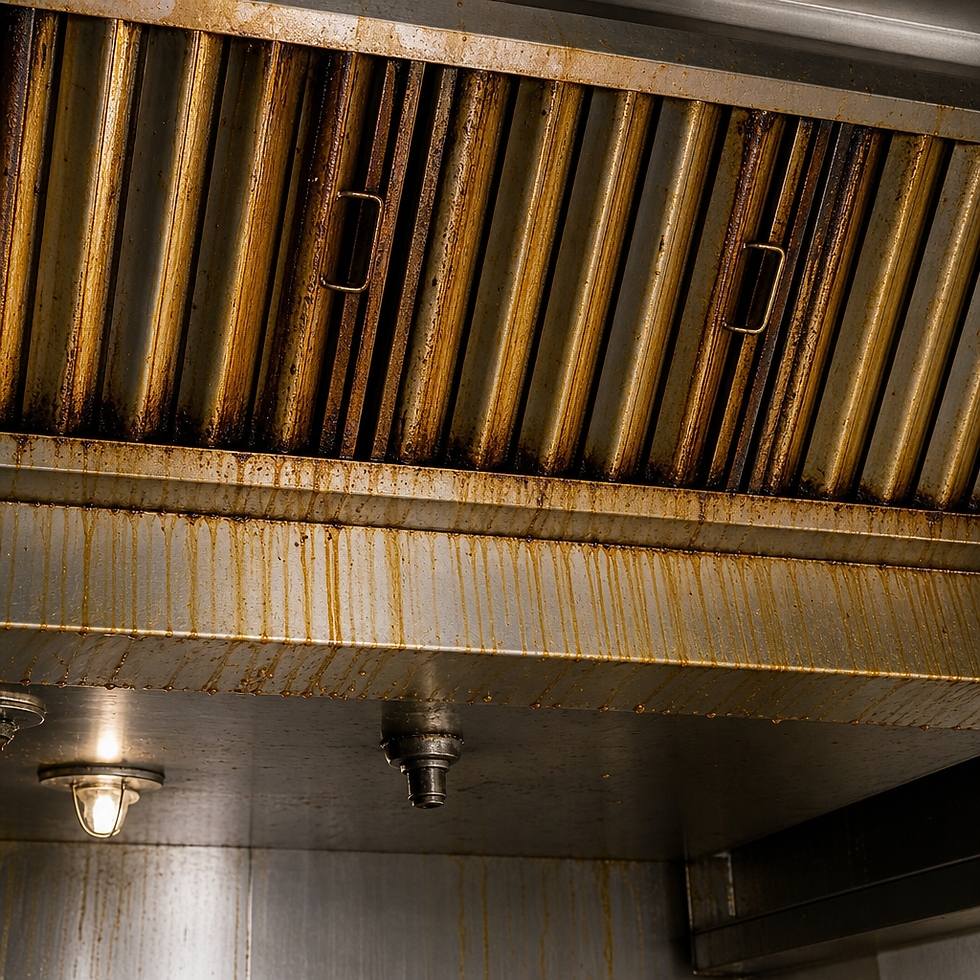
Warning Sign 3: Visible Grease Overflow Around the Fan Housing
Warning Sign 4: Excessive Vibration or Wobbling During Operation
Warning Sign 5: The Motor Runs Hot or Trips the Breaker Repeatedly
Diagnosing the Problem: A Comparison of Fan Failure Scenarios
What Connecticut Restaurant Owners Get Wrong About Fan Maintenance
Quick Takeaways
Key Insight
Explanation
Grinding or squealing noises mean bearing failure
Worn bearings cause metal-on-metal contact and will seize completely if ignored for more than a few service cycles.
Weak airflow is not always a filter problem
If filters are clean but smoke lingers, the fan motor or belt is the likely culprit, not the hood system itself.
Grease overflowing the fan housing is a fire hazard, not just a mess
NFPA 96 sets specific grease accumulation limits. Overflow around the housing means the fan is no longer moving air correctly through the grease trap path.
Vibration damages duct connections over time
An unbalanced fan blade creates micro-fractures in duct joints, leading to grease leaks inside walls and ceilings.
Repeated breaker trips signal motor winding failure
A motor drawing excess current is close to complete failure. Running it further risks electrical fire in the exhaust duct.
Fan belt wear is predictable and preventable
Most fan belts in commercial kitchens need inspection every 6 months. A cracked or slipping belt cuts airflow by up to 40 percent before it snaps.
Delaying repair escalates cleaning costs
A malfunctioning fan pushes grease back into ducts instead of exhausting it, meaning your next hood cleaning will take significantly longer and cost more.
Warning Sign 1: Unusual Noises Coming From the Fan Unit
In practice, the first thing kitchen staff notice is a change in sound. A properly functioning commercial exhaust fan produces a consistent, low hum. When that hum shifts into a grinding, squealing, or rattling pattern, something mechanical has already begun to fail.
Grinding typically points to failing or dry bearings. Squealing usually means the fan belt is slipping or cracking. Rattling often indicates a loose or damaged fan blade that has shifted out of balance. Each of these has a different repair path, but all three share the same urgency: they get worse with every hour of operation.
Why Kitchens in Connecticut Ignore This Sign
Kitchens are loud. Fryers pop, sheet pans clatter, and ventilation hoods create constant background noise. A new grinding sound from the fan unit often gets mentally filtered out by line cooks and kitchen managers focused on service. This is one of the most costly mistakes a Connecticut restaurant operator can make.
A fan bearing that grinds for two weeks turns a $200 bearing replacement into a $900 motor swap or a complete fan unit replacement. The repair cost scales directly with how long you let it run.


Pro tip: Assign one staff member per shift to do a 30-second fan sound check during the pre-service walk. Catching a new noise on day one costs nothing. Catching it after the motor seizes costs significantly more and may leave your kitchen without ventilation during a busy service period.
Warning Sign 2: Noticeably Reduced Airflow and Poor Smoke Clearance
Walk into your kitchen during a high-volume dinner service. If smoke is hovering below the hood line, if staff are squinting near the grill, or if grease mist is collecting on surfaces that are normally clean, your exhaust fan is not moving the air volume it should be.
Poor smoke clearance is one of the most visible signs of a failing commercial kitchen fan, but it is consistently misdiagnosed as a dirty filter problem. Filters do contribute, but a clean filter on a failing motor still produces inadequate airflow. Commercial kitchen fan repair in CT calls that start as a filter complaint frequently reveal a motor running at reduced RPM or a belt that has stretched and is slipping on the drive pulley.
How to Quickly Assess Airflow Before Calling for Service
Hold a single sheet of paper towel near the filter face while the system runs. It should pull firmly and stay flat against the filter surface. If it flutters or falls away, airflow has dropped materially. This is not a definitive diagnostic, but it tells you immediately whether the issue is worth an urgent service call or can wait for a scheduled visit.
The data consistently shows that reduced airflow increases grease deposition rates in ductwork. According to the National Fire Protection Association, inadequate exhaust airflow is a primary contributor to accelerated grease buildup that creates fire conditions well ahead of standard cleaning schedules.
"Grease buildup in commercial kitchen exhaust systems is the leading cause of restaurant fires in the United States. Proper airflow is the first line of defense." - National Fire Protection Association, NFPA 96 Standard for Ventilation Control and Fire Protection of Commercial Cooking Operations
Warning Sign 3: Visible Grease Overflow Around the Fan Housing
If you see grease pooling on top of the fan housing, running down the exterior of the unit, or dripping onto the roof near the exhaust stack, your system has a serious problem. This is not a cleaning issue. This is a functional failure.
When the exhaust fan moves air properly, grease-laden vapor travels through the hood, past the filters, through the duct, and exits at the rooftop fan. Grease collects in drip trays designed to contain it. When the fan is underperforming, that vapor slows down inside the duct and deposits grease on surfaces it was never supposed to touch, including the fan housing itself.
The NFPA 96 Compliance Angle Connecticut Kitchens Cannot Ignore
NFPA 96 sets specific standards for grease containment and accumulation limits in commercial exhaust systems. A Connecticut kitchen with visible grease overflow at the fan housing is almost certainly out of compliance. That matters because your insurance carrier and local fire marshal both reference NFPA 96 when evaluating fire risk and claim eligibility.
A common mistake is cleaning the visible grease overflow and assuming the problem is solved. Cleaning the surface without addressing the fan's mechanical failure just means the overflow returns within days. The fix is restoring proper fan performance, not wiping down the housing.

Pro tip: Check your rooftop fan housing monthly, not just during scheduled cleanings. A quick visual inspection after your last service call gives you a baseline. Any new grease accumulation between cleanings is a red flag that fan performance has dropped.
Warning Sign 4: Excessive Vibration or Wobbling During Operation
Place your hand on the fan housing while the unit is running. A small amount of vibration is normal. Vibration strong enough that you feel it distinctly through your palm, or visible wobble in the fan assembly, is not normal and needs immediate attention.
Excessive vibration in a commercial exhaust fan almost always comes from one of three sources: an unbalanced or damaged fan blade, a failing motor mount, or worn bearings allowing shaft movement. All three cause the same downstream problem: the vibration transfers into the ductwork, loosening joints and creating small gaps where grease can leak into wall and ceiling cavities.
Why Fan Blade Damage Is More Common Than Owners Expect
Rooftop exhaust fans in Connecticut face serious weather exposure. Ice accumulation during winter, debris impact from storms, and UV degradation of plastic blade components all contribute to blade damage that creates imbalance. A blade that is slightly bent or has lost a small piece changes the rotational balance of the entire assembly significantly.
In practice, a fan running out of balance for three to six months will wear through its motor bearings far ahead of their normal service life. What should be a $150 blade replacement becomes a $600 to $900 motor and bearing job. Restaurant exhaust fan warning signs like vibration are exactly the type of early indicator that saves Connecticut operators real money when acted on promptly.
Warning Sign 5: The Motor Runs Hot or Trips the Breaker Repeatedly
If your kitchen manager reports that the exhaust fan circuit breaker has tripped more than once in a week, or if the motor housing feels hot to the touch during normal operation, the motor is drawing more current than it should. This is a late-stage warning sign, and it demands same-day attention.
Motors draw excess current when internal windings are partially failed, when bearings are so worn that rotation requires significantly more torque, or when the motor is running at wrong voltage due to an electrical issue. Any of these conditions creates heat inside the motor housing and inside the exhaust duct, directly adjacent to grease deposits.
The Electrical Fire Risk Nobody Talks About Openly
The combination of an overheating motor and grease-coated duct surfaces is exactly how electrical fires start in commercial kitchen exhaust systems. The motor does not need to reach ignition temperature itself. It only needs to raise the ambient temperature in the duct enough that accumulated grease becomes reactive. This is not a hypothetical. The U.S. Fire Administration reports that cooking equipment, including ventilation failures, accounts for the largest share of restaurant fires annually.
If the breaker is tripping, stop resetting it and call for service. A breaker that trips repeatedly is performing its designed function by preventing a worse outcome. Overriding that signal with a higher-rated breaker or tape on the switch is genuinely dangerous and a practice that Superior Clean's technicians encounter in the field more often than it should happen.
Diagnosing the Problem: A Comparison of Fan Failure Scenarios
Not every fan problem has the same urgency or the same solution. Understanding what each warning sign typically points to helps you make a faster, more informed call when you contact a repair service. The table below compares the three most common failure scenarios Connecticut restaurant operators deal with.
Failure Scenario
Primary Warning Signs
Typical Repair Action
Fan Belt Wear or Slippage
Squealing noise, reduced airflow, slight burning smell near the unit
Fan belt replacement, drive pulley inspection, tension adjustment
Bearing Failure
Grinding noise, excessive vibration, motor running hot
Bearing replacement or full motor swap depending on shaft damage
Motor Winding Failure
Repeated breaker trips, motor housing very hot to touch, fan spinning slower than normal
Motor replacement, electrical inspection, possible hinge kit check if access was restricted
What Connecticut Restaurant Owners Get Wrong About Fan Maintenance
The most consistent mistake is treating exhaust fan maintenance as an add-on to hood cleaning rather than as a standalone maintenance discipline. Hood cleaning addresses grease accumulation. Fan maintenance addresses mechanical performance. These are related but separate needs, and neglecting the mechanical side because the hood looks clean is a logical error with real consequences.
A common mistake is assuming that because a cleaning service recently visited, the fan must be fine. Cleaning technicians are not always mechanical repair technicians. A hood cleaning visit removes grease from surfaces. It does not necessarily include a bearing inspection, belt tension check, or motor current draw measurement unless the service provider specifically offers that as part of their scope.
What a Complete Exhaust System Service Looks Like
Superior Clean's approach to commercial kitchen exhaust systems in Connecticut covers both sides of this equation. In addition to NFPA 96 compliant hood and duct cleaning, the company provides exhaust fan repair and maintenance, fan belt replacement, motor swaps, and hinge kit installations. This integrated approach means that a single service visit can address both the grease accumulation and the mechanical condition of the fan system, which is the only way to be certain the full system is performing safely.
If you are currently working with a provider that only cleans and does not evaluate fan mechanical condition, you are getting half the picture on your kitchen's fire risk profile. For Connecticut restaurants that want a provider handling the complete scope, exhaust fan repair and maintenance services are available throughout the state.
Frequently Asked Questions
How often should a commercial exhaust fan be inspected for mechanical problems?
At minimum, exhaust fans in high-volume commercial kitchens should receive a mechanical inspection every six months. This aligns with typical hood cleaning schedules for busy restaurants and allows technicians to check belt condition, bearing play, motor temperature, and blade balance at the same time grease removal is performed. Kitchens running 12 or more hours daily should consider quarterly checks.
Can a restaurant legally stay open with a malfunctioning exhaust fan in Connecticut?
That depends on the severity and what a health or fire inspector determines during a visit. A fan that is partially functional may not trigger an immediate closure, but one that creates visible smoke in the kitchen, fails to meet NFPA 96 airflow standards, or poses an obvious fire hazard absolutely can. A failed inspection during peak season is far more damaging than the cost of emergency fan repair. Do not wait to find out where the line is.
What is the difference between a fan belt replacement and a motor swap?
A fan belt replacement addresses the drive belt connecting the motor to the fan blade assembly. It is a relatively straightforward repair that takes less than an hour in most cases. A motor swap involves removing the entire motor unit and installing a replacement. This is needed when windings have failed, when bearing damage has extended into the motor shaft, or when the motor is simply beyond its service life. Motor swaps take longer and cost more, which is exactly why catching belt issues early matters.
Is exhaust fan vibration always a mechanical problem, or can it be an installation issue?
Both are possible, but in an existing installation that previously ran smoothly, new vibration almost always indicates a mechanical change, such as a damaged blade, worn bearing, or loose motor mount. If vibration appeared immediately after a new fan was installed or after a service visit where the unit was repositioned, an installation issue is more likely. In either case, the fan should not continue running until the source is identified and corrected.
How much does commercial exhaust fan repair typically cost in Connecticut?
Fan belt replacements generally range from $150 to $350 depending on belt type and access difficulty. Bearing replacements typically run $250 to $500. Motor swaps, which include parts and labor, commonly range from $600 to $1,200 for standard commercial kitchen fan motors. These figures vary based on fan model, rooftop access complexity, and whether any duct work or hinge kit components also need attention. Waiting until complete failure almost always pushes costs to the higher end of these ranges.
Does grease buildup cause exhaust fans to fail faster?
Yes, directly. Grease accumulation on fan blades adds uneven weight, creating the same imbalance effect as a damaged blade. Grease on motor housing surfaces reduces heat dissipation, causing motors to run hotter than designed. Grease inside bearing housings mixes with lubricant and accelerates wear. This is why mechanical fan maintenance and professional grease removal are not separate considerations but are genuinely interdependent maintenance needs.
Have you noticed any of these warning signs in your own kitchen, or do you have a question about what you have seen? Share your experience below and our team will respond directly.


Comments