


Commercial Kitchen Deep Cleaning: Beyond the Hood
Most Connecticut restaurant owners think they are covered once the hood and exhaust system gets cleaned. That assumption is expensive. Commercial kitchen deep cleaning extends well past the canopy above your range, and the surfaces, equipment, and grease pathways you ignore are precisely where health code violations, fire hazards, and equipment failures originate. The National Fire Protection Association reports that cooking equipment is the leading cause of restaurant fires, and the majority of those incidents involve grease accumulation in areas operators never scheduled for cleaning. This article covers the full scope of what a real deep clean looks like, why it matters, and how Superior Clean approaches it differently across Connecticut.
Table of Contents
Quick Takeaways
Key Insight
Explanation
Hood cleaning is a starting point, not a complete service
Grease migrates to fans, ducts, fryer exteriors, under equipment, and floor drains. Cleaning only the hood leaves the majority of accumulation untouched.
Restaurant equipment detailing prevents compounding repair costs
Grease-caked burner assemblies, clogged pilot lights, and degraded door gaskets each add to energy costs and accelerate equipment failure. Detailing removes those stressors.
NFPA 96 compliance covers more than the hood
NFPA 96 requires inspection and cleaning of the entire grease removal system, including ducts, fans, and access panels. Partial cleaning creates compliance gaps.
Grease trap neglect is a top health code violation trigger
Connecticut health inspectors cite grease trap overflow and odor issues regularly. A trap that is cleaned on a reactive basis rather than a scheduled one almost always fails at the worst moment.
Fan belt and motor condition directly affect exhaust performance
A worn belt reduces fan RPM, which reduces grease-laden air extraction. This causes faster grease buildup in the hood and duct, increasing fire risk between cleaning cycles.
Comprehensive kitchen maintenance is a documented process, not a checklist
A real maintenance program ties cleaning frequency to cook volume, equipment type, and Connecticut health department inspection schedules, not just calendar dates.
Equipment detailing before health inspections reduces violation risk measurably
Inspectors check behind and beneath equipment. Surfaces that are visibly clean at the operational level but grimy underneath will generate citations regardless of hood compliance certificates.
Why the Hood Is Only the Beginning
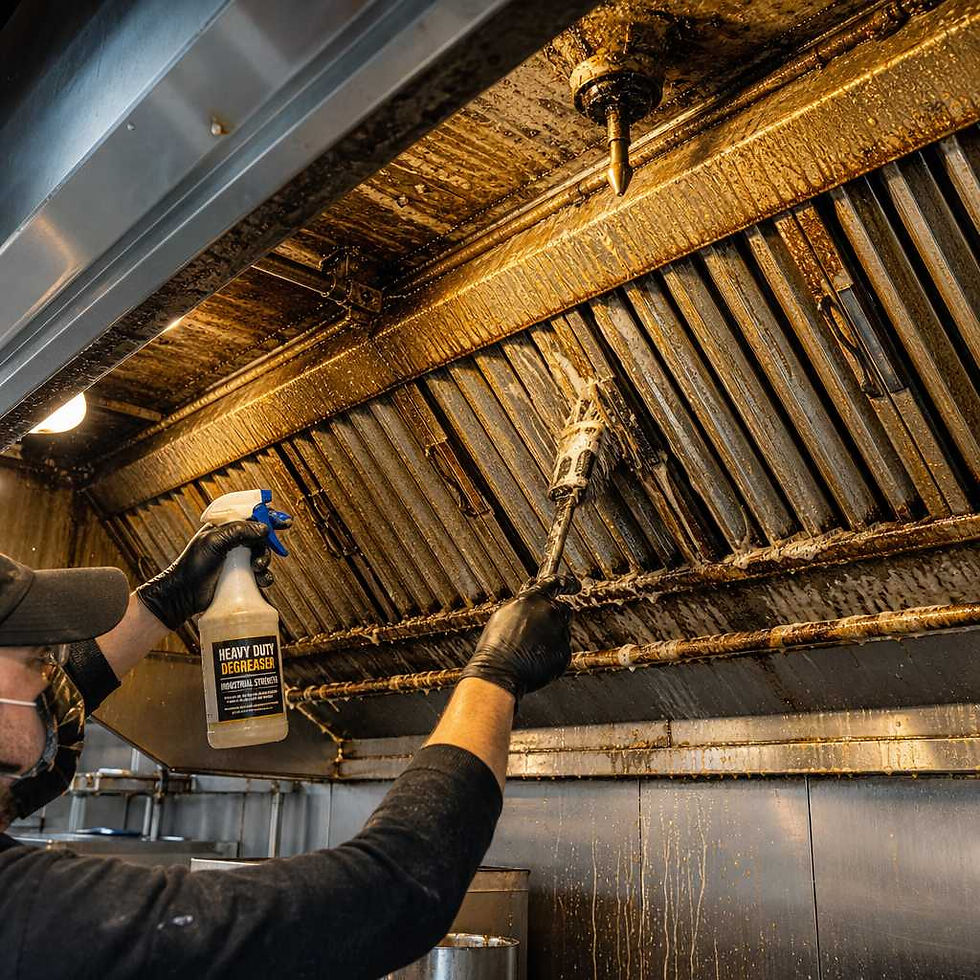
The hood canopy is the most visible component of your kitchen exhaust system, which is exactly why it gets the most attention. But grease does not stay in the hood. It travels. Cooking vapors carry grease particles upward through the filters, into the plenum, along the duct walls, and all the way to the exhaust fan sitting on your roof. Every inch of that pathway accumulates combustible material, and NFPA 96 exists specifically because incomplete cleaning of that pathway has caused catastrophic fires.
In practice, a hood that looks clean after a service visit may still have significant grease deposits in the duct elbows, at the fan housing, and on the fan blades themselves. Superior Clean provides before-and-after documentation of every surface cleaned, because without that documentation you have no way to verify the work stopped at the hood or continued through the entire system.
Beyond the exhaust pathway, there is the rest of the kitchen. The floors under your fryers, the interiors of your convection ovens, the exterior surfaces of your ranges, the undersides of your prep tables, and your grease traps all accumulate contamination that no hood cleaning service touches. A commercial kitchen deep cleaning addresses all of it in a coordinated, sequenced process.
Pro tip: Ask your current cleaning provider to show you grease thickness measurements or photos from inside your duct system at the fan end. If they cannot produce that documentation, you do not know what condition your system is in between the hood and the rooftop exhaust.
Restaurant Equipment Detailing: What It Actually Includes
Restaurant equipment detailing is not a vague term for wiping down your line. It is a systematic, surface-level and component-level cleaning of every piece of cooking and food prep equipment in your kitchen, performed to a standard that satisfies both fire prevention and food safety requirements.
What Gets Cleaned During Equipment Detailing
A proper detailing service covers fryer baskets, fryer pots, and the exterior cabinetry of fryers, including the hard-to-reach areas around the burner tubes where carbonized grease accumulates fastest. It covers the interior walls, floor, and broiler grates of ovens. It covers range tops, burner grates, drip pans, and the inside of any warming drawers. Salamanders and broilers get particular attention because they operate at high radiant heat and accelerate grease carbonization.
Refrigeration equipment gets exterior cleaning and coil brushing. Prep tables get disassembled and sanitized. Slicer blades, mixer bowls, and stand mixer attachments get individual attention. Every surface that comes into contact with food or sits adjacent to a heat source qualifies for detailing.
Why Detailing Is Not Optional Between Deep Cleans
A common mistake is treating equipment detailing as a luxury service done once a year before a major health inspection. In a high-volume Connecticut restaurant running 200 or more covers per night, carbonized grease on a burner assembly can build to a fire-risk level within 30 days. The frequency of detailing should scale with your cook volume and the fat content of your menu, not your budget cycle.
The data consistently shows that restaurants with documented equipment detailing programs have shorter health inspection times and fewer corrective orders. Inspectors move faster through kitchens where the behind-equipment areas are visibly clean, and they probe harder in kitchens where the primary surfaces look maintained but the secondary surfaces do not.
Pro tip: Schedule equipment detailing immediately after your busiest operational stretch of the year, typically the week after the holiday season ends in January. That is when accumulation is at its peak and when a health inspection arriving unannounced would cause the most damage.
Building a Comprehensive Kitchen Maintenance Schedule
A comprehensive kitchen maintenance program is not a single service event. It is a layered schedule where daily operator tasks, monthly professional services, and quarterly deep cleans form a continuous protection system. Most Connecticut restaurant operators have the daily tasks in place. Most are missing the middle and deep layers.
Daily and Weekly Operator Responsibilities
Operators should be cleaning hood filters daily in high-grease environments, or weekly at minimum in lower-volume kitchens. Filters that are clogged reduce airflow through the system, which directly increases the rate of grease deposition in the duct above. This is not discretionary maintenance. It is the mechanical prerequisite for everything else to work correctly.
Floor drain cleaning should happen at the end of every shift. Grease that settles into floor drains contributes to trap overload, drain line blockages, and the kind of backup that generates both health department citations and pest activity.
Monthly and Quarterly Professional Services
At the monthly level, a professional service should inspect and clean grease traps, inspect fan belt tension and condition, and address any equipment detailing tasks identified during the previous month. At the quarterly level, the full exhaust system cleaning, equipment detailing, and a documented mechanical inspection of exhaust fans should happen together.
For high-volume operations, NFPA 96 mandates monthly hood and duct cleaning. For moderate-volume kitchens using solid fuels like wood or charcoal, that frequency increases further. Superior Clean works with Connecticut operators to set service intervals based on actual cook volume and equipment type, not just what is most convenient to schedule.
"Cooking equipment fires account for nearly 61 percent of all restaurant fires in the United States. The majority involve grease buildup in exhaust systems and on equipment surfaces that were not cleaned frequently enough." -- National Fire Protection Association, NFPA 96 Standard for Ventilation Control and Fire Protection of Commercial Cooking Operations
Grease Trap and Exhaust Fan Maintenance
These two components sit at opposite ends of your kitchen's grease management system, and they are both chronically under-serviced. Grease traps prevent fats, oils, and grease from entering municipal sewer systems. Connecticut municipalities actively enforce grease trap regulations, and fines for non-compliance or sewer system contamination run into thousands of dollars per incident.

Grease Trap Cleaning Intervals
The standard rule is that a grease trap should be cleaned when it reaches 25 percent capacity with floating grease and settled solids combined. For a busy Connecticut restaurant running breakfast and lunch service alongside dinner, that threshold can arrive in as little as two to four weeks. Operators who schedule quarterly cleanings and run high-volume breakfast service are almost certainly exceeding that threshold between services.
Superior Clean provides grease trap cleaning as part of its comprehensive service portfolio specifically because trap neglect undermines every other sanitation effort in the kitchen. A backed-up trap creates odor, pest attraction, and regulatory risk simultaneously.
Exhaust Fan Repair, Belt Replacement, and Motor Swaps
The exhaust fan is the mechanical heart of your ventilation system. A fan running at reduced efficiency because of a worn belt or a bearing that needs lubrication is not extracting grease vapors at the designed rate. That means more grease deposits per hour of cook time in every component below the fan.
Fan belt replacement is a straightforward preventive maintenance item that gets ignored until the belt breaks during a dinner service and the kitchen fills with smoke and grease vapor. Belt inspections take minutes. Belt failures cause hours of downtime. Superior Clean includes belt inspections during every exhaust system service and replaces worn belts on the same visit, eliminating a separate service call.
Motor swaps and hinge kit installations fall into the same category. A hinge kit on an exhaust fan allows the fan to tilt away from the curb for cleaning access. Kitchens without hinge kits either cannot clean the fan housing properly or require equipment to access the rooftop unit. That is a cleaning and inspection gap that compounds over time.
How Different Cleaning Approaches Compare
Cleaning Approach
Scope of Service
Best Suited For
Hood-Only Cleaning
Removes grease from filters, plenum, and visible hood surfaces. Does not address ducts beyond initial accessible section, fan, equipment surfaces, or grease traps.
Low-volume operations with minimal frying. Not compliant with NFPA 96 for most commercial kitchens.
Full Exhaust System Cleaning (NFPA 96 Compliant)
Covers hood, filters, plenum, all duct sections, and rooftop exhaust fan. Includes documentation and grease thickness reporting. Fan belt and motor condition checked.
Any commercial kitchen required to meet NFPA 96, which includes virtually all Connecticut restaurant operations with a commercial cooking range.
Comprehensive Deep Cleaning with Equipment Detailing
Full exhaust system cleaning plus equipment detailing, grease trap cleaning, floor drain service, and mechanical inspection. Scheduled on a frequency tied to cook volume.
High-volume restaurants, facilities preparing for health inspections, and operations that want documented compliance across all grease-related systems simultaneously.
The comparison above is not theoretical. In practice, the gap between hood-only cleaning and full system plus equipment detailing is the gap between a kitchen that passes a health inspection and one that receives corrective orders. It is also the gap between a kitchen that has a contained grease fire and one that has a total kitchen fire loss.
Common Deep Cleaning Mistakes Connecticut Kitchens Make
A common mistake is scheduling deep cleaning frequency based on the calendar rather than cook volume. A sandwich shop running 40 covers a day and a full-service restaurant running 300 covers a night are not the same kitchen. Treating them with the same annual cleaning schedule means the high-volume kitchen is out of compliance and accumulating hazardous grease levels for months before anyone addresses it.
Another mistake is separating services across multiple vendors with no single point of accountability. When your hood cleaning company, your grease trap service, and your equipment maintenance are three separate relationships, coordination gaps appear. Grease accumulates in exactly those gaps. Superior Clean addresses this by providing all of these services under a single documented maintenance program for Connecticut operators.
The third mistake is assuming that NFPA 96 compliance certificates from a hood cleaning visit cover everything a health inspector or insurance auditor will check. They do not. A health inspector checking behind your reach-in refrigerators or under your fryers is looking at surfaces that no hood cleaning service ever touched. That is where equipment detailing fills the compliance gap that exhaust system cleaning cannot.
Pro tip: Review your last three health inspection reports before scheduling your next deep clean. Every item that was cited tells you exactly which surfaces and systems your current cleaning program is missing. Use those citations to build a targeted scope of work for your next service.

Frequently Asked Questions
How often should a commercial kitchen deep cleaning be performed?
Frequency depends on cook volume and equipment type. NFPA 96 sets minimum intervals for exhaust system cleaning: monthly for high-volume or solid fuel operations, quarterly for moderate-volume operations, and semi-annually or annually for low-volume operations. Equipment detailing should happen at least quarterly for any full-service restaurant. Grease trap cleaning frequency should be based on actual trap capacity readings, not a fixed calendar interval.
What does restaurant equipment detailing actually cover that regular cleaning does not?
Regular cleaning covers the surfaces your staff accesses during shift. Equipment detailing covers the components and surfaces that require disassembly or movement to reach: burner tube interiors, fryer cabinet interiors, oven wall panels, the undersides of equipment, and the spaces between adjacent pieces of equipment. These are the areas where carbonized grease accumulates to fire-risk levels and where health inspectors look when they are looking for violations.
Is NFPA 96 compliance the same as passing a Connecticut health inspection?
No. NFPA 96 compliance covers the fire prevention requirements for your exhaust system. Connecticut health inspections evaluate a broader set of conditions including equipment sanitation, food storage, pest control, and facility maintenance. NFPA 96 compliance is a component of overall compliance, not a substitute for it. A kitchen can have a current NFPA 96 certificate and still receive health code violations for equipment detailing failures.
How do I know if my exhaust fan belt needs to be replaced?
Visual inspection will show cracking, fraying, or glazing on the belt surface. Performance indicators include increased noise from the fan housing, reduced airflow measurable at the filters, and visible grease accumulation increasing faster than normal between cleaning cycles. A worn belt reduces fan RPM, which reduces grease extraction efficiency across the entire system. Belt replacement should happen as a preventive measure at the first sign of wear, not after the belt fails during service.
Can I schedule hood cleaning, equipment detailing, and grease trap cleaning as a single service visit?
Yes, and coordinating these services in a single visit is the most efficient approach. It eliminates the scheduling overhead of managing multiple vendor relationships, ensures that grease disturbed during hood and equipment cleaning is captured before it migrates to the trap or floor drains, and produces a single documentation package covering your entire grease management system. Superior Clean provides this combined service for Connecticut restaurants specifically because the compliance and safety benefits of coordinated cleaning are significantly greater than the sum of each service done independently.
If you manage a Connecticut commercial kitchen and have questions about what a full deep cleaning scope should look like for your specific operation, leave a comment below or share what your current service program covers. We want to know what gaps you are seeing.
We would love your feedback and any insights you would share with others. What perspective would you add?
References
National Fire Protection Association: fire safety standards and cooking equipment fire statistics
Centers for Disease Control and Prevention: food safety and commercial kitchen sanitation guidance
U.S. Environmental Protection Agency: grease trap and fats, oils, and grease management regulations
Statista: restaurant industry fire loss and commercial kitchen equipment data
Forbes: restaurant operations and food service industry compliance cost reporting


Comments