


Grease Trap Cleaning CT: Frequency, Compliance & Tips
- Aug 6
- 10 min read
A blocked or overflowing grease trap does not just smell bad. It can trigger a health department shutdown, generate a Connecticut DEEP violation, and cost a restaurant owner thousands of dollars in emergency service fees before breakfast. Yet the data consistently shows that grease trap maintenance is the most neglected item on most commercial kitchen checklists. This guide covers everything Connecticut restaurant operators need to know about grease trap cleaning CT requirements, including how often to clean, what state and local rules actually say, and what separates a compliant kitchen from one that is one inspection away from a closure notice.
Table of Contents
Why Grease Trap Cleaning Matters in Connecticut
Connecticut's sewer authority rules are not suggestions. The Connecticut Department of Energy and Environmental Protection (DEEP) and local municipal water pollution control authorities enforce grease discharge limits aggressively, particularly in densely populated areas like Hartford, Bridgeport, New Haven, and Stamford. A single grease release event can result in fines starting at $1,000 per day under the Connecticut Water Pollution Control Act.
In practice, the majority of sanitary sewer overflows traced back to food service establishments involve grease buildup. The EPA estimates that grease is responsible for nearly 47% of all sewer overflows nationally, and Connecticut municipalities have adopted pre-treatment ordinances specifically to push that number down. Ignoring your grease trap is not a low-risk gamble. It is a near-certain liability over any twelve-month window.
Quick Takeaways
Key Insight
Explanation
The 25% rule is the standard cleaning trigger
Most Connecticut municipal pre-treatment programs require cleaning when the combined FOG (fats, oils, grease) and solids layer reaches 25% of the trap's total liquid depth.
High-volume kitchens often need monthly cleaning
A busy Connecticut restaurant processing hundreds of covers per day can hit the 25% threshold in three to four weeks, not ninety days.
Manifests and waste disposal records are legally required
Connecticut requires haulers to be licensed through DEEP and operators to retain grease waste manifests for a minimum of three years.
Enzyme and bio-additive treatments do not replace mechanical cleaning
Biological additives only temporarily suppress odors and move FOG further down the line. They do not remove accumulated grease and are not accepted as a compliance substitute.
Grease trap neglect accelerates hood system contamination
When grease is not captured at the trap level, it recirculates through cooking vapor into exhaust hoods, increasing fire risk and NFPA 96 cleaning frequency requirements.
Indoor hydromechanical traps have smaller capacity and need more frequent service
These units, common in older Connecticut restaurant spaces, can require cleaning every two to four weeks depending on kitchen output.
Skipping cleaning does not save money
Emergency pump-outs, municipal fines, and sewer repair cost assessments routinely exceed twelve months of scheduled cleaning fees in a single incident.
Connecticut Regulations and Compliance Requirements
Connecticut restaurant operators are subject to a layered compliance structure. At the state level, DEEP's water quality standards under Connecticut General Statutes Section 22a-430 require that any facility discharging to a municipal sewer maintain approved pre-treatment equipment, which includes grease interceptors. At the local level, each municipality's Water Pollution Control Authority (WPCA) sets its own cleaning frequency requirements, inspection schedules, and manifest documentation rules.
What the WPCA Inspection Process Looks Like
In most Connecticut towns, a WPCA inspector can arrive unannounced at any food service establishment to inspect the grease trap. They will measure the current FOG and solids accumulation depth, review your service manifests, and check that your hauler is DEEP-licensed. If your records are missing or the trap is over the 25% threshold, you will receive a notice of violation. A second violation in many jurisdictions triggers a compliance schedule with daily penalties.
A common mistake is assuming that because the trap was cleaned six months ago, it is still compliant. Compliance is determined by the current condition of the trap at the time of inspection, not by the date of your last service record alone. Your service log matters, but it does not override a failed physical measurement.
Pro tip: Keep your three most recent grease trap service manifests in a clearly labeled binder near the trap access point. Inspectors appreciate immediate access, and it signals a well-managed kitchen operation.
"Fats, oils, and grease from commercial kitchens are among the leading causes of sanitary sewer overflows in the United States. Pre-treatment programs that enforce regular interceptor maintenance are essential to protecting both public health and municipal infrastructure." - U.S. Environmental Protection Agency, Pre-Treatment Program guidance documentation
How Often Should You Clean Your Grease Trap
The honest answer is: as often as it takes to stay below the 25% threshold. That said, in practice, frequency depends on three measurable factors: the volume of food being prepared, the type of cooking being done, and the size of your interceptor relative to your flow rate.


Frequency Benchmarks by Kitchen Type
A quick-service burger or fried chicken restaurant in Connecticut with high fryer output and a standard 1,000-gallon interceptor will typically need cleaning every four to six weeks. A full-service Italian restaurant doing heavy pasta and sauce preparation may get away with every six to eight weeks. A bakery or light-prep café with minimal fry cooking might stretch to every ninety days. These are benchmarks, not guarantees.
The only way to know your actual interval is to have a technician measure the FOG layer at your first two or three cleanings and back-calculate your accumulation rate. From that data, you can set a defensible cleaning schedule that satisfies both your WPCA and your budget.
Seasonal Variation in Connecticut
Connecticut kitchens see real seasonal swings. Summer months bring higher customer volumes from tourism and outdoor dining, while the holiday season from November through January pushes output up significantly. Both windows accelerate grease accumulation. Plan for shorter intervals during these periods, not the same interval you use in February.
Pro tip: Schedule a grease trap inspection before the Memorial Day weekend and again before Thanksgiving. Both represent volume spikes that push traps toward the 25% threshold faster than operators anticipate.
Indoor vs. Outdoor Grease Traps: What Connecticut Kitchens Actually Have
Connecticut's building stock skews older, particularly in cities like New Haven, Waterbury, and Hartford. Older restaurant spaces frequently have small, indoor hydromechanical grease interceptors installed under a prep sink or dishwashing station. These units are typically rated between 20 and 100 gallons and have almost no buffer capacity against high-volume kitchens. In practice, these need cleaning every two to four weeks in any medium-to-high volume operation.
Newer construction or recently renovated locations typically have large outdoor gravity interceptors, which range from 500 to 2,000 gallons. These require less frequent service but generate significantly more grease waste per service event and require a licensed vacuum truck for pump-out. The cleaning process is more involved, which is precisely why it should be scheduled rather than reactive.
A common mistake Connecticut restaurant operators make is inheriting a building with an undersized indoor unit and assuming it meets current code. If your kitchen output has grown since the interceptor was installed, or if the previous tenant operated a lighter-prep concept, your current trap may be legally undersized for your use. A qualified technician can assess this during a service visit.
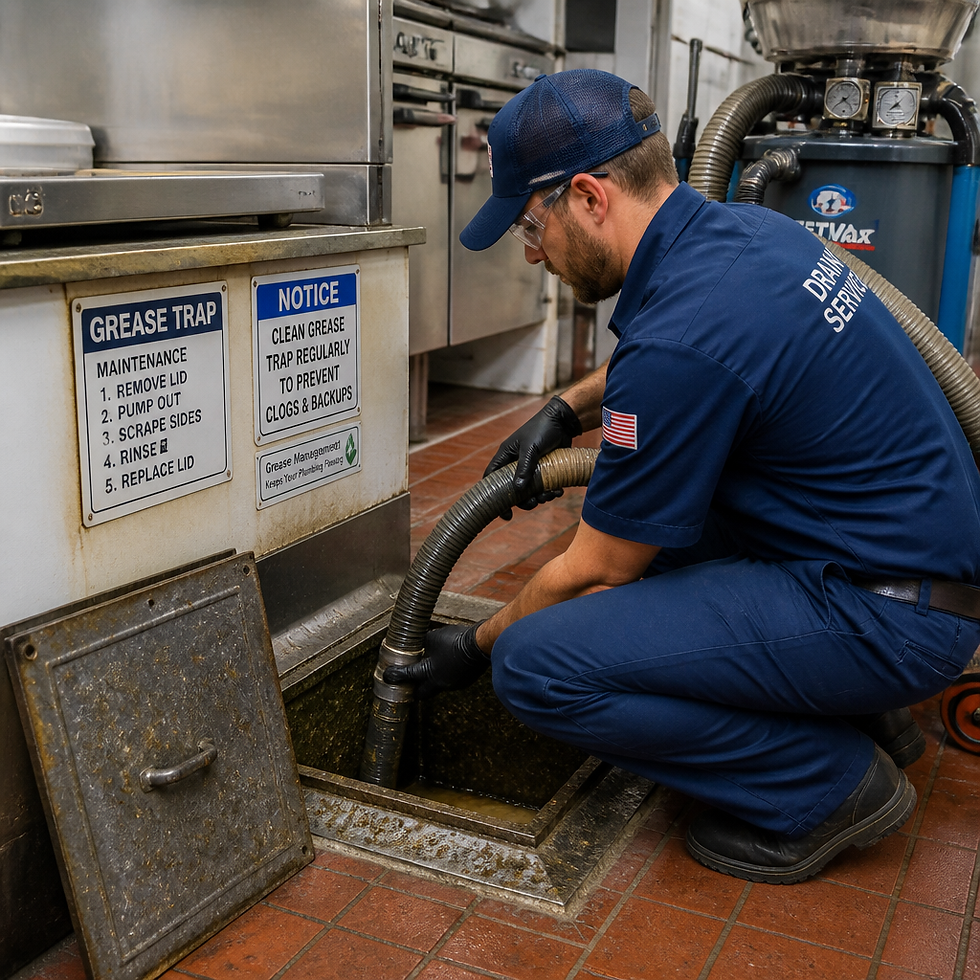
Cleaning Methods Compared
Not all grease trap service is equivalent. The method used determines whether you are actually compliant or just appearing to be. Here is a direct comparison of the three approaches Connecticut restaurant operators most commonly encounter.
Cleaning Method
What It Involves
Compliance Status in CT
Full pump-out and manual scrape
Licensed vacuum truck removes all liquid and solids. Technician manually scrapes baffle walls and lid. Waste is transported to an approved disposal facility with a signed manifest.
Fully compliant. The only method accepted by all Connecticut WPCAs.
Partial pump-out (skimming only)
Operator or unlicensed technician skims the visible FOG layer from the surface without removing accumulated bottom solids.
Not compliant. Solids accumulation is not addressed, and no manifest is generated. Will fail WPCA inspection.
Enzyme or biological additive treatment
Liquid or powder additives introduced through kitchen drains to break down FOG between service visits. Sometimes sold as a standalone maintenance solution.
Not a substitute for mechanical cleaning. Accepted only as a supplemental odor management tool, not as a compliance measure under any Connecticut municipal pre-treatment ordinance.
The data consistently shows that partial pump-outs and additive-only approaches are how restaurants end up with violations. A compliant service generates a signed manifest from a DEEP-licensed hauler, every single time. If your current service provider does not deliver that documentation, find a different provider.
Signs Your Grease Trap Needs Immediate Attention
Most grease trap failures do not happen without warning. The warning signs are just easy to rationalize away when a kitchen is busy. Do not do that.
Slow drains in the dishwashing station or prep sinks are the first indicator. If water is pooling around floor drains or backing up into a sink basin, the trap is either over capacity or partially blocked at an inlet pipe. A persistent sulfur or rotten-egg odor in the kitchen, particularly near drain access points, means the trap is anaerobic and overdue for service by weeks, not days. A gurgling sound from floor drains after a busy service is another reliable signal.
In outdoor interceptor setups, a visible sheen or floating grease layer in the area around the trap lid, or wet spots in the soil near the unit, indicates a seal failure or overflow condition. That is a reportable event under Connecticut DEEP regulations, and you should contact your service provider the same day, not the following week.
How Grease Trap Cleaning Connects to Hood and Exhaust System Maintenance
This connection is underappreciated by most restaurant operators and largely ignored by single-service vendors who only clean one system. In a commercial kitchen, grease management is a continuous chain. It starts at the cooking surface, travels through the exhaust hood and duct system, and exits through the drain system into the grease trap. A failure or buildup at any point in that chain accelerates problems everywhere else.
When a grease trap is undersized, infrequently cleaned, or improperly serviced, the FOG load that does not get captured re-enters the kitchen environment through drain vapor and steam. That increases the rate of grease accumulation on hood filters, baffle surfaces, and duct walls. Kitchens with poorly maintained grease traps consistently require more frequent NFPA 96-compliant hood cleanings, which translates directly into higher maintenance costs.
At Superior Clean, we see this pattern regularly across Connecticut food service accounts. A restaurant that has been stretching its grease trap service intervals often discovers during a hood inspection that grease deposits have built up faster than their normal cleaning schedule would predict. The two systems are not independent. Managing both together, on a coordinated schedule, is the most cost-effective approach for any Connecticut commercial kitchen operator. Our services cover both grease trap cleaning and NFPA 96-compliant hood and exhaust cleaning throughout Connecticut, which means we can assess the full chain in a single visit and give you an accurate picture of your actual fire risk and compliance status.
Restaurant equipment detailing and exhaust fan maintenance, including fan belt replacement and motor servicing, also connect here. A kitchen that manages grease at every point in the system runs cleaner equipment, experiences fewer mechanical failures, and carries a lower fire risk profile overall. That is not a coincidence. It is physics.
Frequently Asked Questions
What is the legal cleaning frequency for grease traps in Connecticut?
Connecticut does not set a single statewide cleaning frequency. Instead, each municipality's Water Pollution Control Authority enforces the 25% rule: the combined FOG and solids layer must not exceed 25% of the trap's total liquid depth at any time. In practice, most Connecticut WPCAs expect high-volume kitchens to service their traps monthly, though the legal standard is condition-based, not calendar-based. Your specific WPCA may also impose minimum quarterly cleaning requirements regardless of trap condition.
Do I need a licensed hauler for grease trap waste in Connecticut?
Yes. Connecticut DEEP requires that all grease waste removed from interceptors be transported by a licensed septage or grease waste hauler operating under a valid permit. The hauler must deliver waste to an approved treatment or disposal facility and provide you with a signed manifest for each service event. Retaining those manifests for a minimum of three years is a condition of compliance under most Connecticut municipal pre-treatment programs.
Can I clean my own grease trap to save money?
For small indoor hydromechanical units, an operator can remove and manually clean the trap components. However, the waste must still be disposed of properly through a licensed facility. You cannot pour grease trap waste down a floor drain, into a dumpster, or onto the ground. For any outdoor gravity interceptor, self-service is impractical without vacuum equipment and is generally not accepted as compliant by Connecticut WPCAs because no licensed manifest is generated.
How do I know if my grease trap is the right size for my kitchen?
Interceptor sizing in Connecticut follows guidelines based on the flow rate of your drainage fixtures and the number and type of cooking appliances in use. A trap that was adequate for a previous tenant running a light prep operation may be significantly undersized for a full-service kitchen with fryers, a commercial dishwasher, and high prep volume. If you are consistently hitting the 25% threshold in under four weeks, have a technician assess your current interceptor capacity against your actual flow rate. Undersized traps are a common finding in older Connecticut restaurant properties.
What is the difference between a grease trap and a grease interceptor?
The terms are used interchangeably in common usage, but technically they refer to different devices. A grease trap is typically a smaller, indoor hydromechanical unit installed close to the fixture it serves. A grease interceptor is a larger, outdoor, gravity-based unit with significantly higher capacity. Both function by slowing wastewater flow to allow FOG to separate and rise to the surface. Connecticut restaurants may have one or both, depending on their facility size, age, and local plumbing code requirements.
Will biological additives help me extend my cleaning intervals?
No. Biological additives and enzyme treatments do not remove grease from your interceptor. They temporarily reduce odors and can emulsify some surface FOG, but emulsified grease does not stay in the trap. It passes through into the municipal sewer system, which is precisely the discharge problem Connecticut's pre-treatment ordinances are designed to prevent. Several Connecticut municipalities explicitly prohibit the use of biological additives as a maintenance substitute, and using them to avoid a scheduled cleaning can be treated as a compliance violation if discovered during inspection.
Have you recently dealt with a grease trap compliance issue at your Connecticut restaurant? Share what you learned so other operators can avoid the same situation.


Comments