


Norwalk Hood Cleaning: What Coastal Restaurants Must Know
Updated: Aug 12
Norwalk's restaurant scene runs hard. From the oyster houses near the waterfront to the high-volume kitchens tucked into South Norwalk's dining corridor, coastal cooking means one thing for kitchen operators: grease builds up faster than you think, and the consequences of ignoring it are worse than most owners realize until it is too late. Norwalk hood cleaning is not a box-checking exercise for a fire marshal visit. It is the single maintenance task most likely to prevent a kitchen fire, an insurance denial, or an unexpected forced closure. This guide covers what busy Norwalk restaurant operators actually need to prioritize, in plain language, without filler.
Table of Contents
Why Norwalk Kitchens Face Elevated Grease Risk
Coastal restaurants in Norwalk tend to run cooking profiles that push grease accumulation rates higher than a typical inland diner. Charbroiled seafood, high-output fryers running through long weekend dinner services, and wood-fired or charcoal-based cooking equipment all generate significantly more grease vapor than standard flat-top or oven cooking. These are exactly the operation types that NFPA 96 singles out for more aggressive cleaning schedules.
Busy seasonal surges along the Connecticut shoreline also mean Norwalk kitchens often run near or at capacity for extended stretches, then slow down in the off-season. That pattern creates a specific hazard: operators who schedule cleaning around their quiet periods are often running their heaviest volume with the most accumulated grease in the system. That is precisely backwards from a fire safety standpoint.
The humidity and salt air of a coastal environment add a secondary concern. Grease that might remain somewhat dry and powdery in an inland kitchen tends to bond more aggressively to duct surfaces in humid coastal conditions, making manual cleaning more labor-intensive and making skipped service intervals more consequential.
Quick Takeaways
Key Insight
Explanation
Cleaning frequency depends on cooking type, not calendar preference
NFPA 96 Table 11.4 sets cleaning intervals based on operation type. Charbroil and wok operations require quarterly cleaning. Solid fuel cooking requires monthly. Annual schedules are only for low-volume seasonal operations.
The entire exhaust system must be cleaned, not just the hood filters
NFPA 96 §11.6.1 requires cleaning from hood to rooftop fan. Filters-only service is not compliant and leaves the ductwork as the primary fire hazard.
Digital documentation is now required
The 2025 update to NFPA 96 requires digital documentation of all cleaning and inspection activity. A paper sticker on the hood is no longer sufficient evidence of compliance.
Contamination found during inspection triggers immediate cleaning
Per NFPA 96 §11.6.1, if contamination is found during an inspection, cleaning must begin immediately, not at the next scheduled service date.
Exhaust fan condition directly affects hood performance
A rooftop fan running with worn belts, a failing motor, or inadequate grease containment reduces the entire system's airflow and creates a rooftop fire hazard. Fan maintenance belongs in every service conversation.
Rooftop grease containment is a separate compliance requirement
NFPA 96 §8.1.1.3 limits upblast fan grease receptacle capacity to 3.8 L (1 gallon). Overflow from neglected containment creates a rooftop fire hazard that many operators overlook entirely.
Missing documentation is what turns a fire into an insurance denial
When a fire occurs and cleaning records are incomplete or missing, insurance carriers reference NFPA 96 compliance as a condition of coverage. No documentation means no claim.
NFPA 96 Cleaning Frequency: What the Standard Actually Requires
NFPA 96 is the national standard governing commercial kitchen ventilation, fire suppression, and exhaust system maintenance. It is not a suggestion. Fire marshals in Connecticut enforce it, and insurance carriers reference it when evaluating claims. Understanding the cleaning frequency table inside this standard is the starting point for any serious Norwalk restaurant operator.
NFPA 96 Table 11.4 sets cleaning frequency based on what you are cooking, not on what is convenient for your schedule. The four tiers are: monthly for solid fuel operations using wood or charcoal; quarterly for 24-hour operations, charbroiling, and wok cooking; semi-annual for moderate-volume or seasonal operations; and annual for genuinely low-volume facilities like day camps or churches with occasional cooking. Most full-service Norwalk restaurants fall into the quarterly or semi-annual category at minimum.
A common mistake Norwalk operators make is scheduling hood cleaning once a year because "that's what the last company told us." If your kitchen runs charbroil equipment, fries seafood continuously through a summer season, or operates extended hours, that annual schedule puts you out of compliance and exposes your business to both enforcement action and insurance risk. The frequency requirement is tied to your equipment type and volume, not to a single default calendar.
When a commercial kitchen exhaust fire occurs and the hood cleaning documentation is missing, out of date, or does not cover the full system from hood to rooftop fan, the insurance denial arrives before the fire marshal's citation does.
NFPA 96 §11.6.1 adds a requirement that catches many operators off guard: if an inspector finds contamination during a scheduled inspection, cleaning must begin immediately, not at the next booked service date. This means that if your quarterly service is overdue and grease has accumulated beyond acceptable thresholds, you cannot simply move it to next month's calendar. You are already in a forced-cleaning scenario.

What "Clean to Bare Metal" Actually Means
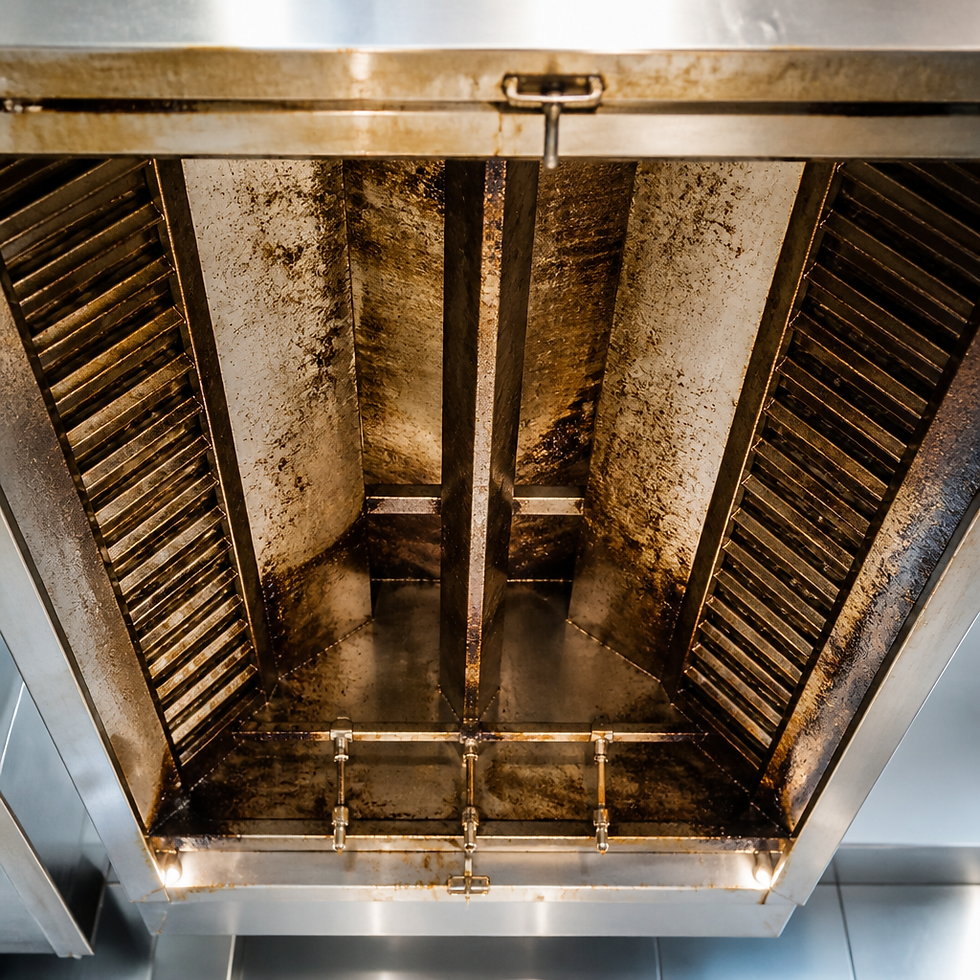
NFPA 96 §11.6.1 requires that the entire contaminated system be cleaned to bare metal. This is not a figure of speech. It means every surface inside the duct run, every accessible interior hood surface, and the fan housing must be free of grease deposits. A cleaning company that wipes down the visible hood interior and changes the filters without accessing the duct interior and rooftop fan has not completed a compliant service. In practice, you should be able to visually inspect any accessible interior surface after a proper cleaning and see bare metal, not a thin residual film of grease that was "mostly cleaned."
The Full System: Hood to Rooftop Fan
Commercial hood cleaning in Norwalk CT must cover the complete exhaust pathway, not just the components visible from the kitchen floor. The full system runs from the grease removal devices inside the hood (the filters), through the plenum and duct interior, up through vertical and horizontal duct runs, and out through the rooftop exhaust fan housing. Each segment accumulates grease at a different rate, and each segment presents its own fire risk if neglected.
Duct interiors are where the most dangerous grease accumulation occurs. They are invisible during daily kitchen operations, which means the problem grows unnoticed. A thick grease layer inside a duct run exposed to the high-temperature air coming off a commercial range is a fire waiting for an ignition source. Proper commercial hood cleaning requires access panels in the duct to allow interior cleaning of vertical runs. NFPA 96 has expanded access panel requirements precisely because duct interior access is where compliance failures most commonly occur.
Grease Filters and the Plenum Area
Grease removal devices, meaning the baffle filters or mesh filters inside the hood, are the first line of defense in the system. They require daily visual inspection by kitchen staff, per NFPA 96 §11.6.2. If filters show visible grease pooling or dripping, that is an immediate cleaning trigger, not a note for the next scheduled service. Filters should be removed and cleaned at every professional service visit, and the plenum area behind them should be cleaned to bare metal as part of every compliant service.
Rooftop Fan and Grease Containment
The rooftop upblast exhaust fan is the component that gets the least attention and causes some of the most serious problems. Grease that travels through the duct system eventually reaches the fan housing and accumulates there. NFPA 96 §8.1.1.3 limits upblast fan grease receptacles to 3.8 liters (one gallon). A neglected receptacle overflows, deposits grease on the rooftop surface, and creates a direct fire hazard at the rooftop level, away from the kitchen where anyone would notice it. Every professional cleaning visit should include inspection and service of the rooftop fan and its grease containment.

Documentation: The Part Most Restaurants Get Wrong
Most Norwalk restaurant operators understand that the kitchen hood needs to be cleaned. Fewer understand that the documentation of that cleaning is equally important from a legal and insurance perspective. The 2025 update to NFPA 96 requires digital documentation for all cleaning and inspection activity. A paper service sticker on the hood face is no longer sufficient evidence of compliance for an authority having jurisdiction (AHJ) that knows the current standard.
What proper documentation looks like in practice: a detailed service report identifying the date of cleaning, the technician performing the work, the specific system components cleaned, before-and-after photographic evidence, and confirmation that the cleaning was completed to bare metal throughout the accessible system. This report should be stored digitally and retrievable on demand, whether by a fire marshal, an insurance adjuster, or a new building owner during a facility audit.
Pro tip: Ask your hood cleaning company to provide a digital service report with photos as a standard deliverable, not as an add-on. If they cannot produce photographic documentation of the duct interior after cleaning, you have no way to verify the work was done to NFPA 96 §11.6.1 standards, and neither does your insurer.
The access panel tags required by NFPA 96 are a related documentation requirement. Every access panel on the duct run must be labeled so inspectors can locate and open them. If your duct system has no access panels or the panels are not labeled, that is a compliance gap your cleaning company should flag and help you address, not ignore because it adds work.
Exhaust Fan Maintenance Beyond the Cleaning Visit
Grease cleaning is the most visible part of exhaust system maintenance, but it is not the only part that affects fire risk and kitchen performance. The rooftop exhaust fan is a mechanical component with wear parts that fail independently of grease accumulation. A fan running with a worn fan belt, a failing motor bearing, or a cracked hinge kit is reducing the airflow through your entire exhaust system, even if the duct is perfectly clean.
Reduced airflow means the hood captures less grease vapor at the source, which accelerates grease accumulation in the duct and increases the fire risk between cleaning visits. It also means smoke, heat, and cooking odors back up into the kitchen, affecting staff comfort and food quality. These are the problems that become expensive emergencies when they are ignored until the fan stops working during a Friday dinner service.
Fan Belts, Motors, and Hinge Kits
Fan belt replacement is one of the most straightforward preventive maintenance tasks on a rooftop exhaust fan, and it is one of the most commonly deferred. A stretched or cracked belt reduces fan speed and efficiency before it fails completely. Motor swaps, when a motor is drawing excess current or showing bearing noise, are best handled during a scheduled service visit rather than as an emergency call. Hinge kit installations, which allow the fan to be properly tilted for cleaning and maintenance access, are a safety and compliance requirement for upblast fans. If your rooftop fan does not have a functioning hinge kit, your cleaning technician cannot properly service the fan housing interior, which creates a documented compliance gap.
Pro tip: Bundle your exhaust fan mechanical inspection with every hood cleaning visit. A technician already on the roof cleaning the fan housing is the right person to check belt tension, listen for bearing noise, and confirm the hinge kit is functioning. Scheduling these as separate visits costs more and creates gaps between mechanical failures and their detection.
How to Choose a Hood Cleaning Company in Norwalk CT
Not every company offering restaurant kitchen exhaust cleaning in Norwalk delivers the same service. The price difference between a compliant full-system cleaning and a filters-and-hood-surface wipedown can be significant, but the risk difference is far larger. The questions below will quickly separate a qualified provider from one that will leave you with a sticker on the hood and a duct full of grease.
Questions That Reveal Whether a Company Actually Does the Work
Ask specifically which duct sections they access during a standard cleaning, and how. A qualified company will describe their process for accessing duct interiors, including any access panels they open or install. If the answer is vague or focused only on the hood filters and visible plenum, they are not cleaning the full system to NFPA 96 §11.6.1 standards.
Ask what documentation they provide after the service. The answer should include a digital service report with photographs of the duct interior before and after cleaning. Ask whether they inspect the rooftop fan and grease containment as part of their standard service, and whether they can perform fan belt replacement, motor service, or hinge kit installation if issues are found. A company that only cleans and cannot address mechanical issues will send you back to the phone to find someone else, costing you time and money.
Finally, confirm that they are familiar with NFPA 96 compliance requirements and can provide documentation in a format that satisfies an AHJ inspection. Companies that cannot answer that question directly are not operating at the level a Norwalk restaurant operator needs them to.
Service Frequency Comparison
The table below compares three common approaches to hood cleaning service scheduling, showing what each covers, where each falls short, and which operation types each is appropriate for. Understanding these differences helps Norwalk operators make an informed choice rather than defaulting to whatever the previous owner had set up.
Approach
What It Covers
Appropriate For / Key Limitation
Annual filters-and-hood service (common low-budget approach)
Hood filters, visible plenum surfaces, hood face. Duct interior and rooftop fan typically not included or not thoroughly cleaned.
Appropriate only for genuinely low-volume seasonal operations per NFPA 96 Table 11.4. Most full-service Norwalk restaurants are out of compliance using this schedule. Creates an insurance documentation gap.
Quarterly full-system cleaning (NFPA 96 compliant for charbroil and high-volume operations)
Hood filters, full plenum, duct interior via access panels, rooftop fan housing, and grease containment. Digital documentation provided after each visit.
Required for charbroil, wok, and 24-hour operations. Covers the complete exhaust pathway as required by NFPA 96 §11.6.1. The correct schedule for most high-volume Norwalk coastal restaurants.
Quarterly cleaning plus scheduled mechanical maintenance (fan belts, motor inspection, hinge kit service)
Everything in the quarterly full-system cleaning, plus rooftop fan mechanical inspection and repair of wear components during the same service visit.
Best practice for any restaurant that cannot afford an unexpected rooftop fan failure during peak service hours. Eliminates the gap between grease compliance and mechanical reliability. Superior Clean provides this bundled approach for Connecticut restaurants.
Frequently Asked Questions
How often does a Norwalk restaurant need hood cleaning under NFPA 96?
It depends on what you are cooking, not on a single universal calendar. NFPA 96 Table 11.4 requires monthly cleaning for solid fuel (wood or charcoal) operations, quarterly for charbroiling, wok cooking, and high-volume or 24-hour operations, semi-annual for moderate-volume kitchens, and annual only for genuinely low-volume seasonal facilities. Most full-service Norwalk restaurants need quarterly or semi-annual service at minimum. If you are currently on an annual schedule and running a high-volume coastal kitchen, you are likely out of compliance.
Does hood cleaning cover the full duct system or just the hood itself?
A compliant cleaning covers the full exhaust pathway from the hood filters and plenum through the duct interior all the way to the rooftop exhaust fan. NFPA 96 §11.6.1 requires the entire contaminated system to be cleaned to bare metal. A service that only addresses the hood filters and visible hood surfaces is not compliant and leaves the duct interior, which is the highest fire risk segment, untouched.
What happens if a fire marshal finds my Norwalk kitchen is not NFPA 96 compliant?
Consequences range from reinspection fees and required immediate cleaning to forced operational closure in more serious cases. The authority having jurisdiction (AHJ) in Connecticut has the power to require cleaning before a kitchen resumes operation. Beyond enforcement, a kitchen fire that occurs while documentation is missing or out of date creates a strong basis for an insurance claim denial, leaving the operator exposed to the full cost of the fire damage.
Is a paper service sticker on the hood enough documentation for compliance?
No. The 2025 update to NFPA 96 requires digital documentation of all cleaning and inspection activity. A paper sticker on the hood face is no longer sufficient evidence of compliance for an AHJ that knows the current standard. Proper documentation includes a digital service report with photographs covering the duct interior before and after cleaning, the date of service, the technician performing the work, and confirmation of full-system bare-metal cleaning.
Can my kitchen staff handle any part of the NFPA 96 exhaust maintenance requirements?
Yes, but only the operator-level daily tasks. NFPA 96 requires kitchen staff to visually inspect hood filters for grease accumulation each shift, confirm the exhaust fan is running during cooking operations, and empty and clean grease collection cups and drip trays daily. These tasks do not require certification. The cleaning of duct interiors, fan housings, and the full exhaust system must be performed by a properly trained, qualified, and certified company. Daily staff checks supplement professional cleaning but do not replace it.
How do I know if my rooftop exhaust fan needs more than just cleaning?
Signs that your rooftop fan has mechanical issues beyond grease accumulation include reduced airflow at the hood face even after a recent cleaning, unusual noise from the rooftop unit (bearing noise or belt slap), visible belt wear or cracking, and a fan that vibrates excessively during operation. A fan running in any of these conditions is reducing your exhaust system's effectiveness and increasing fire risk between cleanings. Fan belt replacement, motor inspection, and hinge kit service should be evaluated during every cleaning visit.
Have you had an experience with a hood cleaning service in Norwalk that others should know about? Share what worked, what did not, and what you wish you had asked before signing a service agreement.


Comments