


Restaurant Equipment Detailing CT: Protect Your Investment
Most Connecticut restaurant owners replace equipment far sooner than they should. A commercial fryer that should run for 15 to 20 years gets pulled after eight because grease hardened around the heating elements, warped the basket guides, and made the thermostat read wrong. That is not a product failure. That is a maintenance failure, and it is entirely preventable. Restaurant equipment detailing in Connecticut is the systematic, professional-grade cleaning and servicing of every piece of cooking and support equipment in your kitchen, going well beyond the end-of-day wipe-down your staff does before clocking out. Done right, it extends equipment life, protects your health inspection score, and reduces the fire risk that follows every commercial kitchen like a shadow.
Table of Contents
What Restaurant Equipment Detailing Actually Means
Equipment detailing is not the same as daily cleaning, and it is not the same as equipment repair. It sits deliberately in between. A detailing service strips every accessible surface back to clean metal or clean finish, removing carbonized grease, food debris, mineral scale, and biological buildup that accumulates in the joints, hinges, pilot ports, and interior cavities that staff simply do not reach during normal closing routines.
Think of it the way a professional auto detailer approaches a car. The exterior might look acceptable to a casual observer, but the professional goes into the door jambs, the vents, underneath the mats, and into the seams where corrosion starts. Your commercial kitchen equipment has identical blind spots, and those blind spots are where premature failure, pest harborage, and health code violations begin.
Pro tip: Schedule equipment detailing separately from your hood cleaning appointment. Hood cleaning focuses on the exhaust pathway. Equipment detailing focuses on the cooking surfaces, interiors, and mechanical components. Both are necessary, and conflating them leads to gaps in coverage.
Why Connecticut Kitchens Need Professional Detailing
Connecticut's food service environment is competitive and heavily inspected. The Connecticut Department of Public Health oversees food service licensing, and local health departments conduct inspections that carry real consequences, from required corrective action to public posting of scores. Equipment condition, cleanliness of surfaces, and evidence of grease accumulation are all documented during inspections.
Beyond inspections, the economics of equipment replacement in Connecticut are unforgiving. Commercial kitchen equipment is expensive to purchase, expensive to ship, and expensive to install in the tight, built-out kitchen layouts common in older Connecticut buildings across cities like Hartford, New Haven, Bridgeport, and Stamford. Replacing a piece of equipment you could have preserved for another five years with proper detailing is a cost most operators cannot easily absorb.
Regular maintenance is not about spending money. It is about protecting your initial investment and avoiding catastrophic repair bills that arrive at the worst possible moment.
Regular upkeep can extend the life of commercial kitchen equipment by a meaningful margin, with well-maintained refrigeration units lasting 10 to 20 years and properly cared-for commercial fryers reaching up to 20 years of service life. The difference between a fryer that reaches year eight and one that reaches year eighteen is almost always consistent, thorough cleaning and early intervention on mechanical issues.

Equipment-by-Equipment Cleaning Priorities
Not all equipment degrades at the same rate, and not all equipment carries the same consequence when it fails. Prioritize accordingly.
Fryers
Commercial fryers are among the highest-risk pieces of equipment in any kitchen. Oil breaks down, carbonizes, and bonds to heating elements. That carbonized buildup reduces heat transfer efficiency, meaning the fryer works harder, runs hotter where you cannot measure it, and uses more energy to produce the same output. A properly detailed fryer, with elements cleaned to bare metal and oil ports cleared, runs at the temperature it is actually set to.
Fryer detailing also directly reduces fire risk. Accumulated carbonized oil in the fryer cabinet and on heating elements is combustible. This is separate from the exhaust system fire risk your hood cleaning addresses. The fryer itself is an ignition source if it is not maintained.
Ovens and Ranges
Gas ranges and ovens suffer most from clogged burner ports and carbonized grates. Clogged ports produce uneven flames, which means uneven heat, which means inconsistent food quality. Pulling grates and burner heads, clearing ports, and cleaning the interior cavity regularly is the difference between a range that cooks true and one that becomes unreliable. Electric ranges and ovens can remain in service for around 15 years under proper maintenance. Gas stovetops, when maintained well, can reach 18 to 20 years.
Refrigeration Units
Refrigeration fails quietly. Condenser coils accumulate grease and dust, the unit works harder to maintain temperature, compressor wear accelerates, and energy costs climb before anyone notices. Refrigeration detailing includes coil cleaning, door gasket inspection, drain line clearing, and interior sanitization. Walk-in coolers that are well-maintained can last more than 15 years. Neglected condensers shorten that timeline considerably and inflate your utility bill in the meantime.
Griddles and Flat Tops
Griddle seasoning and surface condition directly affect food release and cook consistency. Carbon buildup at the edges and corners creates hot spots and cold zones. Professional detailing resurffaces the cooking plate properly, clears the grease channels, and inspects the thermostatic controls. This is work that requires the right tools and knowledge of the specific surface material. Stone scrubbing an incorrect griddle surface causes damage that shortens its life rather than extending it.
Pro tip: When scheduling equipment detailing for your Connecticut restaurant, ask specifically whether the technician will be cleaning interior cavities and heating elements, not just exterior surfaces. Surface-only cleaning is not detailing. It is a more thorough version of what your staff already does.
How Detailing Connects to Hood and Exhaust System Compliance
Equipment detailing and hood cleaning are complementary services, not interchangeable ones. Your exhaust hood, ductwork, and exhaust fan handle grease-laden vapors that rise off the cooking line. NFPA 96, the national standard for commercial kitchen fire prevention, governs how that exhaust system must be maintained, and it is not advisory for Connecticut restaurants. It forms the technical baseline for state fire codes and local inspection authority requirements.
What NFPA 96 compliance does not cover is the condition of the equipment generating those vapors. A fryer producing excessive smoke because its heating elements are coated in carbonized oil will overwhelm a properly cleaned exhaust system. The grease loading in your ducts increases faster, your cleaning intervals shorten, and your compliance costs go up, all because the equipment underneath the hood was never properly detailed.

In practice, the cleanest approach for Connecticut food service operators is to treat equipment detailing and exhaust system cleaning as a coordinated program rather than two separate reactive tasks. When your equipment runs cleanly, your hood system stays compliant longer between scheduled cleanings. When your hood system is clean and functional, it draws properly and reduces the grease that falls back onto your equipment. The two services reinforce each other.
Superior Clean handles both sides of this equation for Connecticut restaurants. Exhaust hood cleaning to NFPA 96 bare-metal standards, exhaust fan maintenance, fan belt replacement, motor swaps, and hinge kit installations are part of the same equipment health picture as the detailing work done at the cooking line level.
Detailing Approaches Compared
Connecticut restaurant operators generally encounter three approaches to equipment cleaning and detailing. Understanding the differences helps you evaluate what you are actually buying.
Approach
What It Covers
Best For
In-House Daily Cleaning
Exterior surfaces, floors, accessible cooking surfaces, filters. Does not reach interior cavities, heating elements, condenser coils, or grease pathway interiors.
Maintaining cleanliness between professional services. Not a substitute for detailing.
Commercial Kitchen Deep Cleaning
Full kitchen environment including floors, walls, behind and under equipment, hoods, and surfaces. Often includes equipment exteriors. Scope varies significantly by provider.
Pre-inspection preparation, periodic resets. Useful but not always equipment-specific in its focus.
Professional Equipment Detailing
Equipment-specific interior and exterior cleaning, heating element service, burner port clearing, coil cleaning, gasket and seal inspection, mechanical component check. Restoration to functional condition, not just clean appearance.
Extending equipment lifespan, maintaining energy efficiency, reducing fire risk at the equipment level, protecting capital investment.
The mistake most Connecticut operators make is assuming that a deep clean of the kitchen environment covers their equipment. It does not. A kitchen that looks clean can still have fryers running at degraded efficiency, ranges with partially blocked burner ports, and refrigeration condensers operating under a layer of grease-laden dust.
Building a Maintenance Schedule That Actually Holds
A maintenance schedule that lives in someone's head or on a sticky note on the walk-in door does not hold. It gets skipped during a busy week and forgotten after a staff change. The operators who consistently get the most life out of their equipment treat maintenance scheduling the same way they treat payroll: it happens on a calendar, it has an owner, and it does not get bumped.
Daily and Weekly Tasks Your Staff Should Own
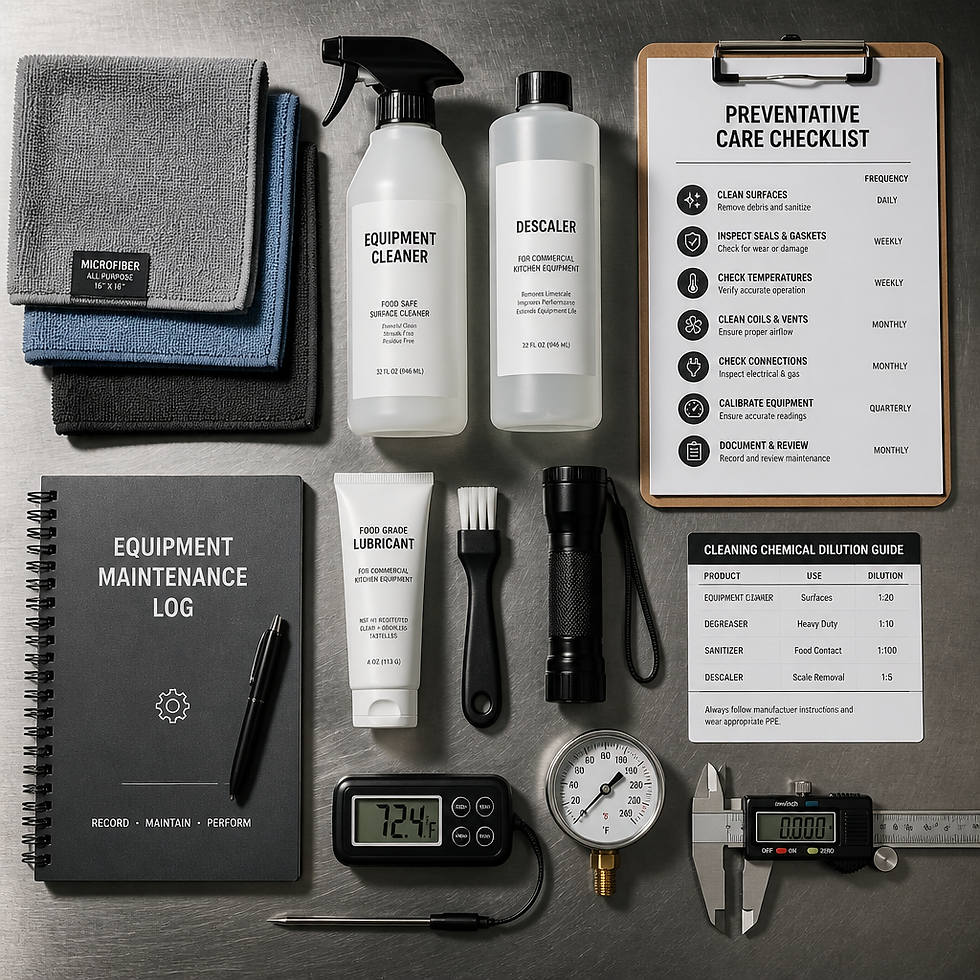
Daily tasks include wiping down cooking surfaces, emptying and cleaning grease traps, clearing visible debris from burner grates, and logging any unusual equipment behavior. Weekly tasks include filter cleaning or replacement, clearing accessible drain lines, and inspecting door gaskets on refrigeration units. These are not detailing tasks. They are the baseline that makes detailing more effective when it does happen.
Quarterly and Annual Professional Service Intervals
Professional equipment detailing should happen at minimum twice per year for most Connecticut commercial kitchens. High-volume operations running multiple shifts should move to quarterly detailing for their most-used equipment. Fryers in busy fry-heavy operations, for example, accumulate carbonized buildup fast enough that a semi-annual service interval is not adequate.
Exhaust hood cleaning intervals under NFPA 96 depend on cooking volume and the type of cooking performed. Monthly cleaning is required for solid-fuel cooking and high-volume operations. Quarterly cleaning applies to most standard commercial operations. Semi-annual intervals apply to low-volume cooking. The Authority Having Jurisdiction in Connecticut can adjust these requirements based on actual inspection findings, so staying ahead of the minimum is always the safer position.
Coordinating Services to Reduce Disruption
Connecticut restaurants rarely have the luxury of extended downtime. The practical solution is to batch services. Schedule equipment detailing and hood cleaning for the same overnight window. If exhaust fan work, belt replacement, or other mechanical service is needed, include it in the same appointment rather than treating each service as a separate interruption.
Pro tip: After any equipment detailing service, run each piece of equipment through a complete cycle before the next service period and note its behavior. A fryer that runs quieter, a range that heats more evenly, or a refrigeration unit that cycles less frequently after detailing confirms the service was effective and gives you a meaningful baseline for the next inspection.
Consistently maintained kitchen equipment also produces measurably better food quality. Ovens that heat true, fryers that maintain accurate oil temperature, and ranges with clean burner combustion all contribute to consistent output from your kitchen. In a Connecticut food service market where customer expectations are high and competition is real, kitchen consistency is not a minor operational detail.
The financial case for professional equipment detailing is straightforward. Equipment that lasts longer does not need to be replaced as often. Equipment that runs efficiently costs less to operate. Equipment that is clean and in good mechanical condition is less likely to fail during service, which means fewer emergency repair calls, fewer lost covers, and fewer situations where your kitchen cannot operate at capacity.
Frequently Asked Questions
What is the difference between restaurant equipment detailing and a standard commercial kitchen deep clean?
A standard deep clean focuses on the kitchen environment, including floors, walls, surfaces, and hoods. Equipment detailing focuses specifically on individual pieces of equipment, cleaning interior cavities, heating elements, burner ports, condenser coils, and mechanical components that a general deep clean does not reach. You need both, but they serve different purposes and should not be confused with each other.
How often should Connecticut restaurants schedule professional equipment detailing?
Most Connecticut commercial kitchens benefit from professional equipment detailing at least twice per year. High-volume operations, particularly those running multiple shifts or heavy fry operations, should move to quarterly detailing for their most-used equipment. The right interval depends on your cooking volume, the types of cuisine you produce, and how aggressively your staff maintains equipment between professional services.
Does equipment detailing count toward NFPA 96 compliance?
No. NFPA 96 compliance specifically governs the exhaust pathway: hoods, ducts, exhaust fans, and grease-removal devices. Equipment detailing addresses the cooking equipment itself, which sits beneath the hood. Both are necessary for a safe and compliant kitchen, but they are separate requirements. Your hood cleaning must be performed by a qualified contractor and documented. Equipment detailing is a maintenance best practice that supports overall kitchen safety but is tracked separately.
What equipment should be prioritized if a Connecticut restaurant is working with a limited maintenance budget?
Prioritize in this order: fryers first, because carbonized buildup creates both fire risk and energy waste; refrigeration condensers second, because coil fouling raises operating costs and accelerates compressor failure silently; ranges and ovens third, because burner port issues affect food quality and can cause gas combustion problems. Do not skip refrigeration simply because it is not a fire risk. The cost of a compressor replacement or a walk-in cooler failure during summer service in Connecticut will exceed the cost of several years of maintenance.
Can restaurant equipment detailing help pass a Connecticut health department inspection?
Yes, directly. Health inspectors document equipment condition, evidence of grease accumulation on cooking surfaces and in interior cavities, and pest harborage risk created by food debris buildup. Equipment that has been professionally detailed presents clean surfaces, clear interior cavities, and no evidence of carbonized buildup or pest activity. Detailing also reduces the likelihood of mechanical failures during inspection periods, which can themselves generate corrective action requirements.
Does Superior Clean service equipment detailing alongside hood cleaning for Connecticut restaurants?
Yes. Superior Clean provides restaurant equipment detailing as part of its Connecticut commercial kitchen service offering, alongside NFPA 96 compliant hood cleaning, exhaust fan maintenance, fan belt replacement, motor swaps, hinge kit installations, and grease trap cleaning. Coordinating these services through a single provider reduces scheduling complexity and ensures the equipment-level and exhaust-level work are approached as a connected system rather than isolated tasks.
If you operate a commercial kitchen in Connecticut, we would like to hear what maintenance challenges you are navigating. Share your experience in the comments or reach out directly so we can give you a straight answer about what your kitchen actually needs.
We would love your feedback and any insights you would share with others. What perspective would you add?


Comments