


True Cost of Skipping Hood Cleaning in CT
- 4 hours ago
- 11 min read
Most Connecticut restaurant owners think skipping a hood cleaning cycle saves money. It does not. The cost of skipping hood cleaning compounds fast, moving from a deferred maintenance bill into fire damage claims, failed health inspections, and forced shutdowns that can permanently close a business. The National Fire Protection Association reports that cooking equipment is the leading cause of structure fires in restaurants, and grease buildup in exhaust systems is a primary accelerant. If you operate a commercial kitchen in Connecticut, this is not a theoretical risk. It is a documented, measurable financial threat.
Table of Contents
Quick Takeaways
Key Insight
Explanation
A single grease fire can cost $50,000 or more
Property damage, lost inventory, temporary closure, and emergency repairs stack up quickly. This figure often excludes lost revenue during downtime.
Insurance claims get denied without cleaning records
Many commercial property insurers require proof of NFPA 96 compliant hood cleaning. No documentation means no payout after a fire.
Connecticut health inspectors check hood condition
A visibly greasy hood and exhaust system can trigger a failed inspection, a corrective action order, or an immediate closure notice.
Grease reduces exhaust fan efficiency significantly
A motor forced to run against grease-clogged resistance draws more electricity, overheats faster, and fails years before its rated lifespan.
NFPA 96 sets the cleaning schedule, not your preference
High-volume kitchens require quarterly cleaning. Skipping one cycle puts you out of compliance and voids the fire suppression system's operational warranty.
Deferred cleaning multiplies labor costs
Hardened, carbonized grease takes significantly longer to clean than fresh accumulation. The longer you wait, the more you pay per cleaning visit.
Competitors in CT who stay compliant win insurance and lease renewals
Property owners and commercial insurers increasingly require documented cleaning schedules before renewing leases or policies in Connecticut.
The Real Numbers Behind Kitchen Grease Fires
The U.S. Fire Administration estimates that restaurant fires cause approximately $172 million in property losses annually across the country. Grease-related fires in commercial exhaust systems account for a disproportionate share of that figure because they ignite inside ductwork where standard fire suppression systems cannot reach. By the time the fire exits the duct and becomes visible, it has already traveled behind walls and above ceilings.
In Connecticut specifically, the State Fire Marshal's office investigates commercial kitchen fires every year that trace directly back to unmaintained exhaust systems. The kitchen grease fire cost in these cases rarely stays below five figures. A modest single-location restaurant can face $30,000 to $80,000 in combined costs when you add structural repairs, equipment replacement, lost revenue during closure, and legal exposure if staff or neighboring businesses are affected.
The part that stings most is that these fires are entirely preventable. Grease does not ignite spontaneously. It accumulates over weeks and months, and then it becomes fuel when the exhaust system runs hot enough. A professional cleaning cycle removes that fuel before it reaches critical accumulation levels.


What Restaurant Owners Consistently Underestimate
A common mistake is calculating only the cost of the cleaning service and comparing it against the fire risk as if fire were a remote possibility. The math changes when you factor in business interruption. A restaurant closed for two to four weeks for fire remediation loses not just revenue but regular customers who form new habits at competing establishments. Some of those customers never return.
The data consistently shows that food service businesses that experience a fire-related closure have a higher permanent closure rate within 12 months compared to the industry baseline. The fire itself is survivable. The compounding losses afterward are frequently not.
Pro tip: Keep every hood cleaning invoice and service report in a physical binder on site. Connecticut fire inspectors and insurance adjusters both ask for this documentation, and a gap in the record is treated the same as a gap in the cleaning itself.
What NFPA 96 Compliance Means for Connecticut Kitchens
NFPA 96 is the Standard for Ventilation Control and Fire Protection of Commercial Cooking Operations. Connecticut has adopted it as the governing standard for all commercial kitchen exhaust systems. It is not a suggestion. Local fire marshals in Bridgeport, Hartford, New Haven, Stamford, and throughout the state use it as the basis for inspection citations and violation notices.
The standard sets cleaning frequencies based on cooking volume and fuel type. High-volume operations using solid fuels like wood or charcoal require monthly cleaning. Systems in high-volume operations using gas or electric equipment require quarterly cleaning. Moderate-volume operations typically require semi-annual cleaning, and low-volume operations require annual cleaning. Most full-service restaurants in Connecticut fall into the quarterly or semi-annual category and do not realize it.
The Compliance Documentation Requirement
NFPA 96 requires that a service report be provided to the owner after each cleaning. That report must document the areas cleaned, the condition found, and any deficiencies that prevented a complete cleaning. A responsible service provider, like Superior Clean, issues these reports as a standard part of every job. A provider that does not issue written documentation is not actually providing NFPA 96 compliant service, regardless of what they say on a phone call.
When a Connecticut fire marshal conducts an inspection and asks for cleaning records, presenting reports that match the required frequency is the difference between passing and receiving a corrective action order. Corrective action orders in Connecticut can include mandatory reinspection fees, mandatory correction timelines, and in some cases, conditional operating permits that require proof of compliance before you can legally remain open.
"Cooking equipment fires in eating and drinking establishments cause an average of 75 injuries and $165 million in direct property damage per year. The leading contributing factor is failure to clean." - National Fire Protection Association, Home Fires Involving Cooking Equipment
What Happens When You Fail a Fire Marshal Inspection
In practice, a failed fire marshal inspection in Connecticut for a non-compliant exhaust system does not always result in an immediate shutdown. More often, you receive a notice of violation with a correction deadline, typically 30 days. But that notice becomes part of your business record. Repeat violations or violations that present an imminent hazard can result in same-day operational restrictions. No Connecticut restaurant owner wants to explain to a dining room full of guests why the kitchen just shut down.
How Grease Buildup Destroys Equipment and Raises Operating Costs
Grease does not just create fire risk. It physically degrades every component it contacts in an exhaust system. The fan motor works harder when the fan blades are coated in grease because the aerodynamic efficiency drops and the motor draws more amperage to maintain airflow. Over time, this causes premature motor failure.
Fan belts on belt-driven exhaust fans wear faster under increased load. A belt that should last two years in a clean system may fail in under a year in a grease-compromised system. The cost of an emergency belt replacement and the labor to access a rooftop exhaust unit is significantly higher than a scheduled replacement during a routine cleaning visit.
The Energy Cost Nobody Calculates
A grease-coated exhaust fan running at reduced efficiency draws measurably more electricity. For a restaurant running exhaust systems 10 to 14 hours per day, that efficiency loss translates into real money on the monthly utility bill. The figure varies by system size, but an inefficient exhaust motor in continuous operation can add $50 to $150 per month in unnecessary electricity costs. Across a year, that is more than the cost of a professional cleaning service.
Pro tip: When Superior Clean performs an exhaust fan service, ask for a written note on the service report if the fan blades show grease accumulation that is affecting airflow. That documentation is useful when budgeting for a motor swap or fan belt replacement before it becomes an emergency repair.

Filters, Ducts, and the Hidden Accumulation Points
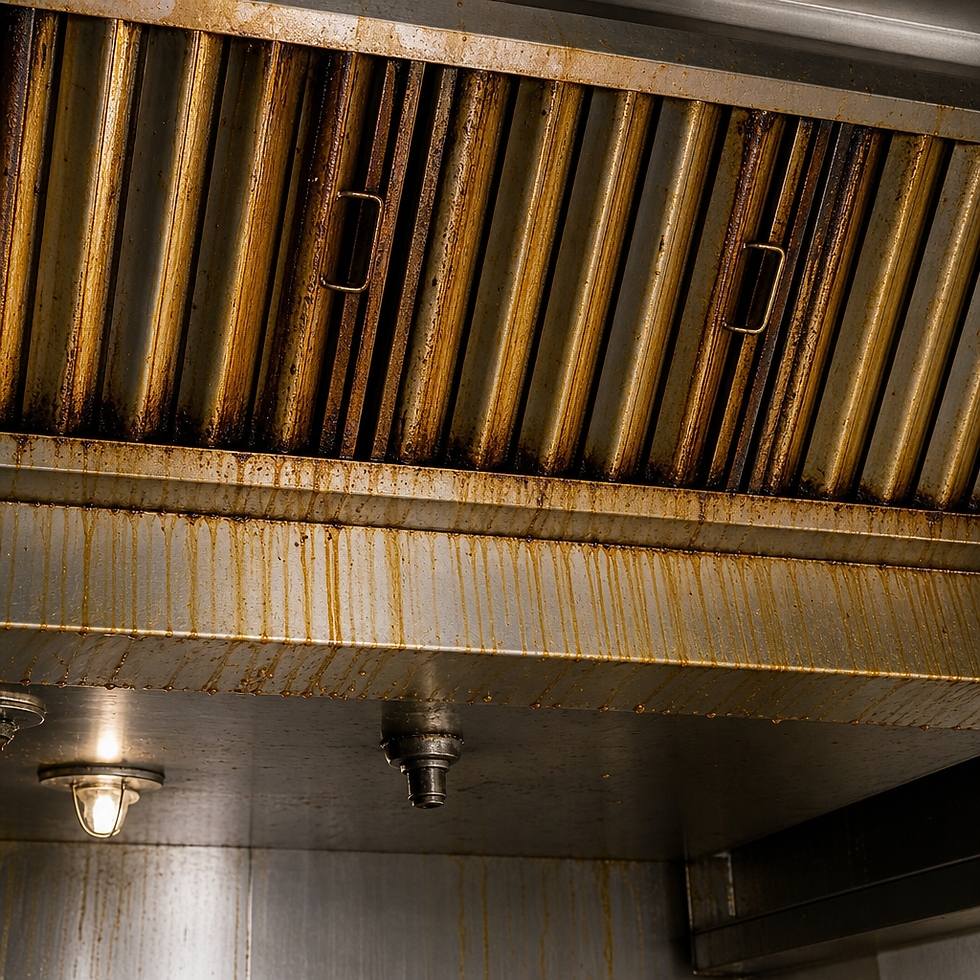
Grease filters in the hood canopy are the first line of defense. When they are not cleaned or replaced regularly, they saturate and lose their ability to trap grease vapor. That vapor then moves deeper into the duct system, coating interior duct walls and accumulating around the exhaust fan housing. Cleaning the hood face without cleaning the full duct run to the rooftop is partial service at best and a compliance violation at worst.
NFPA 96 requires that the entire exhaust system be cleaned, including all interior duct surfaces, the fan, and the grease collection components. Services that clean only the visible hood and skip the duct interior leave the most dangerous accumulation points untouched. This is a key differentiator when evaluating any commercial kitchen hood cleaning provider in Connecticut.
The Insurance Trap Most Owners Do Not See Coming
Commercial property and liability insurance policies for restaurants almost universally contain a maintenance clause. That clause requires the policyholder to maintain the property in a condition that does not increase the risk of fire. A grease-packed exhaust system that has not been cleaned on the NFPA 96 schedule is textbook evidence of an increased fire risk.
When a restaurant fire occurs and the insurer sends an investigator, the first thing that investigator looks for is cleaning records. If those records show the last cleaning was 18 months ago on a system that should have been cleaned quarterly, the insurer has grounds to deny the claim partially or entirely under the maintenance clause. This happens. It is not a theoretical worst case.
The Denial Is Not Always Total
Insurance adjusters sometimes negotiate rather than issue outright denials. The result is a dramatically reduced payout. An owner who expected $60,000 in fire damage coverage might receive $20,000 because the adjuster attributed a portion of the loss to the owner's failure to maintain the exhaust system. That gap comes entirely out of the owner's pocket.
The irony is that the annual cost of professional hood cleaning at the required frequency for most Connecticut restaurants runs between $1,200 and $4,000 depending on system size and volume. That figure is a fraction of a single denied or reduced insurance claim. The commercial kitchen compliance CT requirement is not paperwork overhead. It is active financial protection.
Health Department Inspections and the Compliance Cost Comparison
Connecticut's municipal health departments inspect commercial kitchens on regular cycles, and hood condition is a visible indicator of overall sanitation standards. A hood with visible grease dripping or heavy accumulation signals to an inspector that kitchen cleanliness standards may be inconsistent throughout the facility. That perception can color the entire inspection, not just the hood score.
Health code violations in Connecticut carry fines that range from warnings and corrective action deadlines to fines of $100 to $500 per violation per day for serious or repeat infractions. A single inspection that results in three separate hood and ventilation citations can generate a fine obligation that exceeds a full year's cleaning budget.
The Reputation Cost That Does Not Show Up in Accounting
Connecticut requires that health inspection reports be publicly available, and aggregator sites post these records where potential customers search for restaurant reviews. A failed inspection is not private. Customers who see a recent health code violation related to kitchen sanitation will choose a competitor. That revenue loss does not appear on any single invoice, but it is a real cost of skipping maintenance.
In practice, restaurants that maintain documented cleaning schedules and present clean hood systems during health inspections move through those inspections faster and with fewer follow-up questions. The inspector has one less area to focus on, which reduces the total time and scrutiny of the visit.
Cleaning Frequency Comparison
Not all commercial kitchens have the same cleaning requirements, and not all service approaches deliver the same protection. Understanding the difference between compliant and non-compliant service approaches helps Connecticut restaurant owners make informed decisions rather than simply choosing the lowest bid.
Service Approach
What Is Included
NFPA 96 Compliant
Full system cleaning with documentation (Superior Clean standard)
Hood canopy, filters, all interior duct surfaces, exhaust fan blades, grease collection drip pans, rooftop fan housing, written service report issued to owner
Yes. Meets NFPA 96 requirements for cleaning scope and documentation, supports insurance and fire marshal compliance.
Partial hood-only cleaning (common low-bid approach)
Visible hood face, filters, and sometimes the first few feet of the duct collar. Fan and duct interior are skipped or minimally addressed.
No. Leaves primary grease accumulation points in the duct and fan untouched. Does not satisfy NFPA 96 scope requirements.
Self-cleaning by kitchen staff
Filter washing, visible hood wipe-down, occasional degreaser spray. Staff generally cannot access duct interior or rooftop fan safely or effectively.
No. Does not constitute a professional cleaning under NFPA 96. Does not produce the required service documentation.
The comparison above is not about brand preference. It is about what the standard actually requires. A low-bid provider that cleans only the visible hood face is not providing a service equivalent to a full-system cleaning. Connecticut restaurant owners who choose the cheaper option are not saving money. They are purchasing non-compliance at a discount.
Frequently Asked Questions
How often does a Connecticut restaurant legally need to have its hood system cleaned?
NFPA 96, which Connecticut has adopted, sets the frequency based on cooking volume and fuel type. High-volume operations with solid-fuel cooking equipment require monthly cleaning. High-volume gas or electric operations require quarterly cleaning. Moderate-volume operations typically require semi-annual cleaning, and low-volume operations require annual cleaning. Most full-service restaurants in Connecticut fall into the quarterly category and are often unaware of it.
What happens if my restaurant has a grease fire and I do not have cleaning records?
Without documented cleaning records showing NFPA 96 compliant service intervals, your commercial property insurer has grounds to deny your claim or significantly reduce the payout under a maintenance failure clause. Connecticut fire investigators and insurance adjusters routinely request cleaning documentation after any kitchen fire. The absence of records is treated as evidence of non-compliance, regardless of whether the cleaning actually occurred.
Can a Connecticut fire marshal shut down my restaurant over hood cleaning violations?
Yes, in cases where the violation presents an imminent fire hazard. More commonly, a fire marshal inspection that identifies an out-of-compliance exhaust system results in a notice of violation with a mandatory correction deadline. Repeat violations or systems with severe grease accumulation can trigger immediate operational restrictions. Continued operation after an unresolved violation notice carries additional legal exposure.
Is the cost of professional hood cleaning tax-deductible for Connecticut restaurants?
Professional hood cleaning is a standard operating maintenance expense for a commercial food service business and is generally deductible as an ordinary and necessary business expense under IRS guidelines. Connecticut does not impose additional restrictions on this category. Consult your accountant for specifics related to your business structure, but the expense is routinely deducted by restaurant operators.
How do I verify that a hood cleaning company is providing NFPA 96 compliant service?
Ask for a sample service report before hiring any provider. An NFPA 96 compliant service report documents the areas cleaned, the access points used, the condition of the system before and after cleaning, and any deficiencies that prevented complete cleaning. The report must be signed by the technician and issued to the owner. If a provider cannot produce a sample report or tells you they provide verbal confirmation only, they are not operating to the standard. Superior Clean provides written service documentation on every job as a non-negotiable part of the service.
Does grease trap cleaning connect to hood cleaning compliance in Connecticut?
Grease trap cleaning and hood exhaust cleaning are separate requirements regulated by different authorities. Hood cleaning is governed by fire codes under NFPA 96 and enforced by fire marshals. Grease trap maintenance is governed by local sewer authority regulations and enforced by municipal utilities or the Connecticut Department of Energy and Environmental Protection. However, both represent documented maintenance obligations, and both carry financial and legal consequences if neglected. Many Connecticut kitchen operators who schedule regular hood cleaning with Superior Clean add grease trap service to the same visit to consolidate compliance documentation.
What is the actual price difference between compliant cleaning and the cheapest available option in Connecticut?
The gap between a full-system NFPA 96 compliant cleaning and a partial hood-only service from a low-bid provider can range from $100 to $400 per visit depending on system size. Over a year of quarterly cleanings, that difference is roughly $400 to $1,600. Compared to the potential cost of a denied insurance claim, a fire damage remediation, or health department fines, the cost of choosing the compliant provider is statistically negligible. The restaurant owners who focus exclusively on the per-visit price are solving the wrong problem.
Have you encountered a surprise cost from deferred hood maintenance that your budgeting process completely missed? Share what happened in a comment or reach out directly. Real experiences from Connecticut operators help others make smarter decisions about their maintenance schedules.


Comments