


Black Friday Kitchen Exhaust Risks for CT Restaurants
Black Friday is five days away, and for most Connecticut restaurants the real stress starts Wednesday night, not Friday morning. Thanksgiving week means turkey roasting, stuffing, pie baking, and holiday catering pushing hoods and fans well past a normal Tuesday. Then the kitchen goes quiet on Thursday and fires back up on Friday with grease that has been baking onto the same surfaces for days. The day after Thanksgiving is one of the hardest days of the year for a commercial exhaust system, and it is one of the easiest to plan for.
Table of Contents
Quick Takeaways
Key Insight | Explanation |
|---|---|
Thanksgiving prep loads the hood before Black Friday starts | Wednesday and Thursday roasting, braising, and baking put heavy grease into the hood and duct, so Friday starts with a system that is already behind. |
A closed day does not stop grease from setting | Grease cools and hardens on filters, baffles, and duct walls during a shutdown. It becomes harder to remove and easier to ignite once the fans and burners restart. |
Holiday volume can push you into a tighter cleaning schedule | NFPA 96 frequency depends on cooking volume. A kitchen that runs at high volume for two weeks should plan its cleaning around that load, not around its normal calendar. |
Schedule the clean one to two weeks before Thanksgiving | A cleaning booked for the Monday after the holiday leaves you running Black Friday on a dirty system. Book the window before the prep week starts. |
Watch fan motors, belts, and filters during Friday service | Extra hours and heavier loads show up first as motor heat, belt squeal, and filters that clog faster than usual. These are early warnings, not nuisances. |
Keep documentation for your fire marshal and insurer | A dated service report and a clear cleaning schedule make inspections and claims far easier if a holiday fire or near miss ever happens. |
Black Friday Restaurant Kitchen Demand in Connecticut
Retail Black Friday gets the headlines, but a restaurant kitchen feels the day differently. Depending on your concept, the Friday after Thanksgiving can bring a mix of families eating in after shopping trips, takeout pickups for leftovers and side dishes, and catering orders for weekend gatherings. In practice, the line does not get a day off between Wednesday prep and Friday service.

The volume is only part of the problem. Holiday menus usually mean more long-running equipment: ovens holding roasts for hours, steam kettles for gravy and stock, fryers for appetizers, and ranges running longer than normal for early holiday brunch crowds. Every one of those appliances sends grease-laden vapor into the same hood and duct.
The result is a system that works harder for a longer stretch of days than it was designed to handle on an ordinary week. Many managers assume the Friday rush is the peak. From where we stand, the peak is often the Wednesday before, when prep runs all day and the hood never fully cools. Friday then inherits whatever the week left behind.
Connecticut restaurants also face a practical timing problem. Many kitchens close on Thursday, and some close through the weekend. That gap feels like a natural cleaning window, but it is often the worst time to find out that your filters are saturated or that a duct section is coated. A closure gives you time to clean, but only if you actually book the service before the closure begins.
What Thanksgiving Week Does to Grease Buildup
Grease buildup is not a single event. It is a slow layering process that depends on what you cook, how long you cook it, and how much air moves through the hood. Thanksgiving week compresses that process into a few days, which is why the damage shows up faster than it does in a normal month.
A kitchen exhaust system does not know what day it is. It only knows how much grease reaches it, and holiday week sends more grease through it in fewer days.
Roasting and braising at volume
Roasting turkeys, hams, and large cuts of beef puts out a heavy, sticky vapor, especially when the drippings caramelize in the pan. Braising for gravy, stuffing, and sauces does the same over long hours. The vapor is less visible than smoke, so it can slip past a quick visual check and coat the baffles and the first few feet of duct.
A common mistake is judging the hood by how it looks from the line. The grease that matters is on the top side of the filters, behind the baffles, and inside the duct where you cannot see it from the cooking floor. A hood can look fine while the duct behind it is carrying a dangerous layer.
Fryer oil and the spike in airborne grease
Fryers are often the biggest grease producers in a kitchen, and holiday appetizers can keep them running all day. Frequent oil turnover and high temperatures push more particulate into the air, and that particulate settles on filters and duct surfaces within hours. Kitchens that fry a lot during the holiday week should expect faster filter loading than their normal schedule suggests.
Pro tip: Log how many hours each fryer and oven runs during holiday prep. Those hours give you a reliable estimate of how quickly your filters and hood will load, which is far more useful than guessing from the calendar.
Closed days do not stop grease from setting
When a kitchen shuts down for Thursday, the cooking stops, but the grease does not disappear. It cools, thickens, and bonds to metal. By the time the fans restart on Friday, the buildup is harder to remove and more likely to hold heat. Shutting the equipment off is not the same as cleaning the system.
This is why a closed day should never be treated as a maintenance window by default. If the closure is the only time you can reach the hood, schedule the clean for the closure itself, before the grease has a chance to set through the holiday.
NFPA 96 Holiday Cleaning Schedules
NFPA 96 is the standard most fire marshals and inspectors use to judge commercial cooking ventilation. A useful summary from RAEL's compliance guide lists the cleaning frequency tiers by cooking volume: monthly for high-volume operations, quarterly for moderate volume, and semi-annually for low volume. Those tiers are the starting point, not a ceiling, because the real question is how much grease your system actually collects.
Matching your cleaning category to holiday volume
Most restaurants plan their cleaning around their normal volume, then forget that Thanksgiving week may move them into a heavier category for a short period. If your kitchen is normally moderate, a holiday that pushes it into near-constant high-volume cooking should trigger an earlier clean. Your local authority having jurisdiction, or AHJ, is the final word on how that applies to your building, so ask before the holiday rather than after an inspection.
In practice, the operators who handle this well write down their normal cleaning category, note the weeks when their cooking volume changes, and book the extra service in advance. The operators who struggle usually discover the gap during a surprise inspection in December.
Why the exhaust fan cannot be treated as optional
The Aerovent reproduction of NFPA 96 states that exhaust systems must be operated whenever cooking equipment is turned on. That point matters during the holiday because some managers try to save energy by running equipment at odd hours or shutting fans down between peaks. Running the cooking line without the exhaust is one of the fastest ways to put grease into the room instead of the duct.
Keep the fan logic simple. If the cooking equipment is on, the exhaust should be on, and the filters and hood should be inspected on a schedule that matches the actual load.
Documentation your fire marshal will ask for
A service report with dates, the areas cleaned, and any deficiencies found is one of the most useful documents you can keep during a holiday season. It shows that you knew the system was due, that you acted on it, and that the work was done to code. Inspectors and insurers respond much better to a clear paper trail than to a verbal explanation.
Keep copies of your service reports in a folder the manager on duty can reach. If a fire or near miss happens on a holiday weekend, the first questions are almost always about when the system was last cleaned and who did it.
Fire Risk When Exhaust Systems Run Hard
A kitchen fire rarely starts with a dramatic failure. It usually starts with a clogged filter, a blocked suppression nozzle, or a fan that is working harder than it should. The holiday push makes all three more likely at the same time, and that combination is what turns a manageable problem into a serious one.

The fire risk is not only about flames. Grease in the duct can carry heat through the building, and a fire that starts in the exhaust can travel well beyond the cooking line. That is why the cleaning schedule matters even on days when nothing looks wrong.
Fan motors, belts, and bearings under extra load
Holiday weeks extend the hours your exhaust fan runs, and the motor and belt carry that extra time. Grease on the fan blades also adds weight and drag, which pushes the motor harder. A fan that was fine in October can start to overheat or slip in late November if it has not been cleaned and checked.
A common mistake is treating belt noise as a minor issue. A squeal or a sudden change in airflow often means the belt is worn or the bearings are going, and a fan that fails during Friday service leaves the line without ventilation right when it is busiest.
Blocked filters and suppression nozzles
RAEL's compliance guide makes the key point clearly: excessive grease can block grease removal devices and suppression nozzles, and a blocked nozzle can delay or prevent activation. That is the scenario that keeps fire marshals up at night. The suppression system is supposed to be the backstop, and grease buildup can quietly disable it.
Filters are the first place to look during the holiday week. If you are changing or cleaning them more often than usual, the hood above them is probably loading faster than your schedule assumed.
Warning signs to act on during service
The warning signs are usually simple. Smoke or grease vapor escaping the hood, a sudden drop in airflow, a fan that sounds different, filters that look saturated after a short shift, and a burning smell that lingers after service all need attention. Do not wait until the end of the holiday weekend to call for help.
When any of these show up during peak service, reduce load if you can, shut down the equipment that is producing the most grease, and call your service provider. Waiting to see if the problem goes away is how small problems become insurance claims.
Holiday Cleaning Approaches Compared
Most restaurants choose one of three approaches to holiday exhaust maintenance, and each has a different level of protection. The table below compares them based on what they cover and where they leave you exposed during the busiest days of the year.
Approach | What It Covers | Where It Falls Short |
|---|---|---|
Pre-holiday deep clean, booked one to two weeks before Thanksgiving | Hood, fans, filters, and accessible duct sections are cleaned before the prep week loads them. Problems are found while there is still time to repair them. | Requires planning and a booking before the holiday schedule fills. Grease will still accumulate during the holiday, so filter checks are needed during service. |
Post-holiday clean scheduled for the Monday after Thanksgiving | Removes the full holiday buildup before the next normal week begins, and gives a complete service record for the period. | Black Friday and the weekend run on a system that was never cleaned for the holiday load. This leaves the highest-risk days unprotected. |
Reactive cleaning only when a warning sign appears | Costs nothing until something goes wrong, and can be useful for kitchens with very low holiday volume. | Problems are found during service, often at the worst time. There is no documentation trail, and a missed buildup can disable suppression without anyone noticing. |
For most Connecticut restaurants with a busy holiday week, the pre-holiday deep clean is the only option that covers the full period. The post-holiday clean is useful for the record, but it cannot protect the Friday rush. Reactive cleaning is a fallback, not a plan.
Pre-Holiday Exhaust Checklist
A checklist will not replace a professional cleaning, but it does help managers catch problems before the holiday rush starts. Use it during the week before Thanksgiving, and again on Wednesday evening after prep ends. The goal is to find the obvious issues while there is still time to fix them.

Filters and grease cups
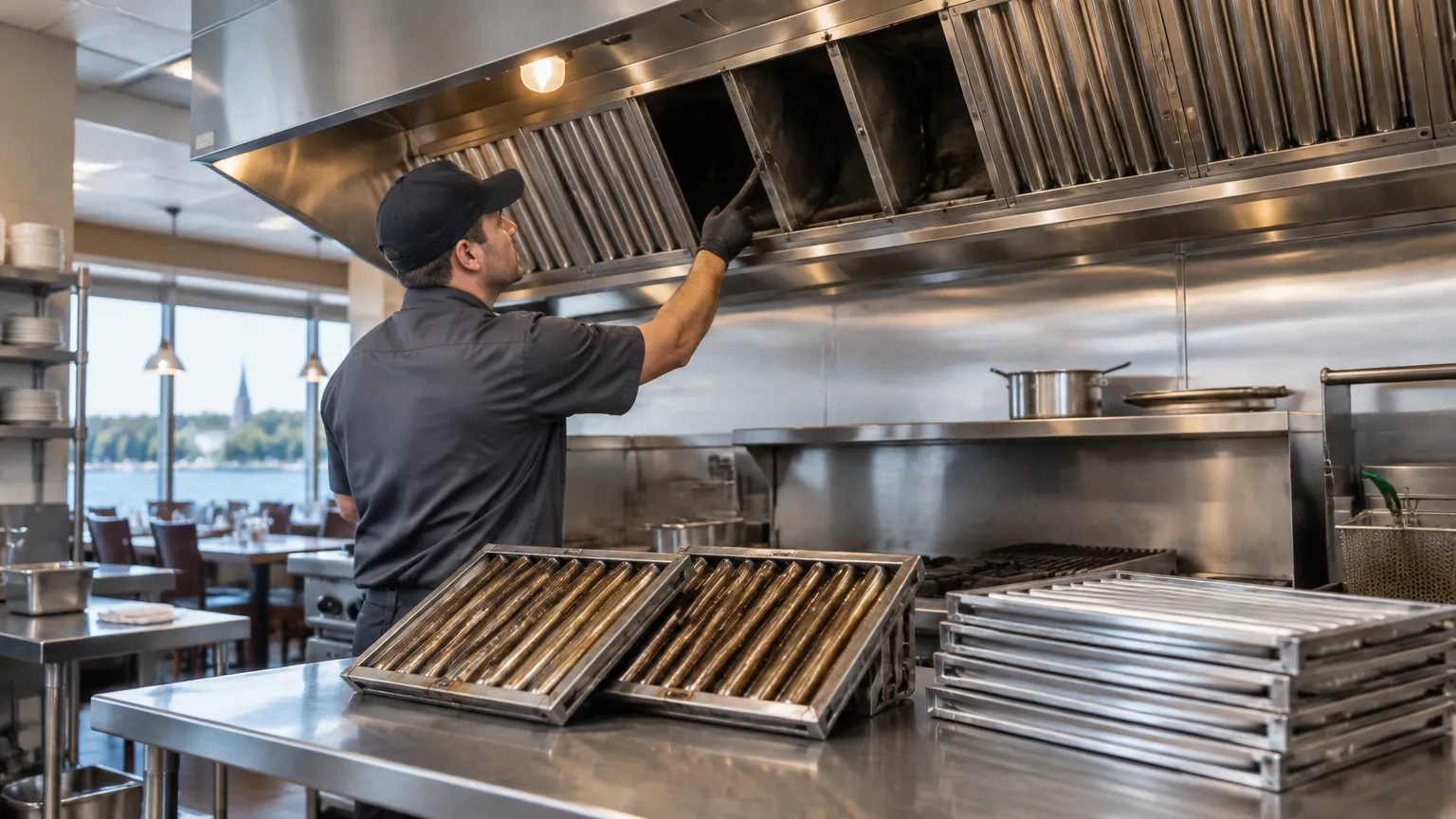
Pull the filters and look at the top surfaces, the edges, and the frames. Check grease cups and collection trays for overflow, and make sure they are seated correctly. If the filters are already dark and heavy before the holiday week begins, schedule the cleaning now rather than planning to push it through.
Replace or clean filters on a shorter interval during the holiday week. Keep a spare set on hand so you are not forced to run a saturated filter through a 14-hour Friday.
Fan and motor checks
Listen to the fan during a normal service period and note the sound. Check the belt for cracks, glazing, and tension. Feel the motor housing carefully after a few hours of operation, and look for grease on the motor itself, which often means the seals or ventilation are compromised.
Pro tip: Keep a short log of fan sound, belt condition, and motor temperature each week. A slow change over three weeks is far easier to catch in a log than in memory, and it gives your service technician a clear history to work from.
Who to call and when
Know your service provider's contact information before the holiday week begins, and confirm that someone can respond on short notice if a fan, belt, or motor fails. A holiday weekend is the wrong time to search for a contractor. Build the relationship before you need it.
What Superior Clean Covers Before the Holiday Rush
Superior Clean works with Connecticut food service establishments on commercial kitchen hood cleaning and exhaust system maintenance, with a focus on fire hazard prevention and equipment performance. The timing advice in this article is the same advice we give restaurant managers who call us in November: book early, clean before the prep week, and keep a record of the work.
NFPA 96 hood, fan, filter, and duct cleaning
Our NFPA 96 compliant cleaning removes grease buildup from hoods, fans, filters, and ducts. For holiday planning, the value is in cleaning the system before the prep week loads it, not after the closure has already given grease time to set. You can review our services and schedule a visit through Superior Clean.
Fan repair, motor swaps, and belt replacement
Exhaust fan repair, fan belt replacement, and motor swaps are the services that matter most when a holiday push reveals a weak point. A belt that squeals on a Wednesday is far easier to replace before Friday than during a service rush. We also handle hinge kit installations for hoods and access panels that need to open cleanly for inspection and cleaning.
Grease trap cleaning and equipment detailing
Grease traps fill quickly during holiday prep, and an overflowing trap adds to the mess in the kitchen and the load on your drains. Restaurant equipment detailing keeps surfaces around the hood and cooking line in better shape during peak weeks. Both services support the same goal: a kitchen that runs clean, safe, and predictable through the busiest days of the year.
Frequently Asked Questions
How far ahead of Thanksgiving should a restaurant book its exhaust cleaning?
Book the cleaning one to two weeks before the holiday prep begins. That timing lets the crew clean the system before the heavy loading starts, and it leaves time to repair anything found during the visit. Waiting until the week of Thanksgiving leaves little room for parts or rescheduling.
Does closing on Thursday mean the hood can be cleaned then?
A closure can be a good window, but only if the cleaning is booked for it in advance. Simply shutting the equipment off does not clean the system, and grease that cools overnight becomes harder to remove. If your closure is the only available time, plan the service for that day specifically.
Does holiday volume change how often NFPA 96 requires cleaning?
NFPA 96 frequency depends on the type and volume of cooking, so a kitchen that moves into near-constant high-volume cooking for a holiday period should reassess its schedule. The final interpretation belongs to your local authority having jurisdiction, so confirm the requirements with them before the holiday season begins.
What is the most common cause of trouble on the day after Thanksgiving?
In practice, the most common problem is a combination of saturated filters and a fan that has been running for many extra hours. Each one alone is manageable, but together they can overload the system and leave the line without reliable ventilation during the busiest service of the year.
Should I run the exhaust fan less during the holiday to save energy?
No. The exhaust should run whenever the cooking equipment is on, because grease that is not captured at the hood ends up on room surfaces and inside the duct. Energy savings are not worth the fire risk, and the fan should be checked, not switched off, if its operation seems off.
What holiday week problems have your kitchen or your inspector run into in past years? We would like to hear how your team handled the Friday push, so share your experience in the comments.
References
Guide to restaurant hood cleaning compliance and cleaning frequency by cooking volume
NFPA 96 standard text on ventilation control and fire protection for commercial cooking


Comments