


Fire Suppression System & Hood Cleaning Coordination Guide
- Jun 15
- 12 min read
Most restaurant fires do not start from a forgotten burner. They start inside an exhaust duct coated in grease that nobody thought to clean before the annual fire suppression system inspection. According to the National Fire Protection Association, cooking equipment is the leading cause of structure fires in eating and drinking establishments, accounting for roughly 61% of all such incidents. Yet the coordination between fire suppression system service and hood cleaning is poorly understood by most Connecticut restaurant operators. This guide breaks down exactly how these two systems interact, what goes wrong when they are treated separately, and how Superior Clean approaches them as a single integrated safety process.
Table of Contents
Quick Takeaways
Key Insight
Explanation
Hood cleaning must precede suppression system inspection
Inspectors assess nozzle placement and coverage. Grease-clogged nozzles or repositioned components found during inspection will trigger a failed report and require re-inspection fees.
NFPA 96 sets the legal minimum, not the safety optimum
High-volume fryer operations in Connecticut can accumulate dangerous grease levels in 30 days. NFPA 96 quarterly intervals are a floor, not a ceiling.
Grease on suppression nozzles compromises activation
Hardened grease can block or redirect the wet chemical agent discharge path, meaning the system may not extinguish a fire effectively even when it activates.
Service records are a liability shield
Insurance carriers and Connecticut fire marshals can deny claims or close facilities if cleaning logs and suppression inspection certificates cannot be produced on demand.
Fan belt condition affects suppression timing
A worn or broken fan belt reduces exhaust airflow, causing heat and grease vapor to linger near suppression fusible links, potentially triggering a false or premature discharge.
Post-cleaning is the right time to reset suppression components
Cleaning crews have the hood fully exposed. Having the suppression service technician present at this stage avoids a second access appointment and reduces total downtime.
Grease trap cycles must align with hood cleaning frequency
A kitchen producing enough grease to need monthly hood cleaning is also producing enough to overflow grease traps on a longer service interval. Both cycles should be reviewed together.
How Fire Suppression and Hood Cleaning Interact
A commercial kitchen fire suppression system is designed to discharge wet chemical agent directly onto cooking surfaces and into the hood plenum when a fusible link or heat detector reaches its activation threshold. The critical assumption built into that design is that the hood, duct, and fan are clean. When grease has accumulated on the plenum walls, filters, and duct interior, the system's designed discharge pattern may be partially blocked, and the fuel load feeding any fire is substantially higher than the system was rated to handle.
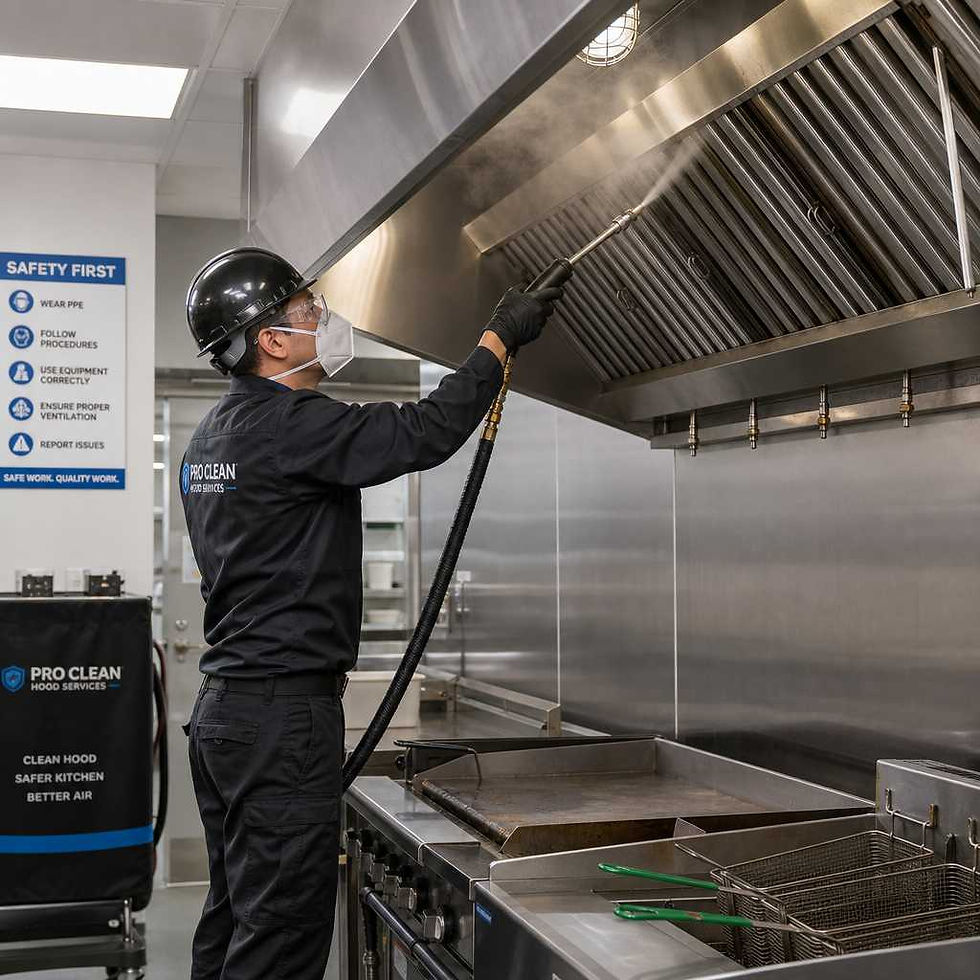
In practice, the two systems are physically connected. Suppression nozzles are mounted inside the hood canopy, positioned to cover specific cooking appliances below. During a professional hood cleaning service, the entire interior of the canopy, the plenum, and the duct run are pressure washed and scraped. That process inevitably contacts the nozzles, the detection line, and the fusible links. This is not a problem when the hood cleaning technician and the suppression service provider are coordinating. It becomes a serious problem when they are not.
A common mistake is assuming hood cleaning and suppression inspection are entirely separate events. Restaurants that schedule them independently often find that cleaning crews inadvertently disturb nozzle alignment or that suppression inspectors flag grease accumulation as a code violation after the cleaning window has already closed for that service cycle.

">
Why Nozzle Placement Changes After Cleaning
Suppression system nozzles are calibrated to cover specific appliances based on UL 300 listings. When a technician pressure washes a hood plenum and a nozzle is bumped even slightly, the coverage zone shifts. The suppression inspector who arrives two weeks later may find that the fryer below is no longer adequately covered, triggering a mandatory repositioning and a re-inspection. That costs time and money that is entirely avoidable with proper coordination.
Superior Clean technicians are trained to work around suppression components during cleaning and to flag any contact with nozzles or detection lines in the service report. This documentation becomes part of the coordination handoff to the suppression contractor.
NFPA 96 Requirements You Must Know
NFPA 96, the Standard for Ventilation Control and Fire Protection of Commercial Cooking Operations, is the governing document for both hood cleaning frequency and fire suppression system maintenance in Connecticut commercial kitchens. Connecticut State Fire Safety Code adopts NFPA 96 by reference, meaning compliance is not optional. It is legally required for any food service establishment operating under a Connecticut health permit.
The standard specifies hood cleaning intervals based on cooking volume and fuel type. High-volume solid fuel operations require monthly cleaning. High-volume charbroiling or wok cooking requires quarterly cleaning. Moderate-volume cooking with gas or electric equipment generally requires semi-annual cleaning. Low-volume operations such as churches or seasonal facilities may qualify for annual intervals. The fire suppression system itself requires inspection every six months under NFPA 17A, which governs wet chemical systems.
"The most common code violation we see during Connecticut fire marshal inspections is not a missing extinguisher. It is a grease-clogged hood with a suppression system that was never re-certified after the last cleaning service." Source: Connecticut Fire Marshal's Office industry guidance documentation.
What the Inspection Certificate Must Show
After every professional hood cleaning, a service certificate must be affixed to the hood or kept on file at the facility. It must include the date of service, the name of the contractor, the areas cleaned, and the signature of the technician. Connecticut fire marshals and insurance adjusters will ask for this document following any kitchen fire incident. Facilities that cannot produce it face both coverage denial and potential license suspension.
Pro tip: Schedule your fire suppression system inspection for the same week as your hood cleaning service, not the same day. Cleaning should complete at least 24 to 48 hours before the suppression inspector arrives. This allows the hood to fully dry, gives you time to verify nozzle alignment visually, and ensures the inspector sees a clean, compliant system rather than a system that was just disturbed.
What Grease Buildup Does to Suppression System Performance
Grease is not inert. Animal fats and vegetable oils accumulate as a viscous film in the hood plenum, thicken with heat cycling, and eventually polymerize into a hard carbon-based coating. At that stage, the material has a flash point well below what most facility managers assume, and it burns with sustained intensity that overwhelms suppression systems rated for standard cooking loads.
The data consistently shows that suppression systems in poorly maintained hoods underperform during actual fire events. A system discharged into a plenum coated with half an inch of hardened grease is working against a fuel source that was never part of its design calculation. The wet chemical agent contacts the grease film on the plenum walls rather than the cooking surface, and the fire continues to spread through the duct run above.
Fusible Link Contamination Is a Hidden Risk
Fusible links are the thermal detection components of a suppression system. They are designed to melt at a specific temperature and release the system. When grease coats a fusible link, two failure modes become possible. First, the insulating layer of grease raises the effective activation temperature, meaning the system triggers later than designed. Second, a thick grease deposit can cause a link to release prematurely under sustained heat from routine cooking, triggering an unnecessary system discharge and a mandatory kitchen shutdown for recharging.
Both outcomes are expensive and preventable. Fusible link inspection and replacement is a standard part of every suppression system service. But that inspection is only meaningful if the hood and plenum are clean when the technician arrives. A suppression contractor who inspects links through a film of fresh grease cannot make an accurate assessment.

">
Duct Grease Depth and Fire Travel Distance
NFPA 96 Section 8.6 specifies maximum allowable grease film depth inside ducts. At or above one-eighth inch, the duct is considered a fire hazard regardless of suppression system status. Grease fires that originate in an unclean duct can travel to the roof exhaust fan, penetrate building structure, and exceed the suppression system's designed coverage zone entirely. The suppression system is not designed to protect the duct run. It is designed to protect the cooking equipment below the hood. Hood cleaning is what protects the duct.
Pro tip: Ask your hood cleaning contractor to document grease depth measurements in the duct at every service visit. Superior Clean provides written grease depth readings as part of every service report. This documentation demonstrates due diligence to your insurance carrier and gives you objective data to justify adjusting your cleaning frequency if grease accumulates faster than expected.
Scheduling Hood Cleaning Around Suppression System Inspections
The most operationally sound approach is to treat hood cleaning and suppression system inspection as a coordinated maintenance cycle, not two separate vendor relationships. In practice, this means establishing a master calendar for your kitchen that maps both service events together, with hood cleaning always preceding suppression inspection by a defined window.
For Connecticut restaurants operating under quarterly cleaning requirements, the recommended sequence is: hood cleaning on month one of each quarter, suppression inspection within seven days of cleaning, and grease trap service scheduled in the same week as hood cleaning. This batching approach minimizes total kitchen downtime, reduces the number of separate vendor visits, and ensures that the suppression inspection always finds a clean system.
Coordinating with Your Suppression Contractor
Not all suppression contractors are accustomed to coordinating with hood cleaning services. The better ones will ask for your cleaning schedule before booking an inspection because they know the inspection findings depend on the state of the hood. When selecting a suppression contractor, ask directly whether they want to see cleaning documentation before arriving on site. A contractor who does not ask this question is either inexperienced or indifferent to finding a genuinely compliant system.
Superior Clean provides service completion certificates immediately upon finishing each job. These can be forwarded to your suppression contractor same-day so they arrive at the inspection with full documentation of what was cleaned, when, and to what standard.
How Exhaust Fan Condition Affects the Coordination Window
An exhaust fan operating with a worn fan belt, a failing motor bearing, or a grease-saturated fan wheel does not move air at its rated capacity. Reduced airflow means the heat and grease vapor dwell time inside the hood canopy increases. This affects both grease accumulation rates and the operating conditions for suppression fusible links. Superior Clean's exhaust fan inspection and fan belt replacement services are directly relevant here. A fan running at degraded capacity can cause a system that was cleaned and inspected on a quarterly schedule to be genuinely non-compliant within weeks of service.
Comparison of Coordination Approaches
The table below compares three approaches Connecticut restaurant operators commonly use to manage the relationship between hood cleaning and fire suppression system maintenance. The differences in compliance risk and total annual cost are significant.
Coordination Approach
Risk Profile
Practical Outcome
Fully Independent Scheduling (separate vendors, no shared calendar)
High. Suppression inspections may occur before cleaning, or cleaning may disturb components after inspection. Documentation gaps are common.
Frequent re-inspection fees, insurance certificate delays, and higher probability of failed fire marshal inspection. Common among first-time restaurant operators.
Loosely Coordinated Scheduling (same week, no formal handoff)
Moderate. Timing is better but there is no documentation chain linking hood cleaning completion to suppression inspection findings.
Reduces re-inspection frequency but leaves the facility exposed in a post-fire insurance claim if records do not clearly establish sequence of services.
Integrated Maintenance Cycle (cleaning precedes inspection, shared documentation, single master calendar)
Low. Both services are timed and documented as a unified compliance event. Insurance carriers and fire marshals can verify the full chain of custody.
Lowest total annual cost when re-inspection fees and insurance premium adjustments are factored in. Required by the most risk-aware multi-unit operators in Connecticut.
Integrated Fire Safety in Connecticut Kitchens
Integrated fire safety is not a marketing phrase. It describes a specific operational posture in which every component of the kitchen exhaust and suppression system is treated as part of a single interdependent system, maintained on a unified schedule, and documented in a way that withstands regulatory and insurance scrutiny. For Connecticut food service operators, this means understanding that the hood cleaning contractor, the suppression service provider, and the grease trap service company are all working on overlapping systems.
The grease that accumulates in a hood plenum came through the filters above the cooking line. It was supposed to be captured by those filters before reaching the duct. Filters that are cleaned infrequently or damaged allow heavier grease loads to reach the duct and the suppression nozzles. This is why Superior Clean includes filter inspection and replacement as part of every hood cleaning service rather than treating it as an add-on.
What Connecticut Fire Marshals Actually Look For
Connecticut fire marshals conducting commercial kitchen inspections look at four things first: the hood cleaning certificate on file, the suppression system inspection tag, the condition of the filters, and the grease depth visible at the duct access panel. A facility that passes all four checks is genuinely low risk. A facility that has a current suppression certificate but a visibly grease-saturated filter bank is a facility where the suppression inspection was conducted on a system that was not actually clean.
Fire marshals in Connecticut have the authority to order immediate cessation of cooking operations if they determine a fire hazard exists. A suppression certificate does not override a visible grease hazard. The only protection is a clean system, documented comprehensively.
Hinge Kit Installations and Access for Both Services
One practical detail that affects both hood cleaning quality and suppression system access is whether the exhaust fan is mounted on a proper hinge kit. A fan that must be completely unbolted to access the duct opening above it significantly increases service time and creates access limitations for both the cleaning crew and the suppression inspector. Superior Clean installs hinge kits as part of its service offerings precisely because this single mechanical change improves access for every subsequent service visit, reducing total labor time and ensuring more complete cleaning of the duct vertical above the fan.
When a hinge kit is in place, the suppression technician can also more easily inspect the uppermost duct section where grease accumulation is often heaviest and least visible during routine walkthroughs.
">
Frequently Asked Questions
How often should hood cleaning happen relative to fire suppression system inspections?
Hood cleaning frequency depends on cooking volume and fuel type under NFPA 96, ranging from monthly for high-volume solid fuel operations to annually for low-volume facilities. Fire suppression system inspection under NFPA 17A is required every six months regardless of cleaning frequency. In every case, hood cleaning should precede the suppression inspection by at least 24 to 48 hours so the system is clean when the inspector assesses nozzle coverage and fusible link condition.
Can a fire suppression system activate during hood cleaning?
Yes, and this is a legitimate risk that professional hood cleaning crews must manage. Pressure washing generates heat and steam. If fusible links are already compromised by age or grease contamination, that heat can trigger a discharge. Reputable hood cleaning contractors notify the building owner before service about the suppression system status and in some jurisdictions are required to have the system placed in a service mode before cleaning begins. Superior Clean's technicians are trained to identify visible fusible link issues before starting pressure washing and to communicate those findings to the facility manager immediately.
Does grease on suppression nozzles actually affect fire suppression performance?
Yes. UL 300 listed wet chemical suppression systems are tested and listed based on unobstructed nozzle discharge. A nozzle with hardened grease buildup around its orifice will not discharge at the designed flow rate or in the designed pattern. This means the cooking appliance below may not receive adequate wet chemical coverage during a fire event. Nozzle cleaning and inspection is a standard part of every suppression system service, but that inspection is only accurate if performed on a clean hood where nozzle condition can be clearly assessed.
What happens to a fire suppression system inspection if the hood has not been cleaned first?
The suppression inspector may still complete their inspection, but they will typically note grease accumulation as a deficiency in the inspection report. In Connecticut, a suppression system inspection report that documents uncorrected grease hazards does not provide the certification coverage that facility operators assume it does. Insurance carriers reviewing a post-fire claim will read the inspection report carefully. A deficiency notation transfers liability back to the operator. More practically, a system inspected through heavy grease may receive a passing tag that does not reflect actual performance capability.
How does exhaust fan maintenance connect to fire suppression system compliance?
An exhaust fan operating below rated capacity due to a worn fan belt, failed motor bearing, or grease-saturated fan wheel reduces the velocity of grease-laden air through the system. This increases grease deposition rates throughout the hood and duct, shortening the effective interval between required cleanings. It also creates elevated heat conditions near fusible links during peak cooking periods. Superior Clean's exhaust fan maintenance services, including fan belt replacement and motor swaps, are a direct contributor to fire suppression system reliability because they keep the system's designed airflow operating as intended between cleaning and inspection cycles.
Are there Connecticut-specific rules that go beyond NFPA 96 minimum standards?
Connecticut adopts the State Fire Safety Code, which incorporates NFPA 96 by reference and empowers local fire marshals to apply additional requirements based on occupancy type, kitchen volume, and proximity to sleeping areas such as hotels with restaurant facilities. In practice, multi-unit operations, hotels with full-service kitchens, and any kitchen attached to a building with above-grade occupied floors in Connecticut face heightened scrutiny. The minimum standard is a starting point. Operators in these categories should consult directly with their local fire marshal to confirm whether additional cleaning frequencies or suppression system testing intervals apply to their specific facility.
Have you run into coordination problems between your hood cleaning schedule and your fire suppression system inspection in your Connecticut kitchen? Share what worked or what you would do differently for other operators reading this.


Comments