


Grease Trap Cleaning Connecticut: Why It Pairs with Hood Cleaning
Most Connecticut restaurant owners treat grease trap cleaning and hood cleaning as two separate line items on their maintenance checklist. That is a costly mistake. Grease moves through your kitchen as a system, from the cooking surface up through the exhaust hood and down through the drain lines into the grease trap. When one part of that system backs up, the rest suffers. Understanding why grease trap cleaning Connecticut and hood cleaning must be coordinated is not just about compliance. It is about protecting your operation from fire hazards, health code violations, and expensive emergency repairs.
Table of Contents
Quick Takeaways
Key Insight
Explanation
Grease travels as a system
From the cooking surface through the hood exhaust and into the drain lines, grease buildup in one area accelerates buildup everywhere else.
NFPA 96 and local CT health codes overlap
Connecticut health inspectors check grease traps while fire marshals inspect hoods. Both can shut you down independently.
Combined service visits save money
Scheduling hood cleaning and grease trap service together typically reduces total labor costs compared to two separate vendor calls.
A neglected grease trap accelerates hood fouling
When drain lines back up due to a full grease trap, airborne grease concentrations in the kitchen increase, coating hood filters faster.
Cleaning frequency depends on cooking volume, not just calendar date
High-volume fryer operations in CT may need grease trap service every 30 days and hood cleaning every 90 days.
Documentation protects your license
CT municipalities increasingly require written records of grease trap pump-outs. A single provider covering both services simplifies recordkeeping.
Emergency pump-outs cost 3 to 5 times more than scheduled service
Reactive grease trap cleaning after a backup or overflow is significantly more expensive than a planned maintenance schedule.
How Grease Moves Through a Commercial Kitchen
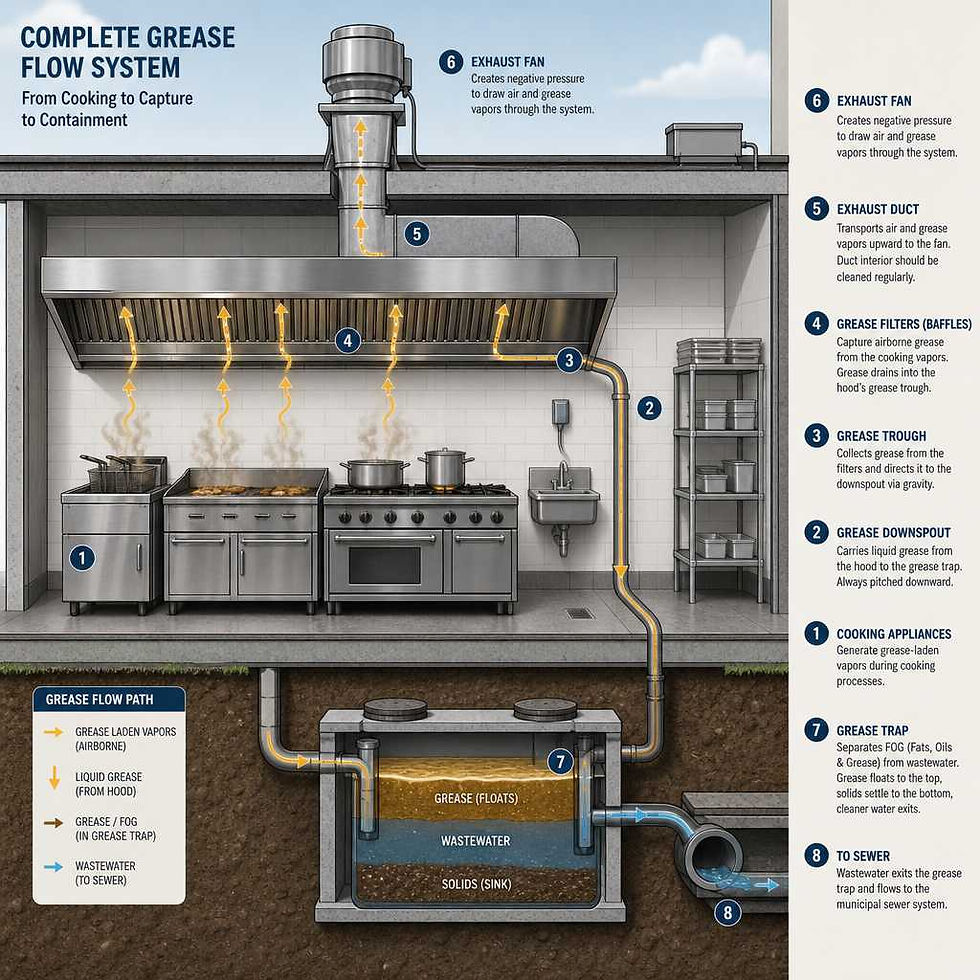
Grease does not stay in one place. When you fry, sear, or saute at high temperatures, aerosolized grease particles rise with hot air into the exhaust hood. Some of that grease gets captured by the hood filters. The rest coats the interior ductwork, the exhaust fan blades, and eventually reaches the rooftop fan. Meanwhile, at the floor level, liquid grease from cooking and dishwashing flows down the drains toward the grease trap, where it is supposed to separate from wastewater before reaching the municipal sewer system.
In practice, these two pathways feed each other. A kitchen that produces a high volume of fried food generates more airborne grease and more liquid grease simultaneously. Ignoring either pathway creates a compounding problem that no single cleaning service can fully address on its own.
For Connecticut restaurant owners, this matters because state and local regulators inspect both systems, often on different schedules and through different agencies. The Connecticut Department of Energy and Environmental Protection (DEEP) has enforcement authority over grease discharges into municipal sewer systems, while local fire marshals enforce NFPA 96 compliance on exhaust systems. You can pass one inspection and fail the other on the same week.

Pro tip: Ask your cleaning provider to document the grease levels found in both the hood system and the grease trap on the same service report. This creates a baseline that helps predict how quickly each system accumulates grease, so you can schedule future cleanings more accurately instead of guessing.
What Happens When Grease Trap and Hood Cleaning Are Out of Sync
A common mistake Connecticut restaurant operators make is hiring a low-cost hood cleaning vendor and a separate grease trap pumping company, each on their own schedule, with no communication between them. The result is a kitchen where one system is always behind.
Backed-Up Drains Increase Kitchen Humidity and Grease Vapors
When a grease trap approaches capacity, drain flow slows. Standing water and grease in floor drains increases the humidity inside the kitchen. Higher humidity means more grease particles stay airborne longer before settling onto hood surfaces. The practical result is that your hood filters clog faster, requiring more frequent cleaning even if your cooking volume has not changed.
Overloaded Hood Systems Push Grease Back into the Kitchen
When hood ductwork is heavily fouled and exhaust airflow is restricted, the system loses its ability to pull grease-laden air away from the cooking surface efficiently. That grease has to go somewhere, and it goes back down into the kitchen, coating equipment surfaces, walls, and yes, eventually the floor drains. This creates a feedback loop that accelerates grease trap fill rates.
The data consistently shows that kitchens with poorly maintained exhaust systems spend significantly more on grease trap pump-outs than kitchens where both systems are serviced on a coordinated schedule. This is not a theoretical benefit. It is something Superior Clean sees directly when taking over accounts from restaurant owners who have been using disconnected vendors for years.
Connecticut Regulations You Cannot Ignore
Connecticut municipalities have become noticeably stricter about grease management enforcement over the past several years. Towns including Hartford, New Haven, Bridgeport, and Stamford have implemented formal Fats, Oils, and Grease (FOG) control programs that require commercial kitchens to maintain grease traps and provide documentation of service intervals upon request.
What NFPA 96 Requires for Hood Cleaning
NFPA 96, the Standard for Ventilation Control and Fire Protection of Commercial Cooking Operations, specifies cleaning frequency based on cooking volume and the type of food being prepared. High-volume operations using solid fuel or wok cooking require inspection and cleaning every month. Moderate-volume operations typically require quarterly cleaning. A CT fire marshal can cite you for noncompliance even if your hood looks clean to the naked eye, because grease accumulates inside ductwork that is not visible during a casual inspection.
What Connecticut FOG Programs Require for Grease Traps
Most Connecticut FOG programs require grease traps to be pumped when they reach 25 percent capacity with fats, oils, and grease. Some municipalities require grease trap service logs to be kept on site and made available during health inspections. Failure to comply can result in fines, mandatory installation of larger interceptors at your expense, or temporary suspension of your food service permit.
"Grease buildup in drain systems is one of the leading causes of sanitary sewer overflows in the United States. Municipal FOG programs exist specifically because restaurant operators historically treated grease disposal as someone else's problem." - U.S. Environmental Protection Agency, Primer for Municipal Wastewater Treatment Systems
Pro tip: Before your next health inspection in Connecticut, pull your grease trap service records and cross-reference them with your hood cleaning certificates. If the dates are wildly out of alignment, you have a gap that an inspector could flag. Aligning your service schedules closes that gap before it becomes a citation.

Comparing Grease Management Service Approaches
Connecticut restaurant operators typically fall into one of three service models when it comes to commercial kitchen grease management. Each has real trade-offs worth understanding before you sign a service contract.
Service Approach
How It Works
Practical Trade-Offs for CT Restaurants
Separate vendors for hood and grease trap
One company handles NFPA 96 hood cleaning. A different company pumps the grease trap on a separate schedule.
Lower per-service cost in some cases, but no coordination between systems. Documentation is split across two providers, making compliance reporting more complicated. Gaps in service timing are common.
Single provider for both services
One company manages hood cleaning, exhaust system maintenance, and grease trap service under a unified schedule.
Higher coordination value. Single point of contact for compliance documentation. Service intervals can be adjusted based on real observations from both systems. This is the approach Superior Clean uses for Connecticut accounts.
Reactive service only (no schedule)
Operators call for service only when a problem is visible, such as a grease trap backup or a hood fire suppression trigger.
Highest long-term cost. Emergency pump-outs and emergency hood cleanings are priced at a significant premium. Health code violations and fire hazards are substantially more likely. Common among independent operators trying to minimize upfront costs.
The single-provider model wins on compliance and cost predictability for most Connecticut restaurants. The separate-vendor model can work if both vendors communicate directly and use synchronized service schedules, but in practice that coordination rarely happens without active management from the restaurant owner.
What a Combined Service Visit Looks Like in Practice
When Superior Clean handles both hood cleaning and grease trap service for a Connecticut restaurant, the visit follows a logical sequence that treats the kitchen as a single grease management system rather than two unrelated tasks.
The exhaust system is cleaned first. Technicians remove and clean hood filters, clean the hood interior and plenum, clean the ductwork from the hood to the rooftop fan, and clean or service the exhaust fan itself. This includes checking fan belts, inspecting motor condition, and verifying that the hinge kit on the exhaust fan is functioning so the fan can be tilted for access during future cleanings. After the hood system is clean, the grease trap is pumped and inspected. Any buildup in the floor drain lines connecting to the trap is also cleared.
The reason for this sequence matters. Cleaning the hood first means any grease residue that drips or washes into the floor drains during the hood cleaning process is captured in the grease trap before it gets pumped. If you reversed the order, you would pump the trap clean and then immediately introduce fresh grease from the hood cleaning into a clean trap, which wastes part of the service.
After both systems are serviced, technicians document grease levels found in both systems, note any areas of accelerated buildup, and recommend adjusted service intervals if the findings suggest the current schedule is off. That documentation is provided to the restaurant as a written service record that satisfies both NFPA 96 compliance requirements and Connecticut FOG program recordkeeping requirements.
Signs Your Grease Trap and Hood Need Immediate Attention
Connecticut restaurant managers sometimes wait too long to schedule service because the warning signs are easy to rationalize as minor inconveniences. They are not minor. Each of the following signals indicates that your grease management systems are already behind and that continued delay increases your risk of a health code violation, a fire hazard, or an expensive emergency repair.
For the grease trap, the warning signs include slow drains throughout the kitchen, gurgling sounds in floor drains, foul odors rising from drains even when the kitchen is clean, and visible grease floating in floor drain openings. Any one of these means the trap is at or near capacity.
For the hood and exhaust system, watch for visible grease dripping from hood filters during cooking, reduced smoke capture at the cooking line, unusual noise from the rooftop exhaust fan, and any grease accumulation visible on the exterior of the hood canopy. If your hood suppression system has triggered without an actual fire, grease buildup in the ductwork is often the cause.
In practice, the most reliable signal that both systems need attention simultaneously is when grease odors become noticeable in the dining room. By that point, the kitchen air quality has deteriorated enough that grease is escaping the exhaust system entirely, and the drain system is likely backing up enough to contribute airborne odors. That is not a maintenance issue anymore. That is an emergency.
Superior Clean serves commercial kitchens throughout Connecticut, including restaurants in Hartford, New Haven, Bridgeport, Stamford, Waterbury, and surrounding areas. Coordinating your restaurant grease trap CT service with your NFPA 96 hood cleaning under a single provider is the most practical way to stay compliant, reduce fire risk, and control maintenance costs across your entire operation. Reach out to discuss a service schedule built around your specific cooking volume and kitchen configuration.
Frequently Asked Questions
How often does a restaurant grease trap need to be cleaned in Connecticut?
Most Connecticut municipalities follow the 25 percent rule, meaning the grease trap must be pumped before fats, oils, and grease reach 25 percent of the trap's total capacity. For high-volume frying operations, that can mean monthly service. For lower-volume kitchens, quarterly service may be sufficient. The only way to know your actual interval is to have the trap inspected and measured at your first service visit, then adjust the schedule based on observed fill rates.
Can I schedule grease trap cleaning and hood cleaning on the same day?
Yes, and it is the recommended approach. Scheduling both services together under a single provider reduces total labor time, eliminates scheduling conflicts between vendors, and ensures that grease washed into floor drains during hood cleaning is captured and removed during the same visit. Superior Clean offers combined service visits specifically for this reason.
What are the penalties for failing a grease trap inspection in Connecticut?
Penalties vary by municipality but commonly include fines starting at several hundred dollars per violation, mandatory pump-out at the operator's expense within a short corrective period, and in repeat cases, suspension of the food service operating permit. Some Connecticut towns also require installation of a larger grease interceptor at the restaurant's expense if documented violations show the existing trap is undersized for the operation's output.
Does NFPA 96 apply to all Connecticut commercial kitchens?
NFPA 96 applies to any commercial cooking operation that uses heat-producing equipment with an exhaust system. This includes restaurants, cafeterias, food trucks with fixed exhaust systems, hospital kitchens, school cafeterias, and hotel food service operations. Connecticut fire marshals use NFPA 96 as the standard during fire code inspections, and noncompliance can result in citations, required re-inspection, and in serious cases, forced closure until the exhaust system meets the standard.
What is the difference between a grease trap and a grease interceptor?
A grease trap is a smaller, indoor unit typically installed under a sink or in the kitchen floor, designed to handle lower flow rates. A grease interceptor is a larger unit, usually installed outside the building underground, designed to handle higher volumes of wastewater from the entire kitchen. Connecticut health codes may require one or both depending on your kitchen's wastewater output. Both require regular cleaning to function correctly, and both are subject to municipal FOG program requirements.
How does a neglected hood system affect grease trap fill rates?
When hood filters are heavily clogged, airflow through the exhaust system drops. Grease-laden air that should be captured and exhausted instead recirculates in the kitchen, settles on surfaces, and drains into the floor drain system. This means a neglected hood system directly increases the rate at which your grease trap fills. Restaurants that coordinate hood and grease trap cleaning on the same schedule consistently report longer intervals between trap pump-outs compared to when the two systems were managed separately.
Have you noticed that your grease trap fill rate changed after your last hood cleaning? Share what you observed, because real-world data from Connecticut kitchens helps everyone schedule more accurately.


Comments