


Hotel & Hospital Kitchen Hood Cleaning CT Guide
Hotels and hospitals in Connecticut face a version of commercial kitchen exhaust compliance that most restaurant owners never encounter. The equipment runs longer, the oversight layers run deeper, and the consequences of a missed cleaning go well beyond a fire marshal citation. A hospital kitchen cited by The Joint Commission for a grease-laden exhaust duct is not just facing a fine. It is facing a finding that can ripple into accreditation risk. A hotel kitchen flagged during a state fire inspection the week before a catered gala is an operational emergency. Hotel kitchen hood cleaning in Connecticut and hospital kitchen exhaust maintenance are not simply "more of the same" compared to a neighborhood restaurant. They require a different level of planning, documentation, and specialized service.
Table of Contents
Quick Takeaways
Key Insight | Explanation |
|---|---|
Hotels typically require semiannual cleaning minimum | Under NFPA 96, standard hotel banquet and restaurant kitchens fall into the moderate-volume cooking category, requiring cleaning at least twice per year. High-volume banquet operations may require quarterly service. |
Hospital kitchens face dual regulatory oversight | Beyond local fire marshals and NFPA 96, hospital food service kitchens are subject to Joint Commission Environment of Care standards and CMS conditions of participation, creating a multi-layer compliance burden. |
Cafeteria exhaust systems are often underestimated | Cafeterias in schools, hospitals, and corporate campuses cook at lower individual volume but run long daily hours. NFPA 96 inspects based on cooking volume AND hours of operation, which can push these kitchens into quarterly schedules. |
Grease buildup is a documented fire cause in institutional kitchens | Failure to clean exhaust systems contributed to a significant percentage of commercial kitchen fires. In high-stakes environments like hospitals, a kitchen fire has consequences for patients and life-safety systems simultaneously. |
Documentation must be service-report quality, not just a receipt | Surveyors and fire marshals expect before-and-after photos, the technician's certification number, areas cleaned, and deficiencies noted. A simple invoice will not satisfy a Joint Commission audit. |
Access scheduling is a major operational challenge in these facilities | Hospital kitchens often operate around the clock and cannot simply close for cleaning. Hotel banquet kitchens have unpredictable booking calendars. Service providers must plan access windows well in advance. |
Connecticut fire marshals enforce NFPA 96 at the local level | Municipalities across Connecticut adopt NFPA 96 as part of their fire code. Local fire marshals conduct inspections and can issue orders to correct deficiencies, including ordering systems out of service until cleaned. |
Why Hotels and Hospitals Face Unique Compliance Challenges
The baseline rule for any commercial kitchen in Connecticut is straightforward: maintain your exhaust system in compliance with NFPA 96, the Standard for Ventilation Control and Fire Protection of Commercial Cooking Operations. What makes hotels and hospitals different is not the rule itself but the number of authorities that enforce their own version of it.
A restaurant owner in New Haven deals with the local fire marshal and perhaps a city health inspector. A facilities director at a Connecticut hospital deals with the state fire marshal's office, the local authority having jurisdiction, The Joint Commission or another accrediting body, and CMS surveyors if the facility participates in Medicare or Medicaid. Each of these authorities can conduct its own inspection with its own paperwork expectations, and none of them will accept "the other inspector was satisfied" as a defense.
Hotels add a different kind of complexity. A full-service hotel in Hartford or Greenwich might operate a breakfast kitchen, a full-service restaurant, a banquet kitchen, and a bar kitchen all under one roof. Each space may have its own exhaust system, its own cleaning schedule under NFPA 96, and its own access challenges. The banquet kitchen that sat idle for two months and then cooked for a 400-person event three weekends in a row has a very different grease accumulation profile than the breakfast kitchen running 365 days a year at moderate volume.
The kitchen is not just another room in the building. In both hotels and hospitals, it is a critical operational node, and its exhaust system is one of the highest fire-risk components in the entire facility. Treating it like a simple maintenance checkbox is how facilities end up with emergency shutdowns.
The other factor that distinguishes institutional kitchens is consequence. A restaurant fire is a disaster. A hospital kitchen fire is a disaster that occurs inside a building full of patients who cannot self-evacuate, connected to medical gas systems, and staffed by personnel whose primary training is clinical, not fire suppression. The stakes are categorically higher, and the compliance expectations reflect that.
NFPA 96 Cleaning Frequencies for Institutional Kitchens
NFPA 96 does not assign different rules to hospitals versus restaurants. It assigns rules based on cooking volume and fuel type. The reason institutional kitchens often land on more frequent schedules is that their operational profiles actually meet the criteria for higher-frequency cleaning. Understanding the framework helps facilities managers plan budgets and service agreements accurately.
The Four Frequency Tiers
Monthly cleaning is required for systems serving solid fuel cooking operations such as wood, charcoal, or mesquite, as well as high-volume cooking operations including 24-hour operations and high-output charbroiling. A hospital that runs a cafeteria line with charbroiled proteins as a daily menu item, or a hotel that operates a 24-hour room service kitchen, may fall into this category.
Quarterly cleaning applies to moderate-to-high volume cooking operations. Most full-service restaurant kitchens, including hotel restaurant kitchens, and most hospital cafeteria kitchens fall into this tier or are close to it. According to NFPA 96 Section 11.4, this is the default for operations that cook at meaningful daily volumes without the extreme output of charbroilers or solid fuel equipment.
Semiannual cleaning is the appropriate tier for standard hotel banquet kitchens and moderate-volume operations. A hotel kitchen that primarily supports periodic banquet events, not daily high-volume cooking, can reasonably justify a semiannual schedule, though any significant increase in usage should trigger a reassessment.
Annual cleaning applies to low-volume operations such as day camps or seasonal facilities. Very few hospital or hotel kitchens legitimately qualify for this tier.
Pro tip: The NFPA 96 schedule is a minimum. If a grease inspection reveals buildup that exceeds safe accumulation thresholds before the next scheduled cleaning, the system must be cleaned immediately regardless of where the calendar says you are in the cycle. Build that reality into your service agreements.
Why Hospitals Frequently Need Quarterly Service
Hospital food service operations run longer daily hours than most commercial restaurants. Patient meal service alone typically requires three main meal productions per day, seven days a week, 365 days a year. Add in staff cafeteria lines, late-night patient snack service, and catering for internal events, and the actual cooking hours per week often push these kitchens firmly into the quarterly cleaning tier. Facilities that assume their hospital kitchen qualifies for semiannual service based on menu simplicity alone are frequently wrong when someone actually calculates weekly cooking hours.


Hotel Kitchen Hood Cleaning: Connecticut-Specific Considerations
Connecticut hotels range from compact boutique properties in New Haven and Mystic to large convention and resort properties in the Hartford metro area and along the shoreline. The kitchen configurations across these properties vary dramatically, but the compliance obligation is consistent: every commercial cooking operation must maintain its exhaust system in accordance with NFPA 96, and Connecticut fire marshals at the local level are the primary enforcement authority.
Multi-Kitchen Properties Require Separate Schedules
A common mistake at full-service hotels is treating all kitchen exhaust systems as a single line item with one cleaning date per year. In practice, the breakfast buffet kitchen running every day at moderate volume has a different cleaning schedule than the banquet kitchen that sits dormant for weeks and then operates at maximum capacity for a weekend. Each exhaust system should be assessed individually, and the service provider should document each system separately in the service report.
Hotels that schedule all their kitchens on a single annual cleaning and submit one combined service report are creating a compliance gap. If the fire marshal asks specifically about the banquet kitchen that handled three events last month, the combined report may not satisfy the inspection.
Event-Driven Grease Accumulation
Hotel banquet and event kitchens present a challenge that restaurants do not: extreme grease accumulation over short periods followed by extended dormancy. A banquet kitchen that produced six large catered events in October generates far more grease than six months of moderate daily restaurant service. The grease does not "evaporate" during the idle weeks between events. It sits in the ductwork, hardens, and becomes increasingly flammable.
The practical approach for Connecticut hotel operators is to schedule a post-peak-season inspection every year, typically in November after fall event season and again in late spring after graduation and wedding catering season. If those inspections reveal significant accumulation, cleaning should follow immediately rather than waiting for a scheduled date.
Pro tip: Work with your exhaust cleaning provider to set up a visual inspection protocol after any booking period that exceeds your normal volume. A brief inspection visit is far less expensive than an emergency cleaning call the night before a major event, and far less costly than a fire marshal citation during peak season.
Hospital Kitchen Exhaust Cleaning CT: The Regulatory Layers
Hospital kitchen exhaust cleaning in Connecticut sits at the intersection of fire code compliance and healthcare accreditation standards. Facilities staff who manage only the NFPA 96 side of this equation are leaving their facility exposed on the accreditation side, and vice versa.
The Joint Commission and CMS Expectations
The Joint Commission's Environment of Care standards require hospitals to manage fire safety risks throughout the facility through documented programs. The hospital kitchen is specifically identified as a high-risk area within that framework. When a surveyor reviews the Environment of Care chapter during an accreditation visit, they will ask to see documentation of kitchen exhaust system maintenance as part of the fire safety program. A missing service report or an outdated cleaning date is a finding, not an oversight they will overlook.
CMS conditions of participation carry similar expectations. Hospitals that participate in Medicare and Medicaid must maintain life-safety compliance as a condition of that participation. A deficiency in kitchen exhaust maintenance that surfaces during a CMS survey is not a minor housekeeping note. It is a life-safety deficiency with a correction timeline and potential consequences for participation status.
The 24-Hour Operation Problem
One of the most practical challenges in hospital kitchen exhaust cleaning in CT is simply finding the window to do it. Hospital kitchens, unlike restaurants, cannot post a "closed for cleaning" sign. Patient meal service is not optional. The logistics of coordinating a full exhaust system cleaning in a facility that cannot stop cooking require advance planning, typically with the kitchen management team, facilities engineering, and infection control staff.
Infection control is a dimension that simply does not exist in restaurant hood cleaning. In a hospital environment, the cleaning process itself, including the chemicals used, the ventilation disruption caused by ductwork work, and the access paths through the facility, may require coordination with the infection control officer. Service providers unfamiliar with healthcare facility protocols will create problems that exceed the original compliance issue.
Documentation Surveyors Actually Examine
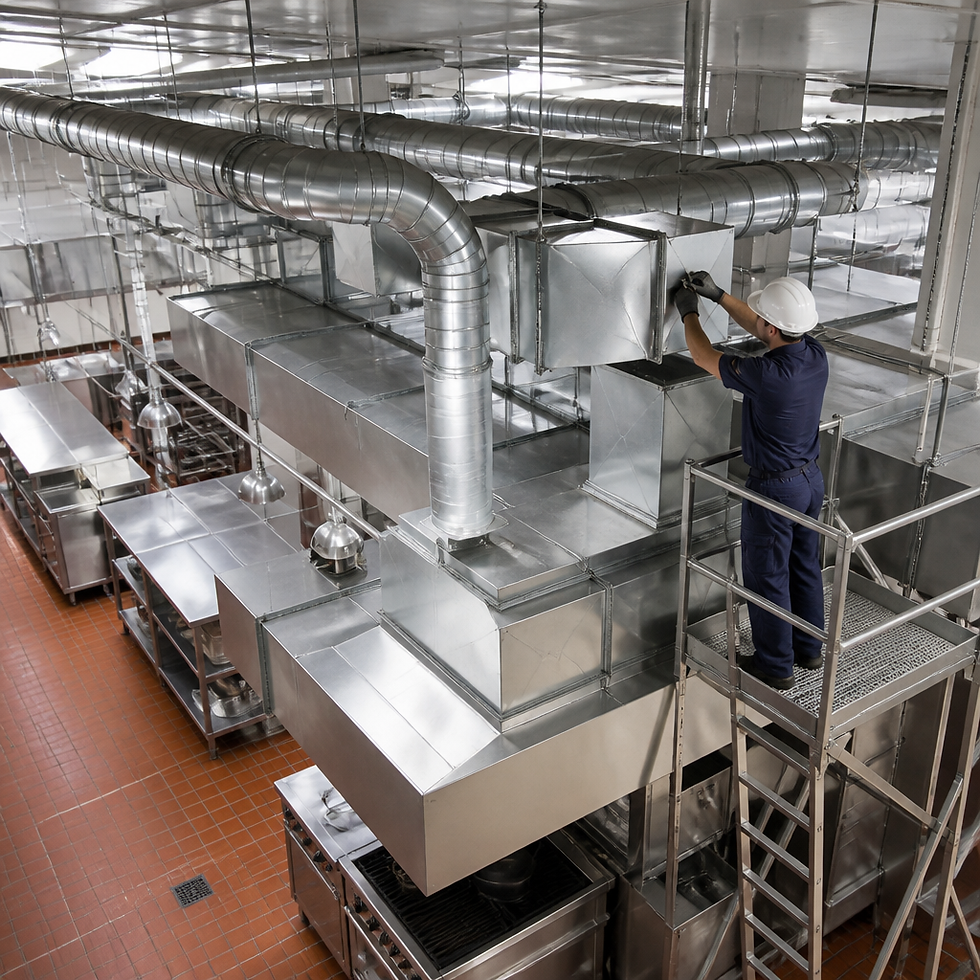
A hospital facilities director cannot hand a surveyor a single-page invoice and expect it to pass review. Joint Commission surveyors and CMS auditors expect to see a service report that includes the date and time of service, the technician's name and certification, a description of each component cleaned, notation of any deficiencies found, before-and-after photographic documentation, and confirmation that the suppression system was properly handled during and after the cleaning. The paper trail surveyors expect is a formal accountability record, not a billing document.
Pro tip: Ask your exhaust cleaning provider for a sample service report before signing any contract. If the sample looks like a generic work order with a few checkboxes, that documentation will not hold up under a Joint Commission review. The report must be detailed enough to stand on its own as evidence of compliant service.
Cafeteria Hood Cleaning Connecticut: Schools and Healthcare Campuses
Cafeteria hood cleaning in Connecticut covers a broader category than it might appear. It includes school cafeterias operated by public school districts under state oversight, cafeterias on university campuses, corporate campus dining facilities, and the dedicated cafeteria lines within hospital complexes that may be physically separate from the main patient kitchen.
Why School and Campus Cafeterias Are Underserved
School cafeterias in Connecticut are often managed by facilities departments that oversee dozens of buildings and hundreds of maintenance items. The kitchen exhaust system is one line item among many, and it is easy to defer. The problem is that deferral does not reduce grease accumulation. School cafeteria lines often run at concentrated high volume during short service windows, generating meaningful grease output within a limited cooking footprint.
In terms of NFPA 96 compliance, a school cafeteria that cooks full meals five days a week during the academic year is not a low-volume operation. It may not operate year-round, but its annual cooking hours can easily push it into the quarterly or at minimum semiannual tier. School facilities directors who schedule annual hood cleaning based on budget convenience rather than actual cooking volume are out of compliance and may not realize it until a fire marshal inspection occurs.
Healthcare Campus Cafeterias as a Separate System
Large hospital campuses in Connecticut frequently operate a public-facing cafeteria separate from the main patient food service kitchen. These spaces cook for staff, visitors, and in some cases the surrounding community. They operate on a different access schedule than the restricted patient kitchen, which actually makes compliance coordination easier, but they carry the same NFPA 96 obligations and, because they are on the hospital campus, they fall under the same Joint Commission and CMS review scope.
Facilities managers who separate these two kitchens in their maintenance programs and only submit documentation for the patient kitchen during accreditation review are creating a gap. Both systems must be documented, and both must meet the cleaning frequency appropriate to their cooking volume.
Documentation: The Detail That Separates Passing from Failing
Across all institutional kitchen types, from hotel banquet kitchens to hospital food service lines to school cafeterias, the single factor that most consistently separates facilities that pass inspections from those that fail is documentation quality. The cleaning itself is necessary but not sufficient. The record that the cleaning happened, what was found, what was corrected, and who performed the work is what gets reviewed.
What a Compliant Service Report Contains
A compliant NFPA 96 service report for a hotel or hospital kitchen should include the facility name and address, the specific exhaust system or systems cleaned, the date and start and end time of service, the name and certification credentials of every technician on-site, a component-by-component account of what was cleaned, photographic documentation of the hood, filters, plenum, ductwork access panels, and rooftop fan both before and after cleaning, any deficiencies identified and whether they were corrected on-site or require follow-up, and confirmation of suppression system status. Some facilities also require the technician to affix a service sticker to the hood itself, which many fire marshals treat as a quick visual confirmation during inspections.
Retaining Records Across Staff Turnover
One of the most common failures in hotel and hospital kitchen compliance is not the cleaning itself but the record retention. Facilities staff turn over. The person who managed the service agreement and filed the documentation leaves, and the records go with them, or sit in an email inbox that no longer exists. Connecticut hotels and hospitals should maintain physical or cloud-stored copies of all exhaust cleaning service reports going back at least three years. Three years provides enough history to demonstrate a compliant schedule to any auditor or fire marshal without gaps.
Comparison: Cleaning Service Approaches for Institutional Kitchens
Approach | Best Suited For | Key Limitations |
|---|---|---|
Scheduled contract service with a dedicated institutional provider | Hospitals, large hotels, multi-kitchen campuses that need coordinated service across multiple systems and accreditation-grade documentation | Requires advance planning, coordination with facility scheduling, and a provider experienced in healthcare or hospitality protocols. Not all providers offer this level of service. |
On-call reactive cleaning only | Very small, low-volume seasonal operations or secondary kitchen spaces with minimal cooking activity | Creates compliance gaps in high-volume institutional settings. No documentation trail for ongoing inspections. Almost always the wrong choice for hospitals or full-service hotels in Connecticut. |
Scheduled contract service with volume-triggered inspection checkpoints | Hotel banquet kitchens with unpredictable seasonal volume spikes, healthcare campus cafeterias with variable cooking schedules | Requires a provider willing to conduct between-schedule inspections and issue condition reports. More proactive than a fixed calendar contract and better aligned with actual NFPA 96 intent, but depends on provider capability. |
The reactive cleaning approach is almost always the wrong model for Connecticut hotels and hospitals. The right model is a contract that establishes baseline cleaning frequency based on cooking volume, with built-in provisions for triggered inspections when volume spikes occur and documentation standards that match what surveyors actually review.
Frequently Asked Questions
How often does a hospital kitchen exhaust system need to be cleaned in Connecticut?
Most hospital kitchens in Connecticut require quarterly exhaust system cleaning under NFPA 96 because their daily cooking hours and operational volume place them in the moderate-to-high volume category. Facilities that operate charbroiling equipment, solid fuel cooking, or round-the-clock service may require monthly cleaning. Facilities managers should not default to an annual schedule without a formal volume assessment, because most hospital food service operations will not legitimately qualify for that tier.
Does The Joint Commission specifically inspect kitchen exhaust systems during accreditation surveys?
Yes. The Joint Commission's Environment of Care standards include fire safety requirements that cover kitchen exhaust systems as a documented high-risk area. Surveyors reviewing the fire safety component of an accreditation visit will ask for service records, and a missing or incomplete cleaning documentation file is a finding. Facilities should keep service reports organized and accessible rather than archived in ways that make them difficult to retrieve on short notice.
What makes hotel banquet kitchen hood cleaning different from a standard restaurant?
The core difference is volume unpredictability. A restaurant cooks at a relatively consistent volume that makes scheduling straightforward. A hotel banquet kitchen may be idle for weeks and then operate at maximum capacity for multiple back-to-back events. That usage pattern creates concentrated grease accumulation episodes that a fixed semiannual schedule may not capture. The best approach is to combine a baseline contract schedule with a post-peak-period inspection that can trigger an additional cleaning if accumulation warrants it.
Can a Connecticut hotel or hospital use the same cleaning provider as a restaurant?
A provider who only works with independent restaurants may not have the experience or documentation practices that institutional clients require. Hotels need providers who understand multi-system properties and event-driven schedules. Hospitals need providers who understand infection control protocols, can work within restricted access schedules, and produce service reports that meet accreditation-grade standards. The technical cleaning work is the same, but the surrounding service model needs to match the institutional environment.
What does a compliant service report look like for a Connecticut hospital kitchen hood cleaning?
A compliant service report should include the technician's name and certification credentials, the date and duration of service, a component-level account of everything cleaned, before-and-after photographic documentation of the hood, ductwork access points, filters, plenum, and rooftop fan, identification of any deficiencies, and confirmation that the suppression system was handled properly. A single-page invoice or a checklist with no photos will not satisfy a Joint Commission surveyor or a CMS auditor. Facilities managers should request and review a sample report from any provider before signing a service contract.
Is cafeteria hood cleaning in Connecticut required for school cafeterias?
Yes. School cafeterias in Connecticut that perform commercial cooking operations are subject to the same NFPA 96 requirements as any other commercial kitchen. The local authority having jurisdiction, typically the local fire marshal, enforces these requirements. The appropriate cleaning frequency depends on the school's actual cooking volume and weekly cooking hours, not simply on the calendar. A school that cooks full meals five days a week during a nine-month academic year may qualify for semiannual service, but facilities directors should confirm this with a volume assessment rather than assuming it.
What happens if a Connecticut hospital is found out of compliance during a kitchen exhaust inspection?
At the fire code level, the local fire marshal can issue a correction order requiring the system to be cleaned within a specified timeframe. If the deficiency is severe enough, the marshal has authority to require the system to be taken out of service until corrected. At the accreditation level, a finding related to kitchen exhaust maintenance becomes part of the hospital's corrective action plan with a defined resolution deadline. Repeated findings in the same area can escalate to more serious accreditation consequences. The most effective way to avoid both outcomes is a proactive service program with solid documentation, not reactive cleaning after a problem is identified.
Have you encountered specific scheduling or documentation challenges managing hood cleaning compliance at your Connecticut hotel, hospital, or cafeteria facility? Share your experience in the comments below.
References
NFPA 96 cleaning frequency categories and fire risk data for commercial kitchens
NFPA 96 cleaning requirements guide covering hotels, hospitals, and cafeteria operations
NFPA 96 Section 11.4 cleaning schedule breakdown by cooking volume and fuel type
Hospital fire safety compliance guide covering Joint Commission and CMS standards
Hospital kitchen preventive maintenance and exhaust hood compliance documentation guide


Comments