


Kitchen Exhaust Cleaning: Before & After Results Revealed
- 6 days ago
- 11 min read
Most restaurant owners have no idea what is actually living inside their exhaust system until a professional opens it up. Grease does not just sit on a surface. It migrates deep into ductwork, coats fan blades, and polymerizes into a rock-hard layer that standard kitchen staff simply cannot remove. The kitchen exhaust cleaning process is more involved than wiping down a hood filter, and the before-and-after difference is dramatic enough to change how you think about fire risk, equipment performance, and health code compliance. This article breaks down exactly what gets removed, why it matters, and what Connecticut restaurant operators should expect when a professional crew comes in.
Table of Contents
Quick Takeaways
Key Insight
Explanation
Grease buildup is a fire accelerant
NFPA 96 identifies grease accumulation in exhaust systems as one of the leading causes of commercial kitchen fires. Even a thin residue of 1/8 inch is considered a violation requiring immediate cleaning.
Fan blades lose efficiency under grease load
A grease-coated fan blade can lose up to 30% of its airflow efficiency, causing heat and smoke to linger in the kitchen and increasing strain on the motor.
Ductwork is where most grease hides
Filters and hoods are visible, but the duct runs can accumulate pounds of hardened grease over months. A professional cleaning accesses these areas; a staff wipe-down does not.
Cleaning frequency depends on cooking volume
NFPA 96 requires quarterly cleaning for high-volume fryers, semi-annual for moderate cooking, and annual for low-volume or solid-fuel systems. Most CT restaurants fall into the quarterly or semi-annual category.
Insurance and health code compliance require documentation
Professional cleaning companies issue a certificate and apply inspection stickers to the system. Without this documentation, your insurance claim after a fire may be denied.
Polymerized grease requires chemical degreasing, not scrubbing alone
Grease that has been heated repeatedly hardens into a polymer. Hot water pressure washing combined with alkaline degreasers is the only reliable method to remove it without damaging ductwork.
A clean exhaust system reduces energy costs
Restored airflow reduces how hard HVAC and makeup air units work. Many operators report a measurable drop in utility costs following a professional deep clean.
What Actually Builds Up Inside a Commercial Exhaust System
The answer is not just grease. In practice, a commercial kitchen exhaust system collects a mixture of aerosolized cooking fats, carbonized food particles, moisture, and airborne contaminants every single service. These materials do not stay in one place. They travel with exhaust airflow and deposit in layers across every internal surface from the filter face to the rooftop exhaust fan.
Grease in its early stage is a sticky, amber-colored liquid. Left unaddressed, heat cycles harden it into a dark, lacquer-like substance that bonds to metal. At that stage, it is no longer a cleaning problem. It is a structural fire risk. The National Fire Protection Association classifies this material as a primary ignition source in restaurant fires.
Beyond grease, professional crews routinely find debris including insect activity, bird nesting material near rooftop fan housings, rust scale inside ductwork, and in older systems, deteriorated insulation material. None of this shows up during a routine filter rinse. It only becomes visible when a trained technician opens access panels and inspects the full system run.
Pro tip: Ask your cleaning provider to photograph the interior of your duct runs before and after service. If they cannot provide those images, they may not have inspected the full system depth.


The Kitchen Exhaust Cleaning Process: Step by Step
A professional kitchen exhaust cleaning process is not a single action. It is a sequenced series of steps that work together. Skipping any step produces a system that looks clean at the hood face but remains dangerous inside. Here is what a compliant, thorough service actually involves.
Pre-Service Inspection and Access Panel Opening
Before any chemical is applied, a technician maps the duct run, identifies all access points, and inspects the rooftop fan housing. This step determines how much grease has accumulated and what tools and chemical concentrations will be needed. It also identifies any mechanical issues such as worn fan belts, damaged hinge kits, or motor problems that should be addressed during the same service visit.
Filter and Baffle Removal
Filters and baffles are removed and soaked in a heated degreasing solution. These components trap the first and heaviest concentration of grease. Soaking loosens carbonized deposits that would otherwise require aggressive scrubbing that could damage the metal. Most commercial baffles emerge from a proper soak looking close to new.
Hot Water Pressure Washing of Duct Interior
This is the step that separates a professional clean from a staff wipe-down. Hot water at high pressure is applied to all interior duct surfaces, working from the rooftop fan back toward the hood. Grease is driven down toward the hood where it is collected in lined waste containers placed over the cooking equipment. The temperature of the water is important. Cold water does not emulsify polymerized grease. Professionals use water heated to at least 180 degrees Fahrenheit combined with an alkaline degreaser.
Fan Cleaning and Mechanical Inspection
The rooftop exhaust fan is cleaned inside and out. Fan blades coated in grease are a significant imbalance risk and a fire hazard. During this phase, technicians check fan belts for cracking or slippage, inspect motor mounts, and assess hinge kit condition. At Superior Clean, this inspection is part of every service because catching a worn belt during a cleaning visit is dramatically cheaper than an emergency motor replacement after a failure.
System Reassembly and Documentation
Filters and baffles are reinstalled. The technician applies an inspection sticker showing the service date and the next recommended service date. A written certificate is issued to the operator. This documentation is what your fire marshal, health inspector, and insurance carrier will ask for.
Hood Cleaning Before and After: The Real Visual Difference
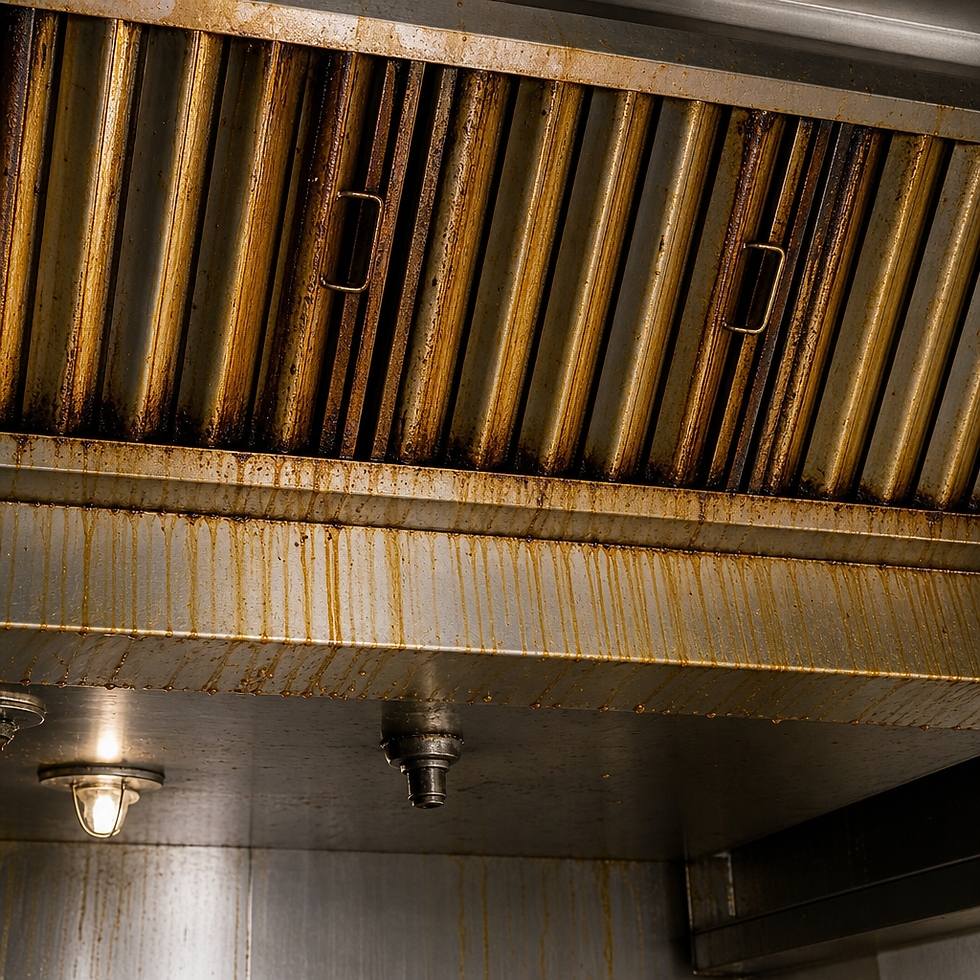
The most striking part of a professional service is the before-and-after visual contrast. Most operators who have not had a professional clean in over six months are genuinely surprised at how much material comes out.
Before a professional clean, a neglected hood interior typically shows a dark brown to black coating across all surfaces. Baffle filters are often partially blocked, reducing airflow through the system. The duct interior, when accessed, may show pooled liquid grease in low spots and hardened deposits along the upper walls. The rooftop fan blades often carry a thick, uneven grease coat that has thrown the blade balance off and is audible as vibration during operation.
After a professional hood cleaning before and after service, the bare stainless steel or galvanized duct metal is visible again. Baffles flow freely. The fan operates without vibration. Airflow through the system is restored to design capacity, which means smoke and heat clear the cooking line faster during service.
"Grease fires in restaurant cooking equipment are among the most preventable commercial fire incidents. The consistent finding across fire investigation reports is that cleaning frequency and depth directly correlate with fire risk reduction." -- National Fire Protection Association, NFPA 96 Standard for Ventilation Control and Fire Protection of Commercial Cooking Operations
A common mistake is judging hood cleanliness by the exterior surface. The hood face is cleaned by kitchen staff during regular sanitation. What kitchen staff cannot access, and what determines actual fire risk, is everything behind and above that surface: the plenum, the duct run, and the fan housing.

Commercial Kitchen Grease Removal: The Hardest Parts to Reach
Commercial kitchen grease removal is not uniformly difficult. Some areas are straightforward. Others require specific tools and experience. The areas that get missed most often are precisely the ones that represent the highest risk.
The Plenum Chamber
The plenum is the internal chamber directly above the baffle filters and below the duct opening. It is a collection zone for grease vapors and one of the dirtiest parts of any system. It is also invisible from the cooking line. Without removing the baffle filters and physically inspecting the plenum interior, there is no way to assess its condition.
Horizontal Duct Runs
Grease pools in horizontal sections because there is no slope to carry it toward a drain point. Over time, a horizontal duct section can accumulate a layer of semi-liquid grease inches deep. In a fire scenario, this reservoir ignites and carries flame horizontally through the building. Professional crews use extended pressure washing wands specifically sized for these sections.
Duct-to-Fan Connections at the Rooftop
The transition point between the duct and the rooftop fan housing is another high-accumulation area that is almost never addressed by in-house cleaning attempts. It requires roof access and knowledge of how the fan assembly separates for cleaning. Hinge kits, when properly installed, make this process faster and safer by allowing the fan to tip open rather than requiring full removal.
Pro tip: If your rooftop fan does not have a hinge kit installed, ask your cleaning provider about adding one. The installation cost pays for itself in reduced labor time on every future cleaning visit.
Fire Hazard Reduction: What the Numbers Say
The data consistently shows that exhaust system grease is a primary driver of commercial kitchen fires. According to the U.S. Fire Administration, cooking equipment is the leading cause of restaurant fires, and grease-related ignition accounts for the majority of those incidents. Approximately 7,640 structure fires occur in eating and drinking establishments annually in the United States, resulting in an estimated 150 injuries and 110 million dollars in property damage each year.
Those numbers represent establishments where cleaning was either skipped, performed at inadequate frequency, or done by staff without the equipment to access the full system depth. Compliant cleaning under NFPA 96 standards has a direct and documented relationship to fire prevention outcomes.
Connecticut restaurant operators face additional scrutiny because the state fire marshal enforces NFPA 96 as part of the state fire safety code. A citation for inadequate exhaust cleaning is not just a compliance issue. It can result in forced closure until the deficiency is corrected, with re-inspection fees added to the operator's cost.
Cleaning Method Comparison: What Works and What Does Not
Not all approaches to exhaust system cleaning deliver the same result. The table below compares three common approaches based on what they actually remove and their compliance outcome under NFPA 96.
Cleaning Approach
What It Removes
NFPA 96 Compliance Outcome
Staff filter rinse and hood wipe-down
Surface grease on hood face and loose debris from filters. Does not access plenum, ductwork, or fan.
Does not satisfy NFPA 96. No inspection certificate issued. Insurance and fire code requirements not met.
Basic hood cleaning service (hood face and filter only)
Hood exterior, filters, and baffle surfaces. Limited or no duct interior access. Rooftop fan may be wiped but not pressure washed.
Partial compliance at best. Duct interior and fan housing deficiencies remain. Certificate validity depends on scope documented.
Full system professional cleaning (hood to fan)
Removes grease from every accessible surface: hood, plenum, full duct run, fan blades, fan housing, and rooftop components. Includes mechanical inspection.
Full NFPA 96 compliance. Inspection sticker applied. Certificate issued. Insurance and fire code requirements satisfied.
The difference between the second and third option is not cosmetic. It is the difference between a system that looks compliant and one that actually is. In practice, the duct interior and the rooftop fan are where the most dangerous accumulations occur, and those areas require professional equipment and roof access to address properly.
Restaurant Hood Deep Cleaning in CT: What Local Operators Need to Know
Restaurant hood deep cleaning in CT operates under specific regulatory requirements that go beyond general best practices. Connecticut adopted NFPA 96 into its state fire safety code, which means the standard is enforceable by local fire marshals during inspections. Compliance is not optional and the documentation requirements are specific.
Connecticut's restaurant density in markets like Hartford, New Haven, Bridgeport, and Stamford means high cooking volumes and, in many cases, older building stock with legacy ductwork that requires extra attention. Older galvanized duct systems accumulate grease differently than modern stainless runs, and some older installations have non-standard access configurations that require experienced technicians who know how to work around them without damaging the system.
Superior Clean works exclusively in Connecticut, which means the team knows which local fire marshals conduct the most rigorous inspections, which building configurations appear most frequently, and what documentation format satisfies Connecticut re-inspection requirements. That local specificity matters. A national franchise operation that services Connecticut occasionally does not carry that institutional knowledge.
Beyond the regulatory angle, Connecticut restaurant operators also deal with seasonal volume swings. A shoreline seafood restaurant running at full capacity through summer months needs more frequent cleaning than the annual calendar suggests. Volume-based cleaning schedules, not calendar-only schedules, are the standard that professional operators use to stay both compliant and safe.
Frequently Asked Questions
How long does a professional kitchen exhaust cleaning take?
Most full-system professional cleanings take between two and four hours for a single hood system, depending on duct length, grease load, and rooftop access complexity. Multi-hood systems in large commercial kitchens can take a full evening. Most service providers schedule overnight visits to avoid disrupting kitchen operations during service hours.
What is the difference between cleaning the hood filters myself and hiring a professional?
Cleaning your own filters addresses only the surface layer of a multi-zone problem. Professional cleaning reaches the plenum chamber, the full duct run, and the rooftop fan housing. These areas are inaccessible without removing access panels and going to the roof. They are also where the most dangerous grease accumulations occur. Self-cleaning filters is good daily maintenance. It is not a substitute for professional system cleaning.
How do I know if my exhaust system is overdue for cleaning?
The most visible signs are reduced airflow at the hood, visible grease dripping from baffle filters during or after service, a smoke smell that lingers in the kitchen after cooking stops, and fan vibration or noise at the rooftop unit. If your last professional cleaning certificate is more than six months old and you operate a high-volume kitchen, the system is almost certainly overdue regardless of visible signs at the hood face.
Will a professional cleaning disrupt my kitchen equipment or finish?
A properly prepared professional cleaning crew protects cooking equipment with plastic sheeting and drop cloths before any water or chemical is applied. Collected grease runs into lined waste containers, not onto your equipment. The cleaning process itself does not damage stainless steel surfaces or cooking equipment when done correctly. Post-clean, all surfaces in the work area should be wiped down as part of the service.
Does the cleaning certificate from Superior Clean satisfy Connecticut fire marshal requirements?
Yes. Superior Clean issues NFPA 96 compliant documentation including a service certificate specifying the date of cleaning, the scope of work performed, and the next recommended service date. An inspection sticker is applied directly to the exhaust system. This is the format Connecticut fire marshals require during inspections, and it is the format your insurance carrier will ask for if you need to file a claim related to a kitchen fire event.
What happens if grease is found dripping from the rooftop fan housing?
Grease dripping from the rooftop fan housing indicates that the grease containment system around the fan is full or missing entirely. This is both a fire risk and a property damage risk because grease will run down the roofline and degrade roofing materials. Professional cleaning addresses this by cleaning the fan housing, clearing the containment reservoir, and assessing whether a proper grease containment system needs to be installed or replaced around the fan base.
Have you had a professional exhaust cleaning recently and noticed a performance difference in your kitchen? Share your experience or ask a question below.


Comments