


Smoke Smell in Your CT Dining Room? Check the Exhaust
If your dining room smells like last night's grill every time the kitchen fires up a full line, guests notice before you do. A smoke smell in a restaurant dining room in CT is rarely a housekeeping problem. Most of the time, air is moving the wrong way, and the kitchen exhaust system is the first place to look. This guide explains how smoke gets from the cooking line into the seating area, which faults cause it, and what to check before you pay for the wrong repair.
Table of Contents
Quick Takeaways
Key Insight | Explanation |
|---|---|
Smoke in the dining room usually means capture is failing at the line | Watch whether smoke rises into the hood or drifts past its edge. If it escapes past the edge, the problem is hood size or position, not just dirt. |
A smell that spikes when doors open points to backdraft | When the room runs under negative pressure, air is pulled in through doors and gaps, and exhaust that cannot keep up pushes cooking smoke back out. |
Hood overhang is a sizing question | Building code calls for at least 6 inches of overhang past the cooking surface on all sides. A clean but undersized hood still spills smoke. |
Grease loading cuts airflow long before the fan fails | Coated filters, baffles, and duct sections restrict flow. Set your cleaning interval by cooking volume, not by how the hood looks. |
Belts and motors wear out quietly | A slipping belt or weak motor drops airflow gradually. Check fan speed during peak service, when a weak fan shows itself. |
Exhaust without make-up air creates the smell | The fan removes air, so something must replace it. Without make-up air, the dining room goes negative and pulls smoke through every gap. |
Why Smoke Reaches the Dining Room
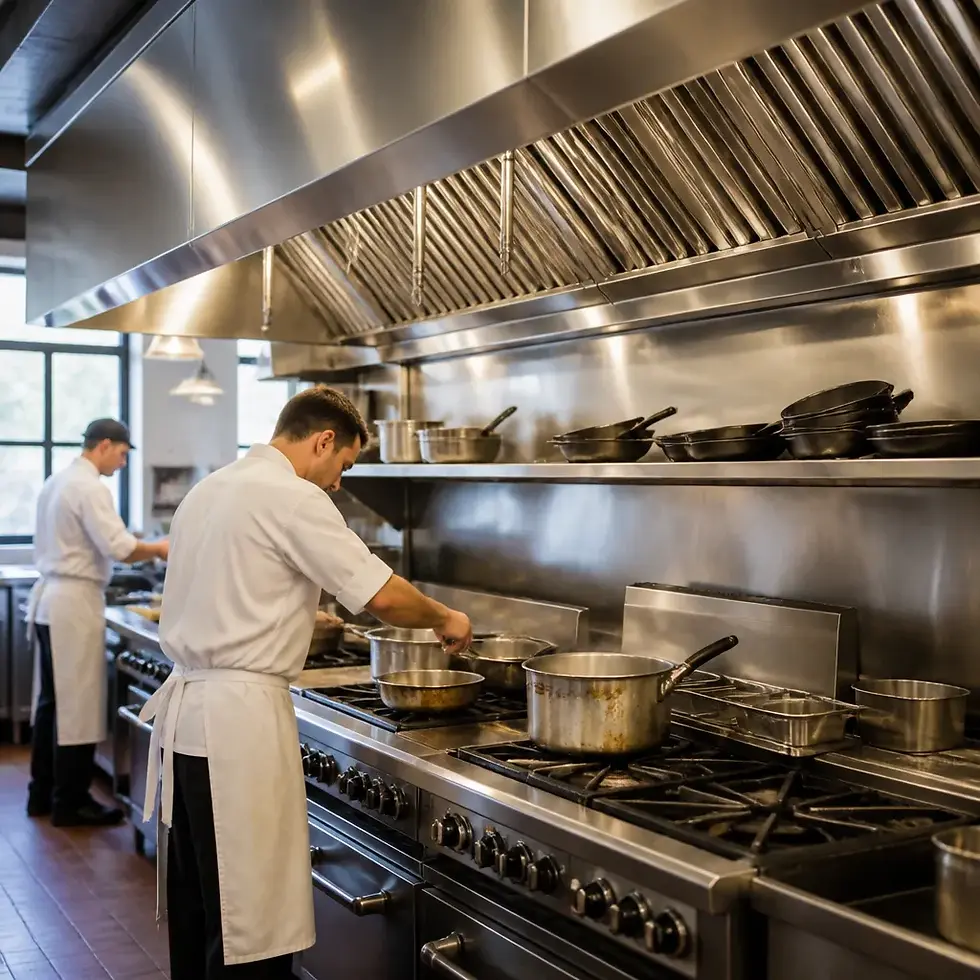
Smoke does not wander into the dining room by accident. Your exhaust hood is designed to capture grease-laden air at the cooking line and carry it up and out, but that only works when the hood gets enough airflow and the cooking surface sits inside its capture zone. When either condition fails, smoke takes the easiest route available, which is usually the front of the line and the open kitchen pass.

Smoke Takes the Easiest Path Out
The dining room is the last place smoke wants to go, but it is the place where the gaps are. Doors to the kitchen, pass-throughs, and seams around the line all act as openings. A kitchen running under capacity will push smoke through those openings in a steady stream during dinner rush.
Operators often assume the smell means the hood is dirty. That is sometimes true, but a clean hood that is too small or mispositioned can spill just as much. The first question to answer is whether smoke is leaving the cooking line at all, or whether it rises and escapes after it passes the hood edge.
Why Odor Peaks During Service
Most complaints come during the busiest hour of service, not during prep. That pattern points to load. When every burner, fryer, and griddle runs at once, the air volume and smoke volume both spike, and an exhaust system that handled the morning fine can fall behind.
Pay attention to the timing of complaints. A smell that appears only at peak load tells you the system is marginal, while a smell that is present all day points to a fault that never goes away.
Backdraft and Negative Pressure
How Backdraft Turns the Hood Into a Problem
Backdraft happens when the room is pulling air harder than the building can supply it. The fan removes air from the kitchen, but the replacement air has to come from somewhere. If the building is tight, that air comes in through the front door, the restroom, and any open gap in the dining room. Once the room is negative, the path of least resistance reverses, and smoke that should have gone up the hood comes back toward the line and out into the dining area.
In practice, the sign is timing. If the smell gets worse the moment the front door opens or a server pushes through the kitchen door, you are looking at pressure, not grease. A hood with good airflow on paper can still backdraft if the room's supply air is starved.
Signs Your Room Is Pulling Air Backward
Look for a few specific symptoms. Smoke hangs visibly at the pass or rolls out over the line. The kitchen door swings toward the dining room when the hood is running, or it slams shut when the fans start. Any of these, combined with a smell that spikes at the front door, is a strong sign of negative pressure.
If the hood pulls less air than the cooking line throws off, the surplus has nowhere to go except into the room.
That is the core of backdraft. It is rarely a single broken part. It is the mismatch between what the line produces and what the system can move, and the dining room smell is usually the symptom that makes the mismatch visible.
Hood Capture and Sizing
The Six-Inch Overhang Rule
Capture starts with the hood footprint. Building code requires a minimum of 6 inches of overhang on all sides of the cooking surfaces as installed, a rule that many older kitchens quietly break after equipment gets moved. A griddle that sits 3 inches off the wall for utility connections needs the hood to extend well beyond its front edge, not just over its center.
Take a griddle that is 30 inches deep and 60 inches wide, set 3 inches from the back wall. Once the overhang and wall clearance are added, the hood needs to be at least 39 inches wide and 72 inches long. Hood width follows equipment depth and hood length follows equipment width, which is why the numbers look backward on a drawing and why installers mix them up.
Wall-Mounted Equipment and Lost Capture
The most common capture failure we see involves equipment added after the hood was installed. A new fryer bank, a salamander, or a relocated prep station can end up outside the hood's footprint, and the smoke from that equipment never reaches the capture zone. The hood looks fine from the aisle, but it is not covering the source.
Before you blame the fan, walk the line with an equipment layout in hand. Mark every heat source against the hood edges. Anything that sits outside the footprint is a dining room smell waiting to happen, no matter how clean the filters are.
Grease Loading and Fan Performance
Grease in the Filters, Baffles, and Duct
Grease does not stay where you can see it. It coats the filters first, then the baffles, then the first sections of duct above the hood. Each layer narrows the airflow path and adds resistance, so the fan works harder for less air. A fan that was balanced against a clean system will move noticeably less air after months of loading.
Cleaning frequency should reflect cooking volume. A fryer station that runs all day loads grease far faster than a light prep kitchen, so the same interval does not fit both. Set the schedule from what your line actually produces.

Pro tip: Photograph the filters and the duct access panel on the same day each month. A visual log makes grease loading obvious and gives your service provider a clear starting point.
Fan Belts, Motors, and Speed Loss
Mechanical wear is the quiet problem. A belt that is stretched or glazed slips under load, so the fan turns but the air volume drops. A motor that runs hot or loses speed shows the same pattern. Neither failure is dramatic, which is why they often go unnoticed until a dining room complaint comes in.
Listen for squealing during peak service, and check whether the fan sounds different at full load than it does at idle. Fan belt replacement and motor swaps are routine repairs, but the trigger should be a measured loss of airflow, not a guess.
Comparing Common Fixes
Choosing Your First Step
Operators often jump straight to the most expensive fix. A better sequence starts with the cheapest test that can rule out a cause. Cleaning, fan repair, and hood changes address different faults, and each one only helps when it matches the diagnosis.
Approach | Best Used When | Main Limitation |
|---|---|---|
Hood and duct cleaning to NFPA 96 standards | Grease is visible on filters, baffles, or duct access points | Does nothing for an undersized hood or missing make-up air |
Fan belt or motor repair | Airflow drops under load while the fan is running | Will not fix capture problems at the line |
Hood extension or replacement | Equipment sits outside the hood footprint or fails the overhang check | Highest cost and the most downtime |
Start with cleaning if grease is visible, because it is inexpensive to verify and is frequently the answer. If the hood is clean and the fan is strong, move to capture and room pressure before you order new hardware.
Make-Up Air and Dining Room Pressure
Why a Tight Building Pulls Smoke Back In
Every cubic foot the hood exhausts has to be replaced. In a tight building, the replacement air comes through whatever openings exist, and the dining room often becomes the path of least resistance. Well-sealed buildings are especially prone to this, because there are fewer natural leaks to supply the air the exhaust is demanding.
The practical fix is not always more exhaust. Often it is a dedicated make-up air supply sized to the hood's demand, so the kitchen and dining room stay close to balanced.
Doors, Restrooms, and Vestibules
Watch the openings that work against you. A front door that opens into a vestibule, a restroom exhaust fan pulling air from the dining room, or a kitchen door that stays propped open all change the pressure picture. Test by closing the kitchen door during service and noticing whether the smell drops. If it does, pressure balance is the problem, and the fix belongs in the building's air supply.
Pro tip: Do not rely on propping doors to fix a smell. Opening a door changes pressure at that one point but adds no make-up air, so the building will simply pull from another opening.
Diagnosing the Smell Step by Step
Start with the cheapest observation and work toward the expensive one. A proper diagnosis takes one busy service period and a notebook, not a week of guessing. The goal is to find out whether smoke is leaving the hood, escaping past it, or never reaching the hood at all.

A Hood Capture Test During Service
During a busy period, hold a smoke source such as an incense stick just inside the hood edge at the cooking line. Watch which way the smoke moves. If it lifts straight into the filters, capture is working at that point. If it drifts past the edge toward the room, the hood is too small, too low, or misaligned for that equipment.
Repeat the test at each station. A single weak spot can be the whole dining room problem, and a station-by-station record shows exactly which section needs work.
Keeping a Service Log
Write down when the smell peaks, which equipment is running, and whether doors were open. Add the fan sound and whether the kitchen door swings. Patterns in this log usually point to backdraft, grease, or mechanical loss within a week.
If the log points to grease or fan problems, Superior Clean handles hood and duct cleaning, exhaust fan repair, fan belt and motor work, and grease trap cleaning for Connecticut food service operations. You can learn more on our main site.
Pro tip: Ask your service provider for a written airflow reading before and after any fan work. Without a number, you cannot tell whether the repair changed anything.
Frequently Asked Questions
Why does my dining room smell like smoke only during dinner service?
Peak service means peak load. When every burner and fryer runs at once, more smoke and air volume move through the system, and a setup that handles light prep can fall behind. The timing is a clue that the system is marginal, not that the room itself is dirty.
Can a clean hood still cause a dining room smoke smell?
Yes. A clean hood that is undersized, mispositioned, or missing make-up air can spill smoke into the room. Cleaning removes grease, but it does not fix capture geometry or pressure balance.
How do I know if the problem is backdraft?
Check whether the smell spikes when the front door opens, the restroom door is used, or the kitchen door is pushed. Backdraft also shows up as smoke rolling out over the line and doors that swing toward the dining room when the hood runs.
How often should hood and duct cleaning happen in a Connecticut restaurant?
Cleaning frequency depends on cooking volume and grease output. NFPA 96 sets minimum intervals by cooking type, and local fire inspectors can require shorter cycles. Set the schedule from your actual load, and move the next cleaning up whenever you see visible grease.
Will a bigger fan solve the smell?
Usually not. A bigger fan without matching make-up air can make backdraft worse, and a hood with poor capture will still spill smoke at the line. Diagnose capture and pressure first, then size the fan to what you find.
Share what you found when you traced a dining room smoke smell in your own kitchen, and which fix actually worked.


Comments