


Exhaust Cleanliness and CT Restaurant Staff Safety Guide
Most restaurant owners in Connecticut think about the exhaust system when the hood starts smelling or an inspector schedules a visit. Meanwhile, line cooks, dishwashers and prep staff breathe whatever that system fails to pull out, every shift, for years. Restaurant staff workplace safety in Connecticut depends heavily on a part of the kitchen most people never look at: the hood, filters, fan and ductwork above the line. When grease builds up there, the risks are concrete. They include fire paths, smoke at eye level, slick floors and hot equipment that fails in the middle of dinner service.
Table of Contents
Quick Takeaways
Key Insight | Explanation |
|---|---|
Owner accountability does not transfer | Hiring a cleaning company does not remove your responsibility for the system. Check the hood, filters and fan yourself, not just the service sticker. |
Hidden grease is the real fire path | Buildup in ducts and fan housings gives a fire a route from the cooking line to the roof. A clean-looking hood face does not prove the interior is clean. |
Smoke at the line means capture has failed | If smoke rolls past the front edge of the hood during service, check the filters, fan and make-up air before the next shift. |
Fan noise is an early warning | Squealing belts, new vibration and burning smells usually show up before a fan fails. Log them and schedule repairs before a peak night. |
Floor grease injures staff | Drips from filters, grease cups and the hood lip create slip hazards. Inspect the floor under the hood at the start and end of every shift. |
Written service reports protect you | A report that lists cleaned areas, access points and unfinished work is evidence of diligence. A one-line "hood cleaned" note is not. |
Why Exhaust Cleanliness Belongs in Your Staff Safety Plan
The exhaust system is usually filed under building maintenance and kept off the staff safety agenda. That split is a mistake. The same grease that threatens your building sits between your cooks and a fire that could start at the fryer or the flat top. Under most fire and mechanical codes, the restaurant owner carries the first line of responsibility for the system, even when a specialist does the cleaning.

Owner responsibility is not a legal footnote for your lawyer to worry about. In practice, inspectors and insurers look at the owner's maintenance records first, and a service sticker on the hood rarely answers their questions. You need to see the hood, filters, fan and any accessible duct sections yourself, at least after each professional service.
Who Holds the Responsibility on Paper
Your cleaning contract may say the provider is responsible for the work it performs. That language does not transfer your obligation to the fire marshal or your insurer. Keep signed service reports where you can find them, and check that each one lists the areas cleaned, the access points used and any areas left unfinished.
A report that says "hood cleaned" with no detail protects almost nobody. When an inspector asks what was done to the fan housing or the duct near the roof, you want a written answer, not a verbal assurance from a technician who has since moved on to another job.
What Staff Feel When the System Falls Behind
Staff rarely name the exhaust system when they complain. They say the kitchen is hot, the air feels heavy, their eyes sting by the second hour of dinner and the fan is loud enough to drown out the tickets. A training provider's article on kitchen staff productivity argues that poor exhaust can increase fatigue and stress, lead to more sick days and lower morale. That is a vendor's argument rather than a controlled study, but any cook who has worked a line with a backed-up hood will recognize the pattern.
Pro tip: Walk your line during the busiest twenty minutes of service and note where smoke, heat and noise are worst. Those spots tell you more about the real condition of your system than a service sticker ever will.
How Grease Becomes a Fire Path Over Your Line Cooks
Grease in an exhaust system is not ordinary dust. It is cooking oil that has been vaporized, carried up the hood, cooled and deposited on metal surfaces, and it burns readily. NFPA 96, the standard covering fire protection, operations and safety guidance for commercial cooking, is built around controlling this exact path from the appliance to the roof.
The risk is not limited to the parts you can see. Many fires that spread through a hood system start in hidden areas, and by the time a cook sees flames at the filter, the fire may already be inside the duct. The useful question for an owner is not "does the hood look clean" but "what is the condition of the parts nobody sees."
Where Grease Hides in Ducts and Fan Housings
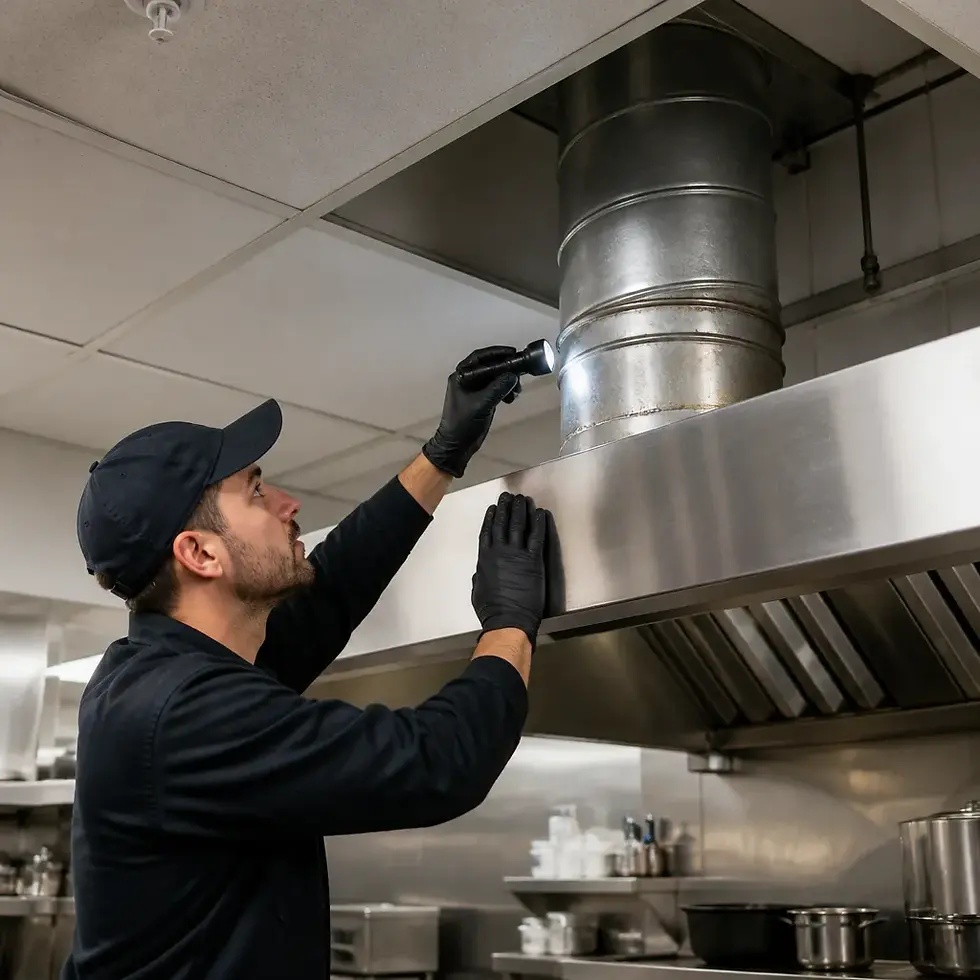
Grease collects where airflow slows and vapor condenses, which means bends, horizontal duct runs and the fan housing itself. In many older buildings, ductwork has tight bends and long horizontal sections, and each of those gives residue another place to settle. Ask your provider to photograph the fan blades and the first several feet of duct from the hood, then compare those photos with the previous service.
Key point: A fan that moves less air than it used to often has grease on its blades, not a motor problem. Cleaning the fan can restore airflow without any parts replacement.
Why a Clean Hood Face Is Not Enough
A shiny stainless hood face tells you the staff wiped it down. It does not tell you that the baffle filters seat correctly, that grease cups are not overflowing or that the access panels were actually opened during the last service. A common mistake is to treat the nightly wipe-down as the cleaning. Nightly wipe-downs help with surface grease, but they do not replace scheduled work on the interior.
A hood that looks clean from the floor can still carry a fire path into the duct.
Kitchen Exhaust Air Quality for Workers in Connecticut
Air quality on the line is where exhaust cleanliness affects staff most directly, every service. The hood is supposed to capture smoke, steam and grease-laden vapor at the source and carry it out of the building. When it captures poorly, the cooks at the fryer breathe the difference for hours. For kitchen exhaust air quality workers in CT, that matters most in summer, when the back door is propped open for airflow and the kitchen is already running hot.
The hood's job is also to keep heat from building up around the people closest to the cooking surface. A dirty filter increases resistance, cuts airflow and pushes effluent sideways toward the line instead of up into the hood. Those are the conditions staff describe as "the kitchen is cooking us," and they are usually a maintenance problem before they are a staffing problem.
What a Capture Failure Looks Like
Watch for smoke rolling past the front edge of the hood, a film of haze on the ceiling near the line, or staff reporting headaches and watering eyes by mid-shift. A capture failure during service is a signal to check the filters, the fan and the make-up air before you assume the system is working. If the problem appears only on certain burners, that tells you where the hood is losing the plume.
Do not wait for the next scheduled cleaning to deal with it. A capture problem during a Friday dinner rush is a safety issue, and it should trigger a same-day check by someone qualified to inspect the system.
Make-Up Air and Why It Changes the Pull
Exhaust fans pull air out of the kitchen, so the building has to bring air back in. When make-up air is weak or unbalanced, the hood struggles, and the kitchen can go negative, pulling air unpredictably through doors and gaps. A freshly cleaned fan that moves air well can still underperform if the supply side is starved. Have your mechanical contractor check the balance whenever the hood is serviced or the cooking line changes.
Pro tip: During a slow period, hold a smoke pencil or an incense stick at the front edge of the hood and watch where the smoke goes. If it drifts toward the line instead of into the hood, the capture problem is real and needs a service call.
Slip, Burn and Fan Hazards on the Line
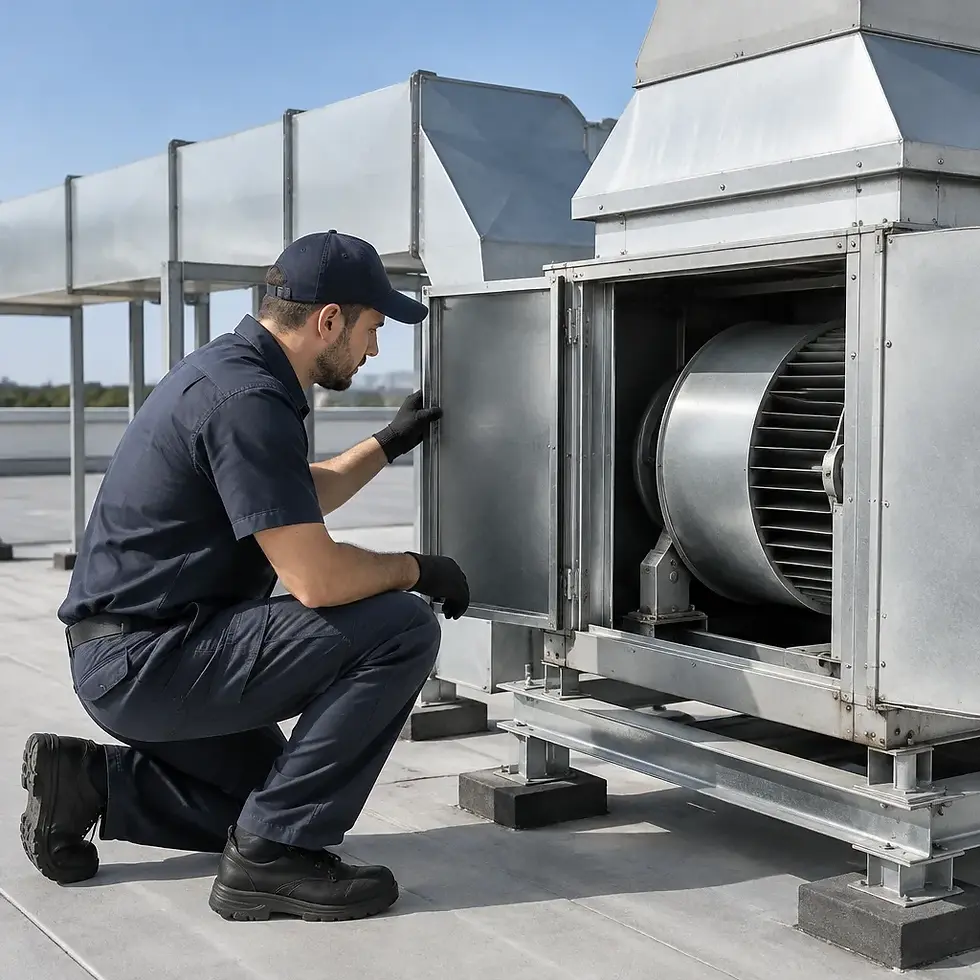
Some exhaust hazards have nothing to do with air. They show up as wet floors under the hood, hot surfaces near the filter tracks and rotating parts that cooks reach past during a rush. These injuries are routine and preventable, and they happen most often when the system is overdue for service.
Grease Drips and Floor Hazards
Grease drips from filters, overflowing grease cups and the hood lip onto the floor below, especially after a long service. The film often does not show until someone steps on it. A practical routine is to check the floor under the hood at the start of every shift and again at close. Place absorbent mats where drips are frequent, and empty grease cups before they reach the rim, not after.
Fan Belts, Motors and Hot Surfaces
Belt-driven fans fail in predictable ways. You hear squealing before a belt slips, you see dust and grease collecting on the pulley, and you smell hot insulation when a motor is overworked. Fan belt replacement and motor swaps are routine repairs, but they are far easier to schedule on a quiet Tuesday than during a Saturday rush. Keep a simple log of noise, vibration and belt replacement dates.
Keep staff out of reach of the fan and access doors while the system runs, and never allow anyone to clean inside the duct while the fan is on. Lockout procedures for the fan motor belong in your written safety plan, not in someone's memory.
Fire Suppression and Evacuation: What Staff Need to Know
Cleaning reduces fuel, but suppression systems deal with fire that starts anyway. Most commercial cooking hoods are protected by an automatic suppression system tied to the appliances below, and its job is to knock down a grease fire at the source. Its effectiveness depends on nozzles being clear and aimed correctly, on caps and seals being in place and on the system being inspected on schedule. Your local fire marshal can confirm which inspection requirements apply to your building, so ask rather than assume.
Suppression Inspections That Actually Matter
A suppression system with a blocked nozzle or a missing cap can fail quietly for months. Check that nozzles are clear and aimed at the appliances they protect, and confirm that the inspection tag is current. If your cleaning provider works on the hood and duct, ask whether it also checks the suppression components or whether a separate technician is needed. Gaps between those two responsibilities are where problems hide.
Training Line Staff on a Grease Fire
In a real grease fire, the most dangerous mistake is often the first one: someone reaches for water. Staff should know where the suppression pull station is, when to activate it, how to shut off gas at the appliance if it is safe to do so and when to leave the building. Run that drill during a slow shift, not once at hiring and never again. A simple rule works well for crews: if the fire is not out within seconds, everyone exits and calls the fire department.
Comparing Exhaust Maintenance Approaches
Most owners end up choosing between three ways to keep the system clean and monitored. Each one protects staff differently, and each has a failure mode you should plan for. The table below compares them on the dimensions that matter most to the crew on the line.
Approach | What It Covers | Gap to Watch For |
|---|---|---|
Scheduled professional cleaning to NFPA 96 | Hood, filters, fan, and accessible duct sections, documented in a written report | Cannot catch problems that develop between visits, and quality depends on the provider's stated scope |
Owner or manager visual checks between visits | Filters, grease cups, floor drips, fan noise and smoke at the line during service | Works only if someone does it consistently and logs the results, which is easy to skip on busy nights |
Filter rotation with clean spares | Clean filters swapped in during service so airflow stays consistent | Helps airflow between visits but does not clean the duct or fan, so it cannot replace scheduled cleaning |
Matching the Approach to Your Kitchen
A high-volume kitchen with heavy frying needs all three approaches, because grease production is high and the system takes a beating between visits. A smaller kitchen with light cooking may get by with scheduled professional service and disciplined visual checks. The choice is not about which approach is cheapest. It is about which failure you can afford to miss.
If you have only one of these in place, you either have the cleaning but no monitoring, or monitoring but no depth. Staff safety depends on both, because the cleaning removes the fuel and the monitoring catches the problems that develop between visits.
What the Productivity Argument Gets Right
The productivity case for clean exhaust is easy to dismiss as marketing, but the mechanism is simple. A hot, smoky line forces people to take more breaks, work more slowly and make more mistakes at the pass. Those costs show up in ticket times long before anyone connects them to the hood. Treat exhaust performance as part of the labor plan, not only the maintenance budget.
Building a Staff-Facing Exhaust Safety Routine
Cooks and dish staff already know the line better than any manager does. A short weekly routine that they own will catch more problems than a quarterly inspection that nobody on the line has seen.

A Weekly Check Line Staff Can Do
Give your crew a checklist with five items: filters seated and undamaged, grease cup not near full, no drips on the floor, fan noise unchanged from last week and no smoke rolling past the hood during peak service. Keep the list short. A longer list gets skipped, and a skipped list gives you no record at all. Ask the lead cook to initial it at close and bring any issue to the manager the same night.
Questions to Ask Your Cleaning Provider
Before you sign a service agreement, ask what areas are included in the scope, whether the fan housing and accessible duct sections are cleaned, how the work is documented and whether damaged or missing parts are flagged in writing. Ask what happens when a section cannot be accessed, and whether you will hear about it in writing. A provider that says everything is fine without photos or a written list has not given you anything usable in an inspection or insurance claim.
Pro tip: Post the checklist at the hood station or on the inside of the walk-in door, and review it at the Monday staff meeting. Crews follow what they see posted every day, and they stop following what lives in a binder in the office.
Frequently Asked Questions
How often should a restaurant hood be professionally cleaned for staff safety?
Cleaning frequency under NFPA 96 depends on cooking volume and the type of cooking, so there is no single answer for every Connecticut kitchen. Ask your provider to show you the schedule and explain the reasoning behind it. A high-volume operation with heavy frying will usually need more frequent service than a light-use café.
Who is legally responsible if a grease fire starts from a dirty hood?
The restaurant owner is generally held responsible first, even when a cleaning company was hired. Keep signed service reports and document your own visual checks. For a specific legal question, talk to a local attorney or your fire marshal.
Can a dirty exhaust system really make kitchen staff sick?
When capture fails, smoke, grease vapor and heat accumulate at the line, and staff who breathe that air for hours can report headaches, eye irritation and fatigue. The exact health effects depend on conditions in each kitchen. The clearest practical signal is smoke drifting past the hood during service.
What are the warning signs that my exhaust fan needs service now?
Squealing or grinding noise, visible vibration, a burning smell, slow response when the fan changes speed, smoke spilling at the hood edge and grease dripping from the fan housing all count. If you see any of these during service, schedule a repair before the next busy night.
Do I still need professional cleaning if my staff wipes the hood every night?
Yes. Nightly wipe-downs manage surface grease, but they do not clean ducts, fan housings or the interior of the system. Professional cleaning covers the parts your staff cannot reach safely.
What does commercial kitchen employee safety in CT require beyond cleaning?
Managers should maintain clear grease fire response training, posted evacuation steps, a current suppression inspection tag and a logged maintenance history. Floor checks and a written weekly exhaust checklist round out the routine. Your local fire marshal can confirm which requirements apply to your building.
Tell us what has worked for your crew when it comes to reporting exhaust problems early, before they turn into emergencies.
We would love your feedback and any insights you would share with others. What perspective would you add?


Comments