


Exhaust Fan Motor Replacement CT: Operator's Guide
- Jul 7
- 12 min read
A seized bearing or burned-out motor in your commercial kitchen exhaust fan is not a minor inconvenience. It is a fire hazard, a health code violation waiting to happen, and a direct hit to your kitchen's air quality and grease removal efficiency. Connecticut restaurant operators often discover these failures at the worst possible time, typically during a busy service or right before a health inspection. This guide covers everything you need to know about exhaust fan motor replacement CT and bearing service, from recognizing early failure signs to understanding what a proper repair actually involves.
Table of Contents
Why Exhaust Fan Motors and Bearings Fail in Commercial Kitchens
Warning Signs Your CT Restaurant Fan Needs Motor or Bearing Work
Motor Replacement vs. Bearing Replacement: Which Does Your Fan Actually Need?
What the Motor and Bearing Replacement Process Looks Like in Practice
Comparing Repair Approaches: DIY, Local HVAC, and Specialist Service
Cost Expectations for Exhaust Fan Motor and Bearing Replacement in Connecticut
Quick Takeaways
Key Insight
Explanation
Grease buildup accelerates motor failure
Grease coats motor windings and bearing housings, trapping heat and causing premature wear in commercial kitchen environments.
Bearing noise is an early warning, not just an annoyance
A grinding or squealing sound from your exhaust fan often means bearing failure is weeks away, not months. Act immediately.
Motor replacement requires correct HP and RPM matching
Installing a motor with the wrong horsepower or speed rating causes poor airflow, overheating, and voided equipment warranties.
Belt-driven fans have more failure points than direct-drive
Fan belt condition and pulley alignment affect bearing load. A worn belt causes uneven bearing wear and shortens motor life.
CT restaurants should schedule fan inspections every 3 months
NFPA 96 inspection intervals align with cleaning schedules, but motor and bearing checks should happen at every service visit.
A failed exhaust fan is a fire code issue, not just a repair issue
Connecticut fire marshals can cite operators for non-functioning exhaust systems because grease accumulates faster without proper airflow.
Hinge kits and motor swaps are often done together
When a motor is replaced, it is the right time to install or inspect hinge kits so the fan can be properly cleaned and accessed going forward.
Why Exhaust Fan Motors and Bearings Fail in Commercial Kitchens
Commercial kitchen exhaust fans operate in one of the most punishing environments any mechanical component can face. Heat cycles, grease-laden air, moisture, and continuous run times combine to degrade motors and bearings far faster than any standard HVAC application. In practice, a rooftop exhaust fan on a busy Connecticut restaurant may run 12 to 16 hours per day, seven days a week, with minimal maintenance attention between professional service visits.
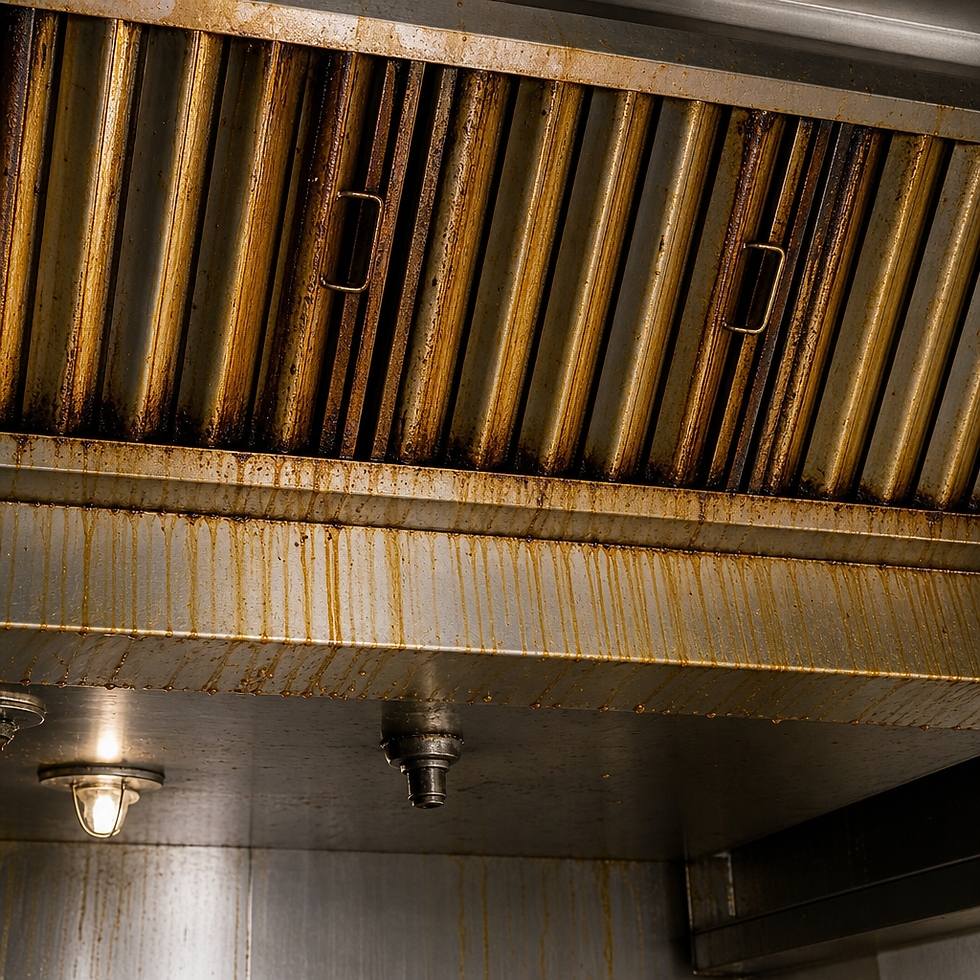
Grease is the primary accelerant of motor failure. It does not just coat the exterior housing. It infiltrates bearing seals, breaks down lubrication, and coats motor windings, creating an insulating layer that traps heat. Once motor winding temperatures exceed design limits, insulation degrades and the motor draws higher current, which accelerates the failure cycle further.
Bearings fail for three main reasons in kitchen exhaust applications: inadequate lubrication, contamination from grease and debris, and misalignment caused by worn belts or improper installation. A common mistake is assuming that a noisy bearing just needs grease. In many cases by the time the bearing is audibly failing, the race is already scored and lubrication alone will not fix it. Replacement is the only correct answer at that stage.
Pro tip: Ask your service technician to check motor amperage draw at every cleaning visit. A motor drawing 10 to 15 percent above its nameplate current rating is overheating and headed for failure, even if it is still running quietly.


Warning Signs Your CT Restaurant Fan Needs Motor or Bearing Work
Catching motor and bearing problems early is the difference between a scheduled repair and an emergency shutdown. Connecticut restaurant operators should train kitchen staff to flag any change in exhaust fan behavior, because the people working under the hood every day will notice problems before any scheduled inspection catches them.
Sounds That Indicate Bearing Trouble
A healthy exhaust fan runs with a consistent, relatively low hum. Grinding, squealing, rattling, or any intermittent rumbling sound points to bearing wear. Squealing typically indicates the bearing is running dry, while grinding suggests the race or balls are already damaged. Neither sound resolves on its own.
Vibration that was not present before is another bearing indicator. If you can feel the fan vibrating through the duct connection or the rooftop curb, the bearing is no longer maintaining proper shaft alignment. This vibration also accelerates wear on every other component connected to the fan assembly.
Performance Drops That Signal Motor Problems
Reduced airflow, smoke not clearing quickly from the cooking line, and cooking staff complaining about heat buildup at the range are all practical indicators of motor performance loss. A motor losing efficiency will spin the fan wheel slower than its rated RPM, reducing static pressure and airflow capacity. This directly affects how quickly grease-laden vapor is captured at the hood face.
Tripping circuit breakers repeatedly is a serious electrical warning. A motor drawing excessive current because its windings are failing or its bearings are seized will trip the breaker as a protective measure. Do not simply reset the breaker and continue operating. That motor needs to be tested and most likely replaced before the next service.
Pro tip: Keep a simple log near your exhaust fan electrical panel. Note the date whenever the fan breaker trips. Two trips in 30 days means the motor needs professional evaluation immediately, not at the next scheduled cleaning.
Motor Replacement vs. Bearing Replacement: Which Does Your Fan Actually Need?
This is the question where a lot of operators get bad advice, usually from technicians who either default to full motor replacement when a bearing swap would suffice, or who replace only bearings when the motor windings are already compromised. The correct diagnosis requires testing, not guessing.
How Technicians Diagnose Motor Condition
A proper motor evaluation includes checking winding resistance with a multimeter, measuring insulation resistance to ground, and checking amperage draw under load. Winding resistance that is significantly lower than the manufacturer's specification indicates shorted turns. Insulation resistance below one megohm to ground on a standard single-phase motor is a clear replacement indicator.
Motor bearings that are integral to the motor itself, as in most direct-drive fans, are replaced as part of the motor replacement. On larger belt-drive fans where the fan wheel shaft uses separate pillow block or flange bearings, those bearings can often be replaced independently without replacing the motor. This distinction matters because bearing replacement alone on a belt-drive unit typically costs significantly less than a full motor swap.
When You Should Replace Both at Once
If the motor has more than five years of service in a high-volume commercial kitchen, and the bearings have failed, replacing both at the same time is the practical choice. The labor cost to open the fan assembly, remove the wheel, and access the mechanical components is the same whether you are doing one component or two. Paying for that labor twice within 12 months because you only did half the job is a predictable outcome that a good service provider should advise you against.
The data consistently shows that deferred maintenance on commercial kitchen equipment costs more over a two-year window than proactive replacement of components that are near end of life. This is not a theoretical principle. It shows up in repair invoices from Connecticut food service operators every year.
What the Motor and Bearing Replacement Process Looks Like in Practice
Understanding what a proper exhaust fan motor or bearing replacement actually involves helps Connecticut operators evaluate whether they are getting quality service or a shortcut job. The process has specific steps, and skipping any of them creates problems downstream.
Accessing the Fan Assembly Safely
Most commercial kitchen exhaust fans are rooftop-mounted. Safe access requires proper fall protection, especially on flat or low-slope roofs common on Connecticut commercial buildings. The fan housing must be opened, which on a properly maintained unit means releasing a hinge kit. If the hinge kit is rusted, seized, or was never installed, the technician will need additional time and may recommend hinge kit installation as part of the service visit.
Before any electrical work begins, the fan circuit must be locked out and tagged out per OSHA standards. A common mistake made by unqualified technicians is skipping formal lockout-tagout procedures because the breaker is physically nearby. This is a serious safety violation and an indicator of the overall service quality you are receiving.
Motor Removal and Specification Matching
The existing motor nameplate must be photographed or recorded before removal. Critical specifications include horsepower, voltage, phase, RPM, frame size, and enclosure type. For commercial kitchen applications, the replacement motor must be a TEAO (totally enclosed air-over) or TENV (totally enclosed non-ventilated) enclosure type. Open drip-proof motors have no place in a grease-laden exhaust fan environment and will fail within months.
Frame size matters for physical fit. A 48-frame and a 56-frame motor are not interchangeable without modifying the mounting bracket. Any technician who tells you they can make a different frame size work with minor modifications is introducing vibration and misalignment into the assembly from day one.
Bearing Installation and Alignment Verification
On belt-drive fans, new bearings must be pressed or driven to their seats properly, not hammered carelessly onto the shaft. Improper bearing installation that applies force through the rolling elements instead of the race is the single most common cause of premature bearing failure after replacement. After installation, belt tension and pulley alignment must be verified. Misalignment as small as two degrees on a pulley can reduce bearing life by 50 percent or more.

Comparing Repair Approaches: DIY, Local HVAC, and Specialist Service
Connecticut restaurant operators have three realistic options when an exhaust fan motor or bearing fails. Each has a different risk profile, cost structure, and outcome consistency. The right choice depends on your operation's size, risk tolerance, and how critical the exhaust system is to your continued service.
Repair Approach
Key Advantages
Key Risks and Limitations
DIY / In-House Maintenance
Lowest immediate cost, fastest response if parts are on hand
High risk of incorrect motor specification, no NFPA 96 documentation, safety hazards from rooftop work and electrical systems, likely to void equipment warranties
General Local HVAC Contractor
Available in most CT markets, comfortable with electrical and refrigeration work
Often lacks specific commercial kitchen exhaust experience, may not understand TEAO motor requirements or NFPA 96 context, may not carry grease-rated replacement parts on the truck
Commercial Kitchen Hood and Exhaust Specialist
Understands full exhaust system context including grease accumulation, carries correct motor specifications, provides service documentation for fire marshal records, often combines motor work with cleaning service
Higher cost than DIY, may have scheduling lead time during busy seasons in CT
In practice, the specialist option delivers the best total cost of ownership for Connecticut operators running full-service restaurants. The reason is simple: a specialist who also handles hood cleaning, grease trap service, and fan belt replacement sees the entire exhaust system as a connected system. They catch problems that a one-time HVAC contractor will miss because the HVAC contractor is only looking at the component they were called to fix.
For smaller operations like food trucks, cafes, or single-fryer quick-service kitchens, the cost difference between a general HVAC contractor and a specialist may be worth the tradeoff on straightforward motor swaps. But for full-service restaurant kitchens running multiple cooking positions, the specialist advantage is clear.
NFPA 96 Compliance and Why It Connects to Fan Motor Health
NFPA 96, the Standard for Ventilation Control and Fire Protection of Commercial Cooking Operations, does not just govern hood cleaning intervals. It addresses the entire exhaust system, including fans, and defines what constitutes an acceptable operating condition. Connecticut fire marshals and insurance carriers both reference NFPA 96 when evaluating commercial kitchen fire risk.
A non-functioning or degraded exhaust fan motor directly affects NFPA 96 compliance in two ways. First, inadequate airflow means grease accumulates faster in ducts and on hood surfaces, shortening the time before the system reaches a fire-hazardous grease loading. Second, if a fire marshal or insurance inspector documents a malfunctioning exhaust fan, the operator faces potential citation, required corrective action, and in some cases, coverage disputes following a fire event.
Superior Clean's approach to commercial kitchen exhaust fan repair and maintenance in Connecticut is built around this compliance context. When a motor replacement or bearing service is performed, the work is documented in a way that supports the operator's NFPA 96 service records. This matters when a fire marshal requests proof of system maintenance or when an insurance adjuster reviews a claim.
"The ventilating system, including the exhaust fan, shall be maintained in proper working order at all times. Any deficiency shall be corrected before the cooking equipment is operated." -- NFPA 96, Standard for Ventilation Control and Fire Protection of Commercial Cooking Operations
This is not a suggestion. It is a code requirement. Running your kitchen with a failing exhaust fan motor is a documentable code violation in Connecticut, and the liability consequences of a grease fire in that context are severe.
Cost Expectations for Exhaust Fan Motor and Bearing Replacement in Connecticut
Connecticut operators deserve straightforward cost information, not vague ranges that tell them nothing. The following figures reflect realistic market pricing for commercial kitchen exhaust fan motor and bearing work in Connecticut as of current market conditions. These are not guarantees but are representative of what qualified specialist service typically costs in this region.
A bearing replacement on a belt-drive exhaust fan typically runs between $200 and $450 parts and labor, depending on bearing size, accessibility, and whether belt replacement is included. If the pulley needs replacement due to wear or damage, add another $80 to $150. This is the lower end of the repair spectrum and the best outcome when the motor itself tests healthy.
A direct-drive motor replacement on a standard commercial kitchen upblast exhaust fan typically costs between $350 and $750 parts and labor. Larger motors above one horsepower, three-phase units, or variable-speed motors push costs higher, sometimes to $900 or above. The motor itself accounts for 40 to 60 percent of the total cost. Labor for a straightforward replacement on an accessible rooftop unit runs one to two hours for a qualified technician.
Combining motor replacement with a hinge kit installation adds $150 to $300 but is highly recommended if the existing hinge kit is absent or damaged. Running a kitchen exhaust fan without a functioning hinge kit means the fan cannot be properly opened for cleaning, which creates a grease accumulation problem that compounds your fire risk and your compliance exposure. The labor overlap when done at the same visit makes this a cost-effective combination.
Emergency after-hours service calls in Connecticut carry a premium, typically 1.5x to 2x the standard rate. The most cost-effective approach is scheduling motor and bearing inspections proactively, during regular cleaning visits, so replacements happen on a planned basis rather than as emergency responses at 2 a.m. on a Saturday.
Frequently Asked Questions
How often should commercial kitchen exhaust fan bearings be inspected in Connecticut?
Bearings should be physically inspected at every hood cleaning service visit, which for most Connecticut high-volume kitchens means quarterly. At minimum, a technician should check for audible noise, vibration, and temperature at the bearing housing. Annual lubrication of regreasable bearings is standard, but quarterly checks catch problems before they become failures.
Can I run my kitchen while waiting for an exhaust fan motor replacement?
No. NFPA 96 is explicit that cooking equipment should not be operated when the exhaust fan is non-functional or significantly degraded. Beyond the code issue, operating without proper exhaust ventilation means grease vapor deposits on every surface in the kitchen, smoke and carbon monoxide build up in the cooking space, and fire risk increases substantially. Connecticut operators who run service without a functioning exhaust fan also face potential insurance claim denial if a fire occurs during that period.
What is the typical lifespan of a commercial kitchen exhaust fan motor?
In a properly maintained commercial kitchen environment, a quality TEAO motor in a residential-to-light-commercial exhaust fan should last 8 to 12 years. In high-volume kitchens running 14 to 16 hours per day with heavy grease loading and infrequent cleaning, expect 4 to 7 years. Regular hood cleaning directly extends motor life by reducing the grease contamination and heat load the motor operates in. Motors in consistently clean exhaust systems outlast motors in neglected systems by a measurable margin.
Does exhaust fan motor replacement require a permit in Connecticut?
Like-for-like motor replacement on existing equipment generally does not require a separate permit in most Connecticut municipalities, but this varies by jurisdiction. Any work that changes the electrical configuration, adds a new disconnect, or modifies the fan mounting may require a permit and inspection. Your service provider should be familiar with local requirements. If you are in doubt, contact your local building department before work begins.
What is the difference between a direct-drive and belt-drive exhaust fan for replacement purposes?
In a direct-drive fan, the motor shaft connects directly to the fan wheel. Motor replacement means the bearings come with the new motor as an integrated unit. In a belt-drive fan, the motor drives a separate shaft via a belt and pulley system. Bearings on the fan shaft are independent of the motor and can be replaced separately. Belt-drive systems have more components to maintain but allow motor and fan speeds to be tuned independently through pulley sizing, which is useful in kitchens with variable ventilation needs.
How do I find a qualified exhaust fan motor replacement specialist in Connecticut?
Look for a provider that specifically services commercial kitchen exhaust systems, not just general HVAC. They should be familiar with NFPA 96 and able to provide service documentation. Ask whether they carry replacement motors and bearings on their service vehicles, or whether they will need to order parts before completing the repair. A specialist who also handles hood cleaning and grease trap service understands the full system context and is better positioned to identify related issues during a motor replacement visit. Superior Clean serves Connecticut food service operators throughout the state with this integrated approach to exhaust system maintenance and repair.
If you have recently dealt with an exhaust fan motor or bearing failure at your Connecticut restaurant, share what symptoms you noticed first and how quickly the problem progressed. Your experience could help another operator catch the same issue before it becomes a shutdown emergency.
We would love your feedback and any insights you would share with others. What perspective would you add?


Comments