


Hospital & Cafeteria Kitchen Hood Cleaning CT Guide
- Jul 9
- 12 min read
Hospital kitchens and school or corporate cafeterias in Connecticut operate under a different set of pressures than a typical restaurant. They cook in high volumes, often around the clock, and they serve populations who cannot afford a grease fire or a health code violation. Despite this, hospital kitchen hood cleaning CT remains one of the most under-serviced categories in the commercial kitchen maintenance industry. Most facilities managers assume that because they clean more frequently, they are covered. In practice, frequency alone is not the answer. The type of cooking, the ventilation design, and the specific regulatory layer that applies to healthcare environments all matter enormously.
Table of Contents
Quick Takeaways
Key Insight
Explanation
Hospital kitchens often require quarterly hood cleaning
High-volume, continuous cooking generates grease buildup at rates that annual or semi-annual cleaning cannot safely manage. NFPA 96 Table 11.4 ties frequency to cooking volume and type.
Infection control restricts access windows in healthcare settings
Cleaning crews must coordinate with hospital facilities teams to avoid patient care hours, sterile zones, and active food service periods, compressing the available service window significantly.
Cafeteria exhaust systems collect different grease profiles
School and corporate cafeteria menus tend toward high-starch and fried food production, which creates a denser, stickier grease deposit than a full-service restaurant with varied cooking methods.
NFPA 96 compliance is not optional for Connecticut food service operations
Connecticut fire marshals and local health departments use NFPA 96 as the enforcement standard. Non-compliance can result in failed inspections, fines, and forced closure.
Documentation must meet both fire code and healthcare accreditation standards
Hospitals pursuing Joint Commission accreditation need hood cleaning records that go beyond a basic service sticker. They need dated reports with grease thickness readings and technician certification on file.
Fan belt and motor condition directly affects exhaust performance
A worn fan belt reduces airflow through the exhaust system, causing grease to accumulate faster in the ductwork rather than being evacuated. This is a compounding fire risk.
Grease trap cleaning must be coordinated with hood cleaning in institutional settings
In a hospital kitchen producing hundreds of meals daily, the grease trap fills faster than in a restaurant of similar size due to continuous production. Scheduling both services together reduces downtime.
Why Institutional Kitchens Require a Different Approach
A hospital kitchen in Connecticut might prepare 800 to 2,000 meals per day across multiple shifts. That volume is not comparable to a 100-seat restaurant cooking dinner service five nights a week. The exhaust system in a hospital kitchen is working continuously, pulling vapor, smoke, and airborne grease particles through filters, into the plenum, and up through the ductwork with almost no rest periods.
The result is accelerated grease deposition. In practice, a hospital kitchen that runs breakfast, lunch, and dinner service seven days a week will accumulate grease in its ductwork at a rate two to four times faster than a conventional restaurant operating similar equipment. This is not a theory. It is a pattern that becomes visible the moment you pull the access panels on a duct that has been on a semi-annual cleaning schedule when it should have been on quarterly service.
Cafeteria exhaust cleaning Connecticut contractors who have only worked in traditional restaurant environments sometimes underestimate this. They show up with the same chemical concentrations and the same dwell times they use on a burger joint and walk away leaving behind residue that hardens within weeks. Institutional kitchens need technicians who have calibrated their process to the specific cooking volume and equipment in play.
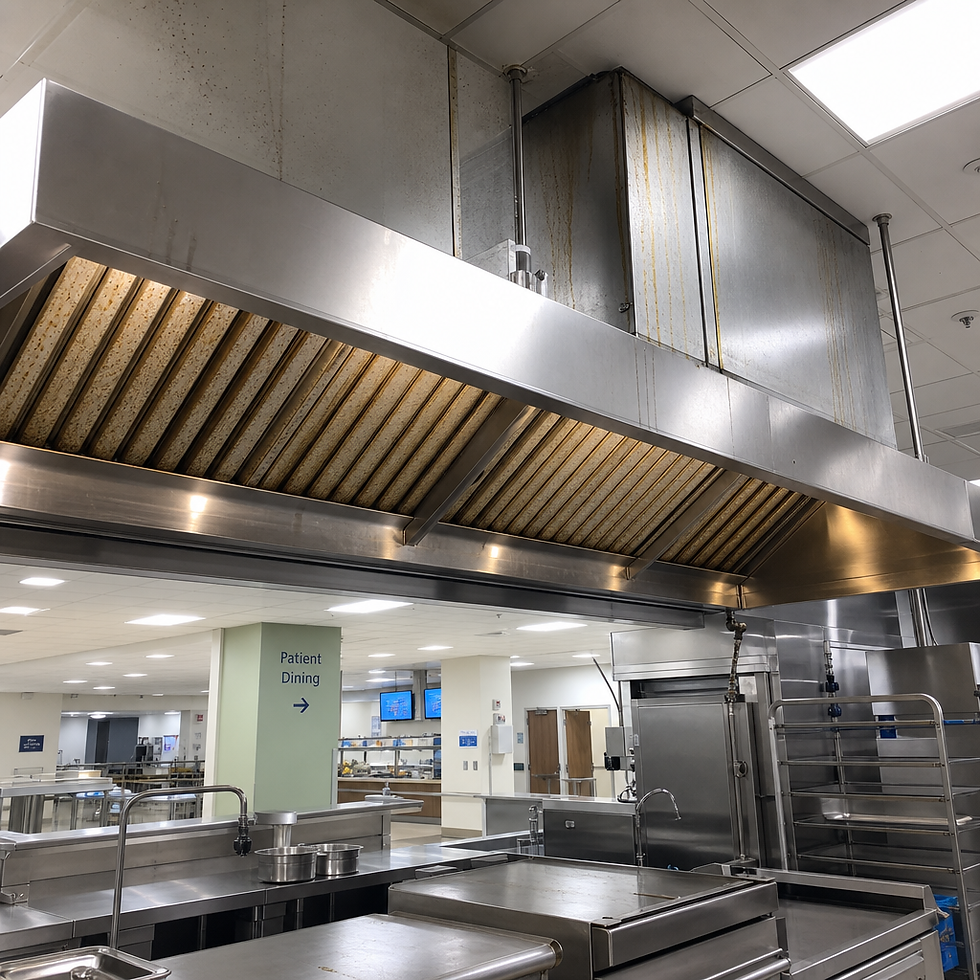

NFPA 96 Requirements for Hospital and Cafeteria Settings
NFPA 96 is the Standard for Ventilation Control and Fire Protection of Commercial Cooking Operations. It is not a suggestion. In Connecticut, it is the enforceable standard that fire marshals and health inspectors reference during inspections. Table 11.4 within NFPA 96 specifies cleaning frequency based on the type and volume of cooking operations.
What Table 11.4 Actually Says About High-Volume Cooking
For systems serving solid fuel cooking, cleaning is required monthly. For high-volume cooking operations, including 24-hour restaurants and institutional kitchens, quarterly cleaning is the minimum. For moderate-volume cooking, semi-annual cleaning applies. Annual cleaning is reserved for low-volume operations such as seasonal or day camps.
A hospital kitchen that operates three meal services per day, seven days a week, qualifies unambiguously as high-volume. This means quarterly cleaning is the floor, not a premium option. Any vendor telling a hospital facilities manager that semi-annual is sufficient for a full-production institutional kitchen is either unfamiliar with NFPA 96 or is underbidding to win the contract.
Connecticut-Specific Enforcement Context
The Connecticut Department of Public Health and local fire marshals both have authority over commercial kitchen environments. For hospitals specifically, the environment of care standards from accreditation bodies such as The Joint Commission layer on top of the state fire code. Failure to maintain documented, NFPA 96-compliant hood cleaning records can trigger a finding during a Joint Commission survey, which carries consequences far more serious than a local health department citation.
"The purpose of NFPA 96 is to reduce the potential fire hazard of commercial cooking equipment and systems to an acceptable level." NFPA 96, Standard for Ventilation Control and Fire Protection of Commercial Cooking Operations, 2021 Edition.
Grease Buildup Patterns Unique to High-Volume Institutional Cooking
Not all grease is the same. A hospital that produces large quantities of roasted meats, fried foods, and steamed vegetables generates a complex mix of saturated and unsaturated fat deposits. These behave differently under heat and in cool duct sections.
Saturated fats, which are common in high-volume protein cooking, solidify quickly in cooler duct sections and create hard, layered deposits that require longer chemical dwell times and mechanical agitation to remove. Unsaturated fats from vegetable-based cooking tend to remain semi-liquid longer but can travel further into the duct system before depositing, which means grease accumulates in sections that are harder to access.
A common mistake is for cleaning crews to focus exclusively on the visible hood and plenum while neglecting the upper duct runs and the area directly around the exhaust fan. In institutional kitchens with long duct runs, this is exactly where the highest grease concentrations are found. Superior Clean's approach to institutional kitchen cleaning NFPA 96 compliance includes inspection of the full duct system, not just the components visible from the kitchen floor.
Pro tip: Request a pre-cleaning grease thickness measurement at three points in the duct system: the plenum, the mid-duct section, and the area nearest the exhaust fan. These three readings tell you whether your current cleaning frequency is actually sufficient for your cooking volume.
Cleaning Frequency: What NFPA 96 Actually Mandates
The single most common compliance gap in Connecticut hospital and cafeteria kitchens is cleaning frequency. Facilities managers inherit a service schedule set by a predecessor and rarely revisit whether that schedule still reflects actual cooking volume. When a hospital expands its patient capacity or a school district opens a new cafeteria building, the cleaning frequency often stays the same while the cooking load increases substantially.
Here is what the data from routine inspections consistently shows: kitchens that have been on semi-annual cleaning schedules but qualify as high-volume under NFPA 96 Table 11.4 have average grease deposits in the 1-to-3-millimeter range at the time of service. That is three to six times the deposit thickness that would be present if quarterly cleaning had been performed. A deposit in that range represents a meaningful fire hazard, not a marginal one.
The right way to set frequency is to schedule a baseline inspection with grease thickness measurement, then use that data to match the NFPA 96 category. If the reading after six months of service shows deposits consistent with high-volume cooking, the interval needs to drop to quarterly. This is not a judgment call. The standard is clear on how to categorize operations.
Comparing Hood Cleaning Approaches for Institutional Kitchens
Not all hood cleaning methods deliver equivalent results in high-volume institutional settings. The three most common approaches are chemical-only cleaning, steam cleaning, and pressure washing with chemical pre-treatment. Each has a legitimate use case, but they are not interchangeable.
Cleaning Method
Best Application in Institutional Settings
Key Limitations
Chemical-Only Cleaning
Routine quarterly service on filters and plenum surfaces where deposit thickness is low and access is easy
Insufficient for hardened deposits in upper duct runs or around exhaust fans. Leaves residue if rinsing is inadequate.
Steam Cleaning
Effective on stainless steel hood surfaces and in environments where water volume must be controlled, such as hospital kitchens near patient care areas
Steam alone does not penetrate thick grease layers. Requires chemical pre-treatment for deposits over 1 millimeter.
Pressure Washing with Chemical Pre-Treatment
High-volume institutional kitchens with significant duct runs and quarterly or more frequent service requirements
Requires proper containment to prevent wastewater from contaminating kitchen surfaces. Not suitable without experienced technicians managing runoff in healthcare environments.
In practice, the most effective approach for a hospital or large cafeteria kitchen is pressure washing with chemical pre-treatment, combined with manual scraping for hardened deposits in the duct. Chemical-only service is appropriate only when quarterly cleaning has been maintained consistently and deposits remain thin.

Infection Control Challenges in Hospital Kitchen Hood Cleaning
Hospital kitchens present a set of operational constraints that do not exist in restaurant environments. Infection control protocols mean that any work taking place near or above food preparation surfaces must be coordinated carefully. A hood cleaning crew cannot simply show up at 11 PM and start pressure washing without a specific clearance from the facilities team.
In practice, hospital hood cleaning is typically scheduled during periods when the kitchen is fully offline, which often means the window between the end of dinner service and the start of breakfast prep. That window can be as narrow as four to six hours. This demands experienced technicians who can complete a full-system clean, inspection, and documentation within a compressed timeframe without cutting corners on duct access or chemical dwell time.
Surface Protection During Hospital Hood Cleaning
Every food contact surface in the kitchen must be covered before cleaning begins. This is standard practice in any commercial kitchen cleaning job, but in a hospital the stakes are higher. Aerosol contamination from high-pressure water can carry grease and cleaning chemical residue onto surfaces that must meet a stricter sanitation standard than a typical restaurant countertop.
Reputable Connecticut contractors working in hospital settings use full surface sheeting, close and seal adjacent storage areas, and perform a post-cleaning sanitation wipe-down of all exposed stainless steel before they leave. This is not optional in a healthcare environment. It is a minimum expectation.
Pro tip: When vetting a hood cleaning contractor for your hospital kitchen, ask specifically whether they have prior experience working in Joint Commission-accredited facilities. A contractor who has never dealt with hospital infection control protocols will slow down your facilities team with questions and may create documentation gaps that affect your next survey.
Cafeteria Exhaust Cleaning in Connecticut: School and Corporate Settings
School cafeterias and corporate dining facilities across Connecticut face a different version of the same problem. These kitchens often run on compressed service windows, batch-cooking large quantities of the same items, which concentrates grease production in a shorter time period than a restaurant kitchen spread across a full dinner service.
A school cafeteria cooking lunch for 600 students generates its peak grease load in about 90 minutes. All of that production moves through the exhaust system in a concentrated burst. Over a school year of 180 operating days, that represents a significant total cooking load, even if the kitchen is dark on evenings and weekends.
Common Exhaust System Problems in Connecticut School and Corporate Cafeterias
The two most frequent mechanical issues found in cafeteria exhaust systems during cleaning visits are worn fan belts and clogged grease filters that have never been removed and washed between cleanings. Both problems reduce airflow through the system and cause grease to accumulate in the ductwork instead of being properly evacuated.
Fan belt replacement is a straightforward service, but it requires a technician who is comfortable working on exhaust fan units, not just a cleaning crew. Superior Clean handles fan belt replacement and motor assessment as part of its service offering specifically because these mechanical issues directly affect how quickly a freshly cleaned duct system re-accumulates grease. A new belt can restore full airflow, which extends the time between required cleanings and reduces the fire risk between service visits.
Corporate cafeterias with on-site facilities managers sometimes have a maintenance culture that treats the exhaust system as a set-it-and-forget-it installation. In Connecticut's climate, where temperature swings between seasons affect grease viscosity and duct condensation, this approach consistently produces systems that are out of compliance before the annual inspection cycle.
Documentation and Compliance Records That Actually Hold Up
The minimum documentation standard under NFPA 96 is a service report that includes the date of cleaning, the areas cleaned, the name of the contractor, and a notation of any deficiencies found. In practice, this minimum is insufficient for hospital environments and for any facility that faces regulatory scrutiny beyond a basic fire marshal inspection.
For hospitals, the documentation package should include grease thickness readings before and after cleaning at multiple duct locations, photographs of access panels before and after service, a written notation of any mechanical deficiencies observed during the clean (such as worn bearings, damaged duct sections, or inadequate fan performance), and the technician's certification credentials. This level of documentation supports Joint Commission survey responses and protects the facility in the event of an insurance claim following a fire event.
How to Maintain a Compliant Service Record in Connecticut
The simplest system is a physical binder kept in the kitchen manager's office and a digital copy filed with the facilities department. Each service visit adds a dated report. The contractor should provide the report on the day of service, not days later. If a contractor cannot provide same-day documentation, that is a meaningful signal about the quality of their compliance process.
Connecticut food service operators should also understand that the cleaning frequency record matters as much as the individual service report. An inspector reviewing a hospital kitchen file wants to see that quarterly service has been maintained consistently, not that a single thorough cleaning was performed six months ago. Gaps in the schedule are findings, even if the most recent cleaning was thorough.
When you are evaluating a new hood cleaning contractor in Connecticut, ask to see a sample documentation package from a comparable institutional client. Any contractor with genuine experience in hospital kitchen hood cleaning CT will have a standard documentation format that covers grease thickness, access panels, mechanical observations, and technician credentials. If they show you a service sticker, keep looking.
Frequently Asked Questions
How often does a hospital kitchen in Connecticut need hood cleaning under NFPA 96?
A hospital kitchen operating three meal services per day, seven days a week qualifies as a high-volume cooking operation under NFPA 96 Table 11.4, which mandates quarterly cleaning as the minimum interval. Some hospital kitchens with particularly heavy cooking loads or solid fuel equipment may require monthly service. The correct frequency should be confirmed by a grease thickness assessment during the first cleaning visit.
What makes hospital kitchen hood cleaning different from a standard restaurant job?
Hospital kitchens combine higher cooking volumes with stricter infection control requirements, compressed service windows, and documentation standards that connect to healthcare accreditation. The technical cleaning process is similar, but the scheduling, surface protection protocols, and post-cleaning sanitation steps are more demanding. Contractors without prior healthcare facility experience frequently underestimate these constraints.
Does NFPA 96 apply to Connecticut school cafeteria exhaust systems?
Yes. NFPA 96 applies to all commercial cooking operations in Connecticut, including school cafeterias, corporate dining facilities, and hospital kitchens. The standard does not distinguish between food service types. What changes is the cleaning frequency, which is determined by cooking volume and cooking method, not by the type of institution operating the kitchen.
What documentation should a Connecticut hospital require from its hood cleaning contractor?
At minimum, hospitals should require a dated service report covering all areas cleaned, grease thickness measurements at multiple duct locations before and after cleaning, photographs of access panel conditions, a written list of any mechanical deficiencies observed, and proof of the technician's certification. This documentation level supports Joint Commission environment of care standards and provides meaningful records for insurance and fire marshal purposes.
How do fan belts and exhaust fan maintenance connect to hood cleaning compliance?
A worn or slipping fan belt reduces the airflow the exhaust fan can generate, which means the system pulls less grease-laden vapor through the filters and into the duct. The result is accelerated grease accumulation on hood surfaces and in the duct system between cleaning visits. Replacing a worn fan belt restores design airflow and directly extends the time before grease deposits reach a hazardous thickness. This is why exhaust fan inspection should be part of every institutional hood cleaning visit, not a separate service call.
Can cafeteria hood cleaning be scheduled around a school calendar in Connecticut?
Yes, and it should be. School cafeterias in Connecticut typically have natural cleaning windows during winter break, spring break, and summer. However, scheduling all cleaning visits during school breaks alone often results in semi-annual or annual service for a kitchen that may require quarterly cleaning based on its cooking volume. The correct approach is to confirm the NFPA 96-required frequency first, then work backward to identify available service windows throughout the school year, including early mornings or weekends during the academic term.
If you manage a hospital kitchen, school cafeteria, or corporate dining facility in Connecticut and have dealt with compliance gaps or scheduling challenges around hood cleaning, share your experience in the comments so other facilities professionals can learn from what you have encountered.
We would love your feedback and any insights you would share with others. What perspective would you add?


Comments